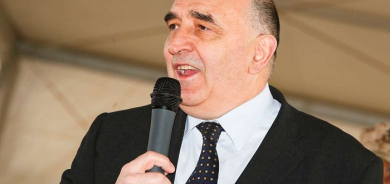
Dr. Nabil Al-Tikriti to Gulan: The Middle East is changing in ways that do not necessarily favor traditional military powers

Nabil Al-Tikriti, Professor of Middle East History, earned a Ph.D. (2004) and M.A. (1996) in Ottoman history from the University of Chicago, an MIA (1990) from Columbia University, and a BSFS (1988) in Arab studies from Georgetown University. He also studied at the Center for Arabic Studies Abroad’s advanced Arabic language immersion program at The American University in Cairo in 1990-91, and the advanced Turkish language immersion program at Bogaziçi Üniversitesi in Istanbul in 1994 and 1995.
Dr. Al-Tikriti’s publications on early modern Ottoman intellectual history, contemporary Iraqi cultural patrimony, higher education, international politics, and forced migration have appeared in a number of journals, edited volumes, and web reports. He has received several grants and scholarships, including three Fulbright fellowships and a 2011 National Endowment for the Humanities (NEH)/American Research Institute in Turkey (ARIT) grant.
He has served as a polling station supervisor or election observer for multiple elections since 1997 in Bosnia, Kosovo, Ukraine, Belarus, Kyrgyzstan, Georgia, Albania, Montenegro, Kazakhstan, Armenia, and Türkiye for the Organization for Security and Cooperation in Europe (OSCE). In conjunction with his interest in peace and conflict, Dr. Al-Tikriti researched the effects on Iraqi civil society of the 2003 Anglo-American invasion after being awarded a 2007-2008 Jennings Randolph Fellowship at the U.S. Institute of Peace (USIP) in Washington D.C.
From 1993 to 2017, Dr. Al-Tikriti completed short term assignments as a context and liaison officer, administrator, and logistician for Médecins Sans Frontières (MSF-Doctors Without Borders), an international humanitarian aid organization that provides emergency medical assistance to populations in danger in more than 75 countries. He worked in Jordan, Turkey, Albania, Iran, Syria, Iraq, Ethiopia, Somalia, and Mediterranean rescue, and his duties included jointly conducting an exploratory mission determining potential Médecins Sans Frontières activity in Iraq; negotiating with community and clan leaders concerning team security and staff contracts; serving as field liaison with United Nations, nongovernmental organizations, and local government personnel; and controlling personnel issues for more than 150 local staff colleagues in a war zone. From 2011 to 2017, he completed two elected terms on the MSF-USA Board of Directors, culminating as Vice President in 2016-17. In an exclusive interview He answered our following questions:
Gulan: In your research on the formation of Ottoman and Safavid identities, you examined how their political rivalry gradually hardened sectarian boundaries in the region. So, to what extent do you believe today’s Sunni-Shia polarization today is shaped by those early modern imperial struggles rather than purely contemporary geopolitics?
Professor Dr. Nabil Al-Tikriti: That’s a long discussion, but what I would say is that I was completing that research around 20 years ago, at a time when Iraq was experiencing terrible sectarian violence. I distinctly remember that the term Sunnis used to insult Shiites was ‘Safavid’ – even though the Safavid dynasty ceased to rule nearly 300 years ago. On the other side, Shiites were referring to their Sunni enemies as ‘Takfiri’ (those who label others ‘heretics’). Both of those terms’ origins can be traced back to the early 16th century, the early years of the Ottoman-Safavid conflict. The figure I wrote my dissertation on, Şehzade Korkut (d. 1513), authored an essentially Takfiri manuscript in which he argued that those who show external signs of unbelief (‘kufr’) can be legally treated by the state as heretics. Following that research, I have come to believe that we today consider the Sunni-Shiite sectarian conflict was fundamentally reformulated only following the rise of the Safavids in the early 16th century. Before that transformational event, the Muslim world’s sectarian map was quite different, particularly during the 14th and 15th centuries, when far more conflict followed Sufi, tribal, or even occasional ethnic lines.
In effect, I believe that the modern Sunni-Shiite divide as we understand it dates back more to the early 16th century rise of the Safavids than to the far more famous 7th century origin story of the Battle of Karbala. The 680 C.E. Battle of Karbala was, of course, extremely important in Islamic history, but the concept of the Twelve Imams continued to evolve throughout the 8th-10th centuries C.E., and their followers were not yet as politically significant as they later became following the rise of the Safavid Empire. Because of that, I see the modern Sunni-Shiite sectarian conflict as a fundamentally different phenomenon than what preceded that seminal event at the turn of the 16th century.
Twelver Shiites were just one of several competing religio-political movements during the relatively complex 14th and 15th centuries (Sufi orders, dynastic competitors, Mongol descendants, etc.). However, after the Safavids established a revolutionary state and declared Shiism to be the state religion, Safavid scholars, with dynastic support, described Shiite identity for Safavid audiences. Meanwhile, something quite similar occurred across the frontier as Ottoman scholars defined what a proper Sunni — or at least Ottoman Sunni – identity entailed. I think that process of defining two competing identities helped drive modern sectarianism.
I believe you also asked whether I think it remains a major problem today. It’s cyclical. At certain times, it grows very severe, while at other times it is far less significant. One must view it alongside competing movements and ideologies such as communism, nationalism, Kurdish nationalism, Arab nationalism, Turkish nationalism, and others. Right now, in 2026, I don’t think Sunni-Shiite sectarianism is nearly as intense as it was 20 years ago – at least not in Iraq. Today, people are largely fighting different battles, at least in Iraq, which remains a key arena.
Gulan: Do you see parallels between the Ottoman-Safavid rivalry of the 16th century and the current confrontation between Iran and the Gulf states?
Professor Dr. Nabil Al-Tikriti: While there is a long-term conflict tree that one can trace, I would not describe it as directly descendant, because the Gulf states’ rivalry with Iran is much more descendant of the 18th century rise of Wahhabism, which for them transcends the Ottoman–Safavid rivalry of the 16th century. So, I think that later moment is even more important for the Gulf region. There is also a very big difference between Wahhabi or Salafi Islam versus Ottoman Islam, which you could almost describe today as ‘Turkish Islam.’ They are quite different from each other – and to me, the Gulf–Iranian dimension is somewhat more closely connected to the Wahhabi/Salafi legacy.
That difference between Ottoman and Salafi Islam grew far more significant after the 18th century and continues into the present. You can see periodic rivalry between Turkish and Saudi visions of Islam. When the Saudis came to power, for example, they removed many Sufi convents and Sufi tekkes in Mecca. They also did not preserve certain Ottoman structures, such as citadels, fortresses, or palaces. There was something in particular that Saudi authorities chose not to preserve in the Hijaz, which caused significant anger in Turkey. I don’t recall the exact case, but it took place around 15 years ago.
Gulan: The Strait of Hormuz has become once again central to global security discussions. Historically, control over maritime trade routes often determined the rise or decline of empires. So, from an Ottoman Indian Ocean historical perspective, how significant is this struggle over Hormuz shaping the future balance of power in the Middle East?
Professor Dr. Nabil Al-Tikriti: Yes, definitely, today’s conflict signifies a huge shift – and it suggests that Iran is now a major regional power, far more so than they were just a few months ago. In addition, I think what they call the ‘U.S. security architecture’ is under extreme pressure. What they mean when they say “security architecture” is the Israeli-U.S. alliance, along with the broader set of U.S. regional alliances. The term also refers to all those U.S. military bases spread throughout the region. Iran’s challenge did not succeed overnight, but in the past year it has completely altered calculations about hosting those bases and relying on their effectiveness in protecting the Gulf states. The challenge is so significant that I think the effects of it we’re only beginning to see. And where it goes is not yet clear.
Now you have a situation where the Emiratis, Israelis, and Saudis are each moving in different directions, and that will carry long-term legacies as well. Overall, I think the U.S. empire has been reduced quite significantly in the region, and what ‘security architecture’ replaces it is not yet clear.
Gulan: So, do you agree that when analysts describe the current Middle East as being in a period of regional reordering, they are witnessing the collapse of the post-World War I regional order, or is it simply another phase in a longer cycle of geopolitical transformation?
Professor Dr. Nabil Al-Tikriti: I don’t know if it’s the collapse of the post-World War I nation-state system, as that would be a large claim indeed. But it definitely challenges it in a way that we don’t yet know what will emerge. So, for example, very quietly and effectively, I can see a scenario where a China–Russia–Iran alignment grows every bit as powerful, if not more powerful, than an Israeli–American–Emirates alignment going forward. And I can also see a scenario where chokepoints become permanent features, in the sense that you have to either pay Oman or Iran to pass through the Strait of Hormuz, and they only allow those they choose to pass. It might come to resemble Turkish control over the Bosphorus and the Dardanelles, or Egypt’s control over the Suez. That is something the U.S., at least for the moment, cannot fully accept. Understandably, the global economy is under pressure, but I think the coming readjustment may ultimately favor longer-term Iranian influence, or at least partial control, over the strait. On their side, what would be required is making it work in coordination with Oman, and perhaps there are ways to achieve that arrangement.
Gulan: In your writing on Iraq and post-2003 developments, you discuss how foreign intervention reshapes civil society. So, do you believe that the region today is moving towards stronger state sovereignty or towards a future dominated by non-state actors and, let's say, transnational militias, as Iraq is grappling or struggling with these militias or non-state actors, and dominating the sovereignty?
Professor Dr. Nabil Al-Tikriti: Well, I think Iraq as a state was extremely weak after 2003, and even really before 2003. Since 1991, the Iraqi state had been getting weaker and weaker, reaching its absolute weakest point around 2003–2006, before it was somewhat re-established. In those early years following the Anglo-American invasion, it was extremely sectarian under Maliki — an absolutely terrible period. After Maliki left office and ISIS was defeated, things began to improve. I mean, improve if you are looking for stability and a stronger state — not everyone necessarily wants that. Since those dark years of sectarian conflict receded, the Iraqi state has been slowly getting stronger — which, again, not everybody is happy about. In terms of transnational military groups like ISIS, I don’t think they are on the rise right now; I think they are in decline. But that could change, as technology drives events to some extent. For example, you’ve probably noticed how drones have transformed warfare completely. The first hint of that shift was the renewed Nagorno-Karabakh conflict between Armenia and Azerbaijan, in late 2020. That was an early indication that something new was emerging, and since that Nagorno-Karabakh conflict concluded in Azerbaijan’s favor, it has grown increasingly clear that warfare is changing. And it is changing in a way that does not necessarily favor the U.S., with its large aircraft carriers and fleets of planes and missiles. Today’s warfare appears to favor actors who can field large numbers of smaller weapons, which, in this context, for now appears to favor Iran rather than the U.S.
Gulan: Energy routes and chokepoints like Hormuz remain essential to the global economy, yet the world is also transitioning toward a new energy system. Could the strategic importance of the Gulf region thus diminish over time? Or will geography ensure that the region remain central to world politics, regardless of the energy transition?
Professor Dr. Nabil Al-Tikriti: If you are asking whether the strategic importance of the Gulf region will be diminished as the global energy transition continues, my answer is yes. I’m reminded of a 1970s quote from a Saudi royal, who reportedly stated something like: ‘my grandfather rode a camel, and I drive a Cadillac. My grandson will ride a camel.’ I see a scenario where, if the world transitions sufficiently away from fossil fuels, the Gulf becomes far less important. In the current generation, the Emirates has tried to reinvent itself as a banking center, a tourism hub, a global investor, and an events center. That can work, but only with stability. It does not work at all under conditions of conflict, at least not at home. Their long-term plan is possible, but it’s not environmentally easy to sustain, because they have to supply water from desalination plants. It’s not obvious they’re going to remain this wealthy forever, and if the world moves away from fossil fuels, that may hurt them in the long term.
Gulan: Looking historically at moments of imperial decline, regional fragmentation or transformation, what warning signs today concern you most about the possibility of a wider regional war involving Iran, Israel, Gulf states and global powers?
Professor Dr. Nabil Al-Tikriti: In the short term, what concerns me most is that the U.S. president cannot be trusted in international affairs. He is just crazy enough to resort to nuclear weapons. That has happened before, and the only country that has ever done so is the USA. If you examine the American self-critique for using nuclear weapons in World War II, it is not a very robust critique – not nearly as strong as, for example, the German self-critique for World War II. So, I could see a scenario where Trump is persuaded or persuades himself to use nuclear weapons against Iran. And then, who knows, once you do that, everything changes completely. And that is very concerning. I’m also a bit concerned about the USA as an American, right? The American state appears to be starting to unwind and unravel. In addition, I could see a scenario where the U.S. dollar follows the path of the Turkish lira, meaning serial devaluations. Of course, they are currently making economic choices that are very dangerous. They are overspending the budget, not taxing the wealthy enough, and spending heavily on defense while neglecting healthcare and other social services. The American population is frankly growing ever more desperate. At a certain point society could break down, and if it does break down, America could lose a great deal. Some argue that the USA currently resembles what happened to the Soviet Union after 1993–1994, when oligarchs squeezed the population for a decade and grew fabulously wealthy, while everyone else grew rapidly poorer. I think we are seeing elements of that in the U.S. today across economic and political life in both domestic and international spheres. The system continues, but I don’t know if it will continue all that much longer. It is concerning for me as an American to think that what I have saved might not hold its value in the future, or could be devalued to the point of near worthlessness. And I find that very worrying.