Kurdistan Peshmerga to Come Fully Under Ministerial Command, Nechirvan Barzani Says
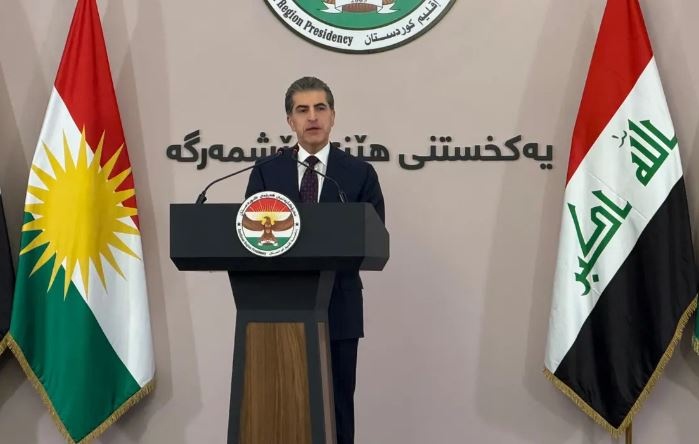
Peshmerga forces will henceforth operate under a unified ministerial chain of command, Kurdistan Region President Nechirvan Barzani said Monday, announcing what officials described as the completion of a decades-long effort to end partisan control over the Region’s military forces.
Speaking at a ceremony marking the unification of the Peshmerga, Barzani said the force must remain above political competition and serve the Kurdistan Region rather than any individual political party.
“The Peshmerga must remain above party competition, because they are not the force of a political party; they are the force of Kurdistan,” Barzani said.
Addressing Peshmerga fighters directly, he added: “When you put on the Peshmerga uniform, you are the Peshmerga of Kurdistan.”
Barzani stressed that the Peshmerga is a national force belonging to no political party and said that, following the latest reforms, no Peshmerga force would remain outside the administration of the Kurdistan Region’s Ministry of Peshmerga Affairs (MoPA).
The move marks a significant development in efforts to unify the Peshmerga, which has historically been divided along partisan lines between the Kurdistan Democratic Party (KDP) and the Patriotic Union of Kurdistan (PUK).
Although laws were introduced following the establishment of the Kurdistan Regional Government (KRG) in 1992 to place the Peshmerga under the MoPA, major forces affiliated with the two parties continued to operate largely outside the ministry’s direct command.
The KDP-affiliated Unit 80 and PUK-affiliated Unit 70 together accounted for roughly 100,000 fighters, with their payrolls and organizational affiliations remaining outside the full jurisdiction of the ministry.
Between 2010 and 2013, efforts to integrate the forces brought around 42,000 Peshmerga under MoPA command. However, political disputes and the war against the Islamic State (ISIS) subsequently slowed the process.
Reform efforts resumed in 2018 after the end of the main phase of the war against ISIS. The US-led international coalition subsequently supported a program focused on reforming command and control structures, professionalizing payroll and logistics, and integrating Units 70 and 80.
The first phase of the latest unification process began in 2022 following the signing of a memorandum of understanding with the US Department of War. The final phase was completed on September 10, with Monday’s ceremony coinciding with the expiration of the memorandum.
KRG Prime Minister Masrour Barzani said at the ceremony that the Peshmerga had now been unified in operations, training, command and control, media, and accounting.
He acknowledged that political affiliation among Peshmerga personnel was a legitimate right but stressed that national and Kurdistani allegiance must guide the force.
“The Peshmerga must adhere to the decisions of their superiors according to the military hierarchy and chain of command,” he said.
In February, President Nechirvan Barzani signed a decree formalizing the authority of Regional Commands 1 and 2. Under the restructuring plan, partisan forces were to be reorganized into 11 divisions.
Prime Minister Masrour Barzani later issued an executive order granting the regional commands legal authority and budgetary responsibilities.
Peshmerga Minister Shorsh Ismail described the completion of the process as the result of the strong political will of the Kurdistan Region’s leadership, calling the Peshmerga a “national asset” of Kurdistan.
He said the force would now operate under a central command rather than being controlled separately by political parties.
Both the Kurdistan Region president and prime minister emphasized that the unified Peshmerga force remains part of Iraq’s federal defense system.
“The unified Peshmerga force is part of federal Iraq’s defense system, with stronger coordination serving the security of the Kurdistan Region and Iraq as a whole,” President Barzani said.
Prime Minister Masrour Barzani also stressed the importance of strengthening military and security cooperation between the Peshmerga and the Iraqi army, saying closer coordination would contribute to Iraq’s stability.
He further called for Peshmerga salaries and financial entitlements to be aligned with those of their counterparts in the Iraqi army and for Peshmerga personnel to receive equal rights.