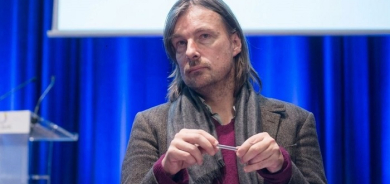
Dr. Thomas P. Bonfiglio to Gulan: National identity is a construct

Dr. Thomas P. Bonfiglio is a Professor of Literature and Linguistics. William Judson Gaines Chair of Modern Foreign Languages. Interdisciplinary Program Coordinator, Linguistics, University of Richmond. Thomas Paul Bonfiglio publishes in the fields of linguistics, literary, studies, and culture studies. His books include the following: Race and the Rise of Standard American (2002) examines the effect of race-consciousness upon the pronunciation and standardization of American English in the twentieth century. Mother Tongues and Nations: The Invention of the Native Speaker (2010) examines the ideology behind the kinship metaphors of “mother tongue” and “native speaker” by historicizing their linguistic development. It shows how the early nation states constructed the ideology of ethnolinguistic nationalism, a composite of national language, identity, geography, and race. Why is English Literature? Language and Letters for the Twenty-First Century (2013) illuminates the ideological forces that gradually caused “English” to become synonymous with literary studies in the United States and other literary traditions to be seen merely as “languages.” The Psychopathology of American Capitalism (2017) synthesizes psychoanalytic and Marxist techniques in order to account for the suppression of leftist politics in America, the protectionist discourses of anomalous American capitalism, and the rise of neoliberalism. Linguistics and Psychoanalysis: A New Perspective on Language Processing and Evolution (2023) demonstrates how fundamental psychoanalytic mechanisms, (e.g., displacement, condensation, overdetermination, and repetition), long absent in the history of linguistic inquiry, can illuminate the understanding of the grammatical structure, evolution, acquisition, and processing of language. He regularly teaches courses in linguistics, literary studies, and psychoanalysis and has also taught courses in English, French, German, and Italian. In an exclusive interview, he answered the following questions for us:
Gulan: To begin, what drew you precisely to study linguistics and literature, and what sparked your interest in the relationship between culture and language?
Dr. Thomas P. Bonfiglio: Well, I grew up in a bilingual family—Italian and English. My family is from Italy, but they moved to the Italian section of Rochester, New York. And so, I grew up bilingual, mostly in a Sicilian dialect. This was, of course, in America, and I didn't fit into the Anglophone stereotypes of an American. Then my parents moved to a suburb—a very white, Protestant suburb—and I did not fit in. They moved there when I was nine, and there I was stereotyped as an Italian kid. But when I would go back to the city, to the Italian neighborhood, the older Italians would call me 'that American boy.' Therefore, I had this identity conflict. And of course, I was the object of ethnic prejudices—Italians were the targets of prejudice in the latter part of the 20th century in the United States."
There were a lot of poor Italian immigrants in the US, and I was called names. Then, I decided to make a career out of it. I became very interested in language and identity, and especially in—if you could say—the folklore and prejudices surrounding them."
Linguistics, on the one hand, is a pure science, but there are popular ideas about language that don't mesh with that. These are language prejudices. I did my education in literary studies as well as linguistic studies. But in this century, I've been moving exclusively toward linguistics.
And I'm very interested in language prejudices. That's why I wrote “Mother Tongues and Nations: The Invention of the Native Speaker”—because I was very bothered by this notion of the absolute authority of the native speaker: 'This is my language, not yours. If you're not born into this language, then you can't really master it.' And there are many counterexamples to that. For instance, clearly at many universities, there are people teaching whose first language is not the language of that region. For instance, I have colleagues from all over the world whose first language is not English, but they teach students here, and they correct their essays. So, it's that discrepancy between folkloric and prejudicial ideas about language, and the science of linguistics itself. And language is a very useful vehicle for expressing prejudices in a deflected way. For instance, people can say, 'Oh, we don't have anything against them'—so initially, you're automatically setting up a division—'We don't have anything against them, but they have to learn our language.
And then there are these myths that if you teach and practice the non-dominant language, then you won't learn the dominant language properly. You see that in the United States with the large Hispanic population. The dominant white population might say, 'Oh, no, no, you can't teach them in Spanish—they won't learn English as well.' Well, there's no evidence of that in linguistic science. Children can grow up with four or five—or even more—languages, and they can be perfectly functional in each one of them without getting them confused. Children are programmed that way. So, that was basically what interests me in linguistics, uncovering prejudices.
Gulan: You contend that 'mother tongue' and 'native speakers' are not basic linguistic facts; they are historically manufactured. So, if they are politically generated and not something inherited, what will happen to our notion of national identity?"
Dr. Thomas P. Bonfiglio: Well, clearly national identity is a construct. It's unstable. It's always changing. Clearly, the national identity of Germany now is not the way it was 80 years ago. Therefore, it's very unstable. Now, we do have to admit that—and this was a conversation I got into at another university in the United States—they seemed to be constructing courses that were attempting to dissolve identity, especially vis-à-vis language. And identity formation is absolutely crucial, psychologically. It's crucial for individual identity and group identity. And it can be done in very positive ways, in ways that are not harmful. For instance, soccer—there is a clear identity to the French national soccer team. But nobody gets killed, okay?
This is a way of grouping yourself around a common culture, and this happens at a mini level—it can happen in the identity formation of a social group. They will tend to share linguistic features and a certain way of talking, and this can become exclusive, especially with adolescents. Adolescents will form groups and then start speaking in a certain way to detect the outsider. If they want to move the outsider further outside, they'll say, 'Oh, we don't talk like that. We don't do that anymore.' So, these are natural developments. I think they're perfectly necessary for psychological functioning. But we have to be careful when they become prejudicial in a damaging way.
Gulan: But can linguistics ever be politically neutral if 'native speaker,' 'standard language,' and 'mother tongue' have—if not nationalistic—at least political connotations? So, can linguistics be politically neutral?
Dr. Thomas P. Bonfiglio: Well, that's certainly what we try to do. I'm teaching linguistics right now, of course, and I try to make my students aware of these exclusionary gestures. Yes, linguistics can be neutral. For instance, we like to illuminate the prejudices in language that stow away—they slip in underneath the surface, and we don't detect them. For instance, there are gender prejudices in language that tend to be silent. A while ago, English used to use the word 'man': 'When did man do this? When did man do that?' And we'd have to step back and say, 'Well, wait a minute, there were women around, too.' And then, of course, the resistance will say, 'Oh, well, that's just a word.' We meant everybody—we just used man.' Then you have to make it clear to them that there are some people who will automatically feel excluded.
Now, whether linguistics can reach a perfect point as far as that is concerned, I don't know. But we clearly are continually striving to move in that direction, especially regarding dialect speakers. What we have in linguistics is something called a dialect continuum. Clearly, you can validate that yourself in dialects of Arabic or dialects of Kurdish: as you move along this dialect continuum, you reach a point where you cross over from here to there, and gradually, you arrive at a point where mutual comprehension disappears.
So you get to a point where you can't be understood anymore. And this brings us to the truth in linguistics: every language is a dialect. There is one specific way of speaking—one dialect—that gets elevated to national status, put on a pedestal, and used to discriminate against other forms of speech. We show students, for instance, the histories of our languages and evidence from the past where there were ways of speaking that would sound absolutely wrong nowadays. And that change will continue. Language is never stable; it changes for a lot of reasons. There is no such thing as good and bad speech. There is no such thing as high and low speech.
Language doesn't have altitude. These are social prejudices imposed upon language. So, we do make an effort to address that, especially when analyzing political speech. The polite discourse of a prejudiced demagogue can cloak and hide a lot of prejudicial aspects. It becomes very clear by implication who they're talking about, especially in terms of economic discrepancy and economic inequality. The class in power will find ways to disenfranchise the disadvantaged class and identify it as inferior in itself—when it is not inferior at all, just excluded by social forces. I taught a course on this last fall, and we came up with a wonderful term: 'intentionally unintentional.' It's where you don't really mean to do something, but at a subconscious level, you do mean to do it.
Gulan: Making language simultaneously look natural, ancestral, or territorial appears to be essential for ethno-linguistic nationalism. So why has language become such a powerful tool for civilizations to turn historical contingencies into identities that seem unavoidable?
Dr. Thomas P. Bonfiglio: Well, everyone on this planet now—all humans—are descendants of a prehistoric type of human that originated in Africa, as you know. Modern humans originated 200,000 to 300,000 years ago, and they were very different from other sub-families of humans. The most recent one, of course, was Neanderthal, but there were a lot of others. And clearly, we developed superior, more effective cognitive abilities, and we could communicate better. That's the important thing: we displaced other families—or other groups of humans—because we could communicate better. We were competing for the same niches, but our communication facility gave us a higher survival rate than the others, and so we displaced them. So that's where language comes in as really the tool of social organization. And it's absolutely necessary for human progress.
Gulan: In your work, you talk about psychoanalysis and nationalism. Psychoanalysis reveals, let's say, conflicts that lie behind identities, while nationalism offers a cohesive communal identity. So, is it a fair characterization to picture nationalism as a collective defense against the ambiguities of social and personal identity?
Dr. Thomas P. Bonfiglio: Yes, and as I said earlier, there's really nothing wrong with national identity—it's absolutely necessary. That's why I brought up soccer: it's a harmless way of negotiating identity, though sometimes people can overreact. In a recent European Cup final, when the Netherlands lost to Spain, people started throwing their television sets out the window. So, blame it on the television set! These are ways of sublimating latent hostilities. Clearly, there's an element of hostility in human culture—our current global situation demonstrates that very well. We are animals. Psychoanalysis tells us that we are animals, but we are animals who control our impulses more than any other. We build civilization upon the control of those impulses.
And those animal impulses pop up from underneath the surface a lot, which clearly can cause conflict and war. Therefore, there is nothing inherently wrong with national identity or national pride—that's absolutely necessary. But we must see identity as elastic and inclusive, because identities change. For instance, while the dominant language in France today is standard Parisian French, at the turn of the 20th century, most of the population—a little over 50%—did not speak French at home. They spoke the dialects of the South, which are related to Spanish and Italian; in the eastern part, they spoke German dialects and Dutch dialects; in the west, they spoke Celtic dialects. So national identity is very fluid.
In the United States, I'm surprised now that my students—who are close to the ages of my grandchildren—a lot of them don't know what their last names mean. That connection has gotten lost over four or five generations. But a hundred years ago, it was vicious. People were identified as Polish, not American; Italian, not American; Spanish, not American. A very interesting example is the actor, Leonardo DiCaprio. He has an Italian first name and an Italian last name, yet there's no perceived connection to Italy at all. A hundred years ago, if you had an Italian name, you were Italian—and you were viewed as inferior. Thus, we need to see national identity as elastic and inclusive, and genetics can help us do this. Genetic research shows us that what we call 'genetic differences' are mostly surface appearances—skin color and hair color, which are controlled by very few genes. In fact, genetics has shown that there can be more genetic affinity between me and a Black person than between me and a random white person. I think we need to see all of this as in flux and just be careful when we construct these identities. We have to recognize them as constructions—necessary and healthy for forming groups, forming clubs, and having symbols, banners, and teams. But it should always be inclusive. And we should always remember that one of the best healing vehicles is humor and laughter. I think we need to make fun of ourselves when we're doing this.
Gulan: In your work, you talk about race consciousness to understand the standardization of American English. So, how much do discussions about 'proper' English, linguistic proficiency, and accents perpetuate historical, racial, and class disparities?
Dr. Thomas P. Bonfiglio: let me say that a very interesting thing happened in the United States. The regional accents in the U.S. that were very active 100 years ago—say, at the turn of the 20th century—were exceptionally strong. But in the 1920s, radio came about, and national radio broadcasts were heard everywhere. Through that, people became aware of how they sounded vis-à-vis others. Before that, people didn't really know how they sounded compared to others because travel was difficult and took a long time. Again, 100 years ago, there were very distinct, identifiable regional accents. Today, those accents are disappearing among the middle class. We now have a clear class difference between the working class and the middle class: once people move into the middle class—once they go to university, or even before that—they tend to lose their regional accents. We were discussing this in class the other day: no one likes being stereotyped.
I think this is a fundamental human reaction: everyone wants to determine their own identity. We don't like being stereotyped, so people will adapt to the group identity. The ideas about 'superior' and 'inferior' language stem from a distaste for another class—it tends to be bourgeois elitism versus the working class. People don't want their kids associating with the working class; they don't want them sounding like that. Accent is what gives that away. When you're learning a second language, accent is the hardest thing to master. As I said earlier, we have faculty members who did not grow up speaking English whose grammar and vocabulary are better than a lot of people born in the United States, but the accent gives them away. That's a very interesting phenomenon: why is it that accent gives us away? I worked on that in my last book.
Gulan: You have also challenged the historical assumption that 'English' should be synonymous with literature studies. So, what does the institutional domination of English literature tell us about the relationship between national political power and knowledge production?
Dr. Thomas P. Bonfiglio: Well, let me jump to a conclusion and then I'll come back to answer that directly. I recently learned that the American ambassador to France does not speak French. The American ambassador to Italy does not speak Italian. It's seen as okay in the US. Thus, there's this notion in the United States—especially in Donald Trump's America—that everybody needs to learn our language, while we don't need to learn these other languages. 'Everybody speaks English.'
In the United States, it has gotten to the point where the term 'English' stands for all literature. It's a very odd idea, and we don't see it in any other country. Americans will say, 'I took an English course,' and it means they read Tolstoy, Dante, Flaubert, or Goethe. Then the students refer to these classes as 'English' courses, and when you tell them they're not English courses—they're literature courses—they don't understand. Why? Because Americans resist the idea that someone could become operationally fluent in another language, largely because all they see are foreigners coming to the United States and speaking English in a nonstandard way.
And the idea that an American could go in the other direction and become functional or operational in another language is a threat to the hegemony of English. My language is dominant; I don't need to learn yours. And Americans make wonderful apologies for that. They will say, 'Oh, you're going to have to excuse me—I took six years of Spanish, but I really can't speak it.' It sounds like an apology, but it's not. It's an arrogant statement of indifference—a polite, arrogant statement of indifference that says, I don't really need to do that.
These are the linguistic forces that aid in American hegemony. When the American embassy was overtaken in Iran in the '70s, there were only two people in the State Department who spoke Farsi Only two people. So, everything gets filtered into English. English is dominant, and if it doesn't fit into English, then it's not really seen as having any worth.
Now, fortunately, this younger generation in the United States is growing up on the internet, and they've been getting information from a lot of international sources. They know that things are different elsewhere, and they seem to be moving in a very different direction.
Gulan: If you were to summarize your insights on the relationship between language, power, and human identity, what would you say your work has primarily been attempting to address?
Dr. Thomas P. Bonfiglio: Well, again, as I said at the beginning, my work attempts to address how language is used in damaging and exclusionary ways—ways that are not visible on the surface. That's the important thing. We can see this very clearly in sexist language, which illuminates gender and sexual prejudices embedded in language that aren't immediately obvious.
The same applies to metaphors of national identity and 'mother tongues.' In doing my research, I learned that the figures and metaphors of the 'mother tongue' and the 'native speaker' are surprisingly recent. They arose in the West during the Renaissance, coming right out of Italy—a lot of things come out of Italy! Before that period, identity and language were not corporealized; they were not embodied. They started getting placed into the body during the Renaissance, and then with the development of post-Darwinian genetics, there were deliberate attempts to localize language physically in the blood. Before the Renaissance—if you look at antiquity in Greece and Rome—language was not attached to anything physical or ethnic.
There were ways of speaking that were social, but not really ethnic. These ethnic prejudices are clearly very damaging because ethnic identity—which is a psychological construct—becomes biologized once tied to physical traits. That biologization freezes the prejudice, making it very hard to deconstruct.
Dante was one of the first thinkers to articulate this. When the Holy Roman Empire collapsed, nation-states began forming, but they lacked shared written traditions since formal texts were restricted to Latin and Greek. Therefore, they had to invent traditions for themselves. Dante described the vernacular language as something we learn at the mother's breast—we are literally suckled by the mother. The implicit message becomes: if you were not suckled by the same mother I was, you cannot be part of our group. That concept represents one of the first major steps toward modern racialization.
And it hits right at the heart of identity: family, mother, belonging. At the same time, language became tied to local geography and climate—the idea that I am a product of the environment I grew up in. A lot of work was done by these racial ideologists and theorists to locate language directly in the physical body and in local nature. Accordingly, the logic becomes: if you don't breathe the same air, if you aren't shaped by the same natural surroundings, then you are not part of us. That is profoundly damaging because this kind of essentialist language inherently creates rigid categories like race and nation."
Gulan: Do you agree that language is a crucial component or indispensable element for nationalism and raising national consciousness? Given that you've discussed the instrumentalization of language to marginalize and exclude other groups, can language ever play a positive and constructive role in this regard?
Dr. Thomas P. Bonfiglio: I think language is clearly the most effective tool. Of course, it can also happen through images—you can have a national hero who embodies national identity, and that can certainly work visually. For example, the classical archetype of an American a hundred years ago was a white Anglo-Saxon Protestant, physically indistinguishable from an Englishman. So those images can construct national identity. But language is clearly the most effective mechanism because we need communication in order to establish those shared identities. And that means not only verbal communication, but symbolic communication as well—gestures, facial expressions, and shared codes.