Erbil’s Uprising: How March 11, 1991 Changed the Course of Kurdish History
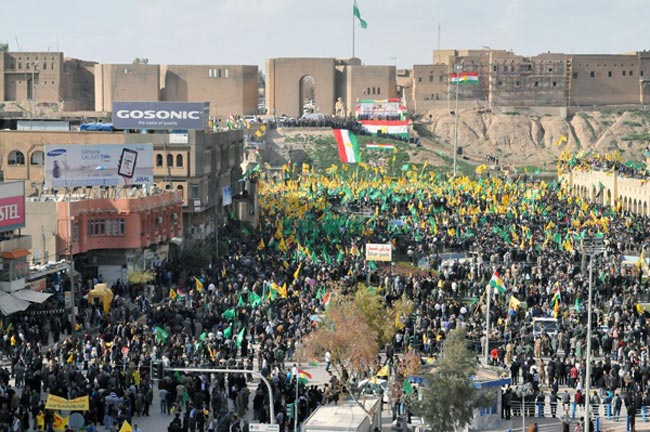
Residents of Erbil are commemorating the 35th anniversary of the 1991 uprising, a historic revolt in which civilians and Kurdish fighters overthrew the rule of the Ba’athist regime and liberated the city after decades of repression under Saddam Hussein.
The uprising in Erbil formed a key chapter of the broader 1991 Iraqi uprisings, a wave of rebellions that erupted across Iraq following the Gulf War. For the Kurdish people, the events of March 1991—known widely as Raperîn (the uprising)—marked a turning point in their struggle for freedom and self-rule.
A City Rises Against Decades of Oppression
Thirty-five years ago, on March 11, 1991, thousands of residents in Erbil took to the streets, joining forces with Kurdish fighters of the Peshmerga and political factions within the Kurdistan Front. Within hours, protesters stormed government buildings, intelligence offices, and military installations belonging to the Iraqi regime.
Despite the city’s heavy security presence—including military barracks, police headquarters, and intelligence agencies—the coordinated uprising overwhelmed regime forces. Crowds seized tanks, occupied administrative buildings, and dismantled the regime’s security apparatus.
Historical accounts indicate that armed crowds took control of the city in as little as three hours, triggering a chain reaction of revolts across Kurdish towns and districts.
The liberation of Erbil came only days after the uprising had begun in Rania, spreading rapidly to Sulaymaniyah, Duhok, and other cities across northern Iraq.
Khaja Bawa: A Symbol of Kurdish Women’s Courage
Among the most revered figures of the uprising is Khaja Bawa, a Kurdish activist widely remembered as a symbol of women’s courage during the rebellion.
Born in 1945 and a mother of seven, Khaja Bawa had long supported the Kurdish resistance movement. On the day of the uprising, she reportedly led a group of youths toward the governorate building, rallying demonstrators with revolutionary slogans.
She was shot by regime forces during the confrontation but continued advancing despite her injuries. Her death transformed her into one of the most enduring symbols of sacrifice in Kurdish history. Today, schools, statues, and public memorials in Erbil honor her legacy.
Roots of the Revolt: From Anfal to the Gulf War
The uprising did not emerge suddenly. It was fueled by years of repression and violence under the Ba’athist regime.
During the late 1980s, Iraqi government forces carried out the Anfal Campaign, a devastating military campaign against Kurdish areas that destroyed thousands of villages and killed tens of thousands of civilians. Chemical attacks—including the infamous strike on Halabja—left deep scars on Kurdish society.
More than 4,000 Kurdish villages were destroyed, and hundreds of thousands of people were forcibly displaced. These policies created widespread anger and resentment that later exploded into rebellion.
The opportunity came in early 1991, after Iraqi forces were defeated by a U.S.-led coalition during the Gulf War. With Baghdad weakened and many Iraqi army units demoralized, Kurdish communities across northern Iraq launched a coordinated revolt.
The Spread of the Uprising
The fall of Ba’athist authority in Erbil had a powerful psychological impact across the region. News of the city’s liberation encouraged other communities to rise up against the regime.
Within days, uprisings spread across northern Iraq—from small towns such as Chamchamal and Aqra to major cities like Kirkuk.
For a brief moment in March 1991, most Kurdish cities had freed themselves from Baghdad’s control.
However, the Iraqi regime soon launched a fierce counter-offensive using elite units and helicopter gunships. The violence triggered a massive humanitarian crisis, forcing more than 1.5 million Kurds to flee toward the mountains and international borders.
The catastrophe ultimately led to international intervention and the establishment of a no-fly zone over northern Iraq—laying the foundations for Kurdish self-rule.
A Turning Point in Kurdish History
For many Kurds, the uprising of March 1991 represents the moment when Kurdish society collectively reclaimed its political destiny.
The revolt eventually paved the way for the formation of the Kurdistan Regional Government and the emergence of a semi-autonomous Kurdish region within Iraq.
Today, Erbil—once a heavily militarized city under the Ba’ath regime—has transformed into one of the Middle East’s most important political and economic centers.
Yet each year on March 11, residents pause to remember the sacrifices that made that transformation possible.
Ceremonies, speeches, and memorial events across the city honor the martyrs of the uprising and celebrate the courage of ordinary citizens who turned a moment of revolt into a defining chapter of Kurdish history.