Professor Thomas Diez to Gulan: “There Is No Magic Formula” for Transforming Deep Political Conflicts
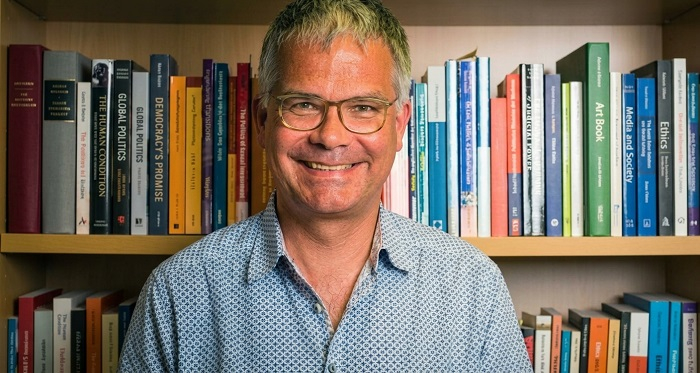
Professor Thomas Diez is a distinguished scholar of European integration and international relations, whose research examines how political institutions can transform conflict and how Europe exercises power beyond its borders. He is Professor of Political Science and International Relations at the University of Tübingen, where he has taught since April 2009. His expertise encompasses the Cyprus conflict, relations between the European Union and Turkey, and the changing relationship between sovereignty, identity and regional integration.
A recipient of the Anna Lindh Prize for his contribution to the study of European foreign policy in 2009, Professor Diez served as President of the European International Studies Association from 2015 to 2017. He earned his doctorate at the University of Mannheim, worked at the Copenhagen Peace Research Institute from 1997 to 2000, and subsequently taught at the University of Birmingham, becoming a professor there in 2005.
His extensive publication record also addresses the wider challenges facing Europe and international society. He is a coeditor of The Routledge Handbook of Critical European Studies and a coauthor of The EU and Global Climate Justice, as well as The Securitisation of Climate Change. These works connect his research on European power with questions of global justice, security and political change.
In this interview, Professor Diez discusses the limits of European influence in Cyprus, the future of relations with Turkey, and the institutional choices facing European defence. He also considers what conflict transformation can offer the relationship between Baghdad and Erbil, while stressing the limits of direct comparisons.
GULAN: Professor Diez, you have studied the Cyprus conflict for nearly three decades, and in your May 2026 lecture you asked whether recent developments could create a new opening after decades of division. Cyprus is in a very unusual position. It is a member of the European Union, yet the island itself remains divided, there is still a UN peacekeeping presence, and fundamental questions of sovereignty, security, territory and identity remain unresolved. After all these years of European involvement, would you say that European integration has genuinely helped transform the Cyprus conflict, or has Europe ultimately become more successful at managing the division than actually overcoming it?
Professor Thomas Diez: I think most of the literature, and I agree, says that the integration process has not really helped to fundamentally transform the Cyprus conflict.
When Cyprus became a member of the European Union, one of the mistakes was that many in the European Union had assumed that there would be sufficient incentives and pressures on both sides so that a solution could actually be found before Cyprus joined the Union.
But this did not work, and Cyprus did become a member. There was still the idea that you could exert pressure, perhaps also on the Greek Cypriots, which, of course, is not the case, because once you have got a state as a member in the European Union, it is part of the European Union, and then it becomes a lot more difficult to exert influence on that member.
GULAN: Is there a genuine opportunity for progress today? Do you see any genuine opportunities?
Professor Thomas Diez: I think the situation remains very difficult. What we see is that there are always episodes, in particular in the north, where there are windows of opportunity. We have seen this with Mustafa Akıncı, the former president, who was someone who actually was very much in favour of a solution. It did not work.
I think now, with Erhürman, there is another opportunity. But Erhürman is not going to be as naive, perhaps in some ways, as Akıncı was. I do not mean naive in a negative sense. I think you sometimes need, in these situations, a certain degree of naivety, because otherwise, if you always consider all the negative possible outcomes, you are not going to move anywhere.
I cannot quite see why there should be movement on the Greek Cypriot side to fulfil some of the conditions that the Turkish Cypriots and Erhürman are setting. So I do not think that we are going to have a solution within the next one or two years.
You should, of course, never discount that there may be events that we cannot foresee. But as things stand at the moment, I am not very optimistic, despite the fact that the situation since Erhürman’s election has improved.
GULAN: In your work on relations between the EU and Turkey, you describe two sides that remain deeply interconnected but continue to struggle over what their long term relationship should actually look like. Today, Europe and Turkey depend on one another in areas such as trade, migration, security, NATO cooperation and regional stability. At the same time, disagreements remain over democracy, Cyprus, the Eastern Mediterranean and Turkey’s broader place within Europe. Do you believe that the original idea of Turkey eventually becoming a member of the European Union has, in practical terms, now been replaced by a more transactional strategic partnership? If that is the case, what consequences would this have for both Turkey and Europe in the long term?
Professor Thomas Diez: I think you are absolutely right. There is no movement on the membership front at this stage. The EU has started to interact with Turkey on a much more transactional basis. So at this stage, I do not think that there is going to be any movement towards membership. I think that both parties interpret the relationship more in interest based and geopolitical terms.
Is that going to be the same for the future? I think we need to be aware that in both the EU member states and in Turkey, there are domestic struggles ongoing, and we do not know what the outcome of these domestic struggles will be.
At this stage, a new party, Yeni Parti, which literally means “New Party”, has formed in Turkey, which is gaining massive importance at the moment. It is not completely inconceivable that this new party will be a major challenge to Erdoğan and therefore change the political landscape again.
At the same time, we have got right wing populist parties all over the EU member states. The result of this may be the opposite of what is happening in Turkey. So we always need to think about this not only in one dimensional terms. I think there is an interaction between what is happening on the international and on the domestic level.
GULAN: Do you think keeping the accession process formally alive still serves a political purpose, or has it become largely symbolic between the EU and Turkey?
Professor Thomas Diez: I would not distinguish so much between the political and the symbolic here. I think it is important to maintain the membership process, because you have got to consider that within Turkey, like in many other countries, there is a fifty fifty split in the population.
If you stop the membership process, you betray all those who had put their hopes in this process. So those 50 per cent whom the EU has already betrayed by not negotiating seriously, the member states at least.
I think it is an important political process, also domestically within Turkey, even though at the moment, of course, the process is completely stalled. But we are not keeping this up for the next month. This is something that is of importance in the long term, and of course, at the moment, you might say it is symbolic. But the symbolism may very quickly turn into political significance.
GULAN: A central theme running through much of your research is the transformative power of integration, the idea that political, economic and social integration can gradually change how societies understand borders, sovereignty and even one another. But when we look at cases such as Northern Ireland, Cyprus or relations between Greece and Turkey, the results have been very different.
In your view, what actually separates a conflict that can be transformed through integration from one that simply becomes frozen or institutionalised? How important are political leadership and changes in collective identity compared with things such as economic interdependence and institutional cooperation?
Professor Thomas Diez: I think our big mistake, when we look at the analysis of such political processes, is that we think we can identify factors that apply universally. As a matter of fact, I think in most of politics, a lot is actually happening in particular circumstances.
Our work, and it is not only my work, it is the work of myself and collaborators, has always been to say that there is a transformative potential. But I think we have always emphasised that there is no automatism.
In fact, in the work that I have done on Cyprus, we have always pointed out that there is no direct causality between the EU membership prospect and conflict transformation. Cyprus is a case that shows how these impacts are dependent on a lot of contextual factors. I want to highlight two contextual factors.
One contextual factor, and Cyprus is a very good example of this, is that you cannot transform a society in which important actors are not willing to transform. So there must be a basic willingness to engage in a process.
In Cyprus, the parties have used, and in particular perhaps the Greek Cypriots have instrumentalised, the European integration process. Not all of them, not only, but in the dominant discourse there was an instrumentalisation to strengthen the Greek Cypriot position. This is not going to be a good starting point for a transformation.
The other factor that is equally important is that an actor that interacts with a conflict, as in this case the EU, needs to be sincere and needs to be consistent. It needs to be focused on conflict transformation and not so much on particular interests.
I do not think the European Union has always been this consistent actor that it always tries to present itself as. If you think about the enlargement process with Turkey, we have talked about this, I do think that in the negotiation process one could have been more helpful for the Turkish domestic processes if one had, in the beginning of the 2000s, negotiated properly.
GULAN: In your 2026 lecture on the “Three Dilemmas of European Defence”, you raised a fundamental question about whether the European Union itself is necessarily the right framework for developing greater European military autonomy.
Europe is now being asked to do several things at once: strengthen its ability to deter external threats, reduce its dependence on the United States, and at the same time protect a political project that was originally built around overcoming nationalism, military rivalries and territorial conflict within Europe.
Can Europe become a much stronger military and geopolitical actor without fundamentally changing the character of the European project itself? Institutionally, where should the future of European defence really sit: within the European Union, within NATO, or perhaps through a new form of cooperation between European states?
Professor Thomas Diez: You summarised my position very accurately, and I am not sure I can add a lot to this. I do think that we need to distinguish between the European integration project as a fundamental project of political transformation, and Europe as a geopolitical entity.
I do not think that the European Union, as the outcome of the European integration project, is an actor or an organisation that, either from its history, its institutional setup or its normative ambition, is well geared to respond to military threats as such.
Therefore, I have been one of those who, for a long time now, have argued that any military cooperation between the member states might better take place outside the structures of the European Union. I have been advocating that this should happen within the European pillar of NATO, not least because there are institutional structures to create certain path dependencies for military action on the European side. I think it is much more difficult to create something completely anew.
The problem that we face, of course, is that within NATO, the United States in particular is currently governed by an administration that fundamentally does not share, I do not think, what people would associate with European values anymore.
I should also hasten to add that, as I said earlier, there are ongoing struggles within the European states as well, both within the EU and outside the EU. So I think the most fundamental issue at the moment is not so much creating military defence as such, but tackling the political future of Europe.
Out of all of this, I think both pragmatically, because the European Union, in terms of its capabilities and institutional structures, will not easily be able to act as a military actor, and normatively, it may not be the right place to do military defence.
I think we need to sort out military cooperation outside the EU context. It involves the UK. That will also likely involve Turkey. We need to separate, as it were, the efforts of political transformation from military defence, where it is ultimately about preventing some states from militarily interfering in other countries.
GULAN: Our magazine is based in the Kurdistan Region of Iraq, so I would like to bring your work into the context of our own region. Iraq and the Kurdistan Region have experienced long running political disputes involving federal authority, disputed territories, natural resources, security arrangements, constitutional interpretation and competing national identities.
Of course, Iraq and the Kurdistan Region are very different from Cyprus or from the European experience, and I would not want to suggest a direct comparison. But looking at your broader work on conflict transformation, are there principles from the European experience that could still be useful in the relationship between Baghdad and Erbil?
For example, could stronger shared institutions, deeper economic interdependence, security cooperation, or mechanisms that gradually reduce the political importance of disputed boundaries help transform these disagreements over time? Equally importantly, where would you caution policymakers against trying to transfer European models into a fundamentally different Middle Eastern political environment?
Professor Thomas Diez: These are a lot of questions, challenging my knowledge, and I have to say straight away that my focus, as you know, is on Cyprus and Turkey. I have not really worked on Kurdistan or indeed on the Kurdish region in Iraq. So whatever I say needs to be taken with a very big pinch of salt, I suppose.
I think there are general principles, independent of the question of Europe or not Europe, that would be helpful in such situations.
In principle, one of the most important things is to realise that any institutional framework will not automatically produce peace. We have talked about this before. It requires that those who are engaged in this, at least on a very basic level, show a willingness. Institutions are helpful. They provide context, they are able to transform also the strategies and the identities of people. But there has got to be an initial starting point, a launch pad for this. If that is not there, it does not work.
Institutions that you normally would think may have a transformative potential need to accomplish what we call squaring the circle. They have got to, on the one hand, allow differentiation between different identities and their self government, and at the same time they need to bring people together. This is something that is very difficult to achieve.
The principle that we have is therefore that you do allow a certain degree of autonomy, but at the same time you have got to make sure that there is sufficient interaction. I do not have a formula, and I think one of the mistakes that perhaps we have made in the past is to think that there is a single institutional formula that will settle this.
But the problem is that the more you actually guarantee autonomy, the more you also reproduce the conflictual identities. Yet, if you do not provide autonomy, you are going to reinforce the hegemony of the dominant population. This is the dilemma. But there is no way out of this dilemma, you see?
We have seen in Bosnia, where we have got far reaching autonomy, that this has only led to a reification of the nationalist identities. In other situations, think about Sri Lanka, you have got peace settlements that then reinforced the hegemony of the dominant, or what we call a “victor’s peace”.
At the end of the day, I think it needs to be clear to everyone involved that there is no neat solution, and that to some extent we also need to think about this in terms of ambiguity. But that means that, as a general principle, neither full autonomy nor a sort of centralist solution are very helpful.
The European integration process has therefore tried to allow more regional identities to flourish and, at the same time, provide a framework in which all of these can operate.
All federal systems, though, have the unfortunate tendency that over time they strengthen the centre, because you can always make an argument that, in the end, the centre is better able to regulate than the regions, and life is too complicated if all the regions do their own thing, et cetera.
I think here the European experience is also one of illustrating this particular problem, that in Europe as well, we need to think about how we reinforce a European integration process that does not, at the same time, override the autonomy of individual regions.
I do not think there is a magic formula. We have tried a lot of different solutions in the past. In Cyprus, the 1960 constitution was a very progressive one. It had all sorts of ingredients that we call consociational in our discipline, with special quotas, checks and balances, A Greek-Cypruiot president and a Turkish-Cypriot vice president, et cetera.
The problem, though, is that all of this, where you think, fantastic ideas, none of the groups will dominate, et cetera, at the end of the day reinforced the political divisions between what were assumed to be separate ethnic communities. But the solution would have been, actually, that all of them understood each other as Cypriots, not as separate communities.
But if you have got checks and balances between Turkish Cypriots and Greek Cypriots, and you can only vote if you identify yourself as Turkish or Greek Cypriot, then, of course, you reinforce the whole sort of problem that you want to solve. This is the dilemma that I think we have not solved yet.