Mexican Artist Lubella Gauna to Gulan: “A Kurdish Artistic Collaboration Would Be an Exceptional Experience.”
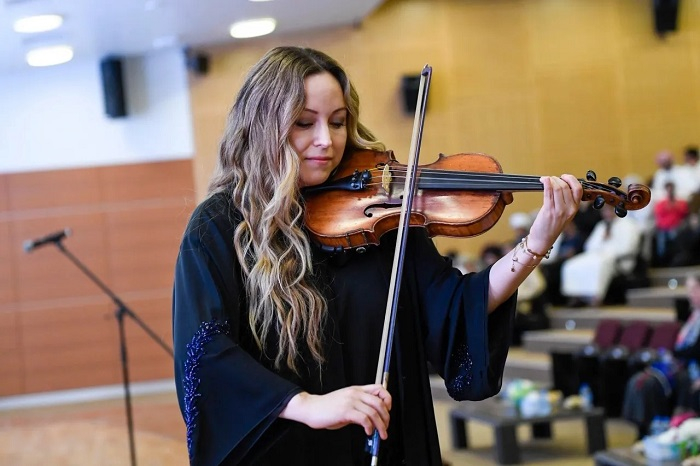
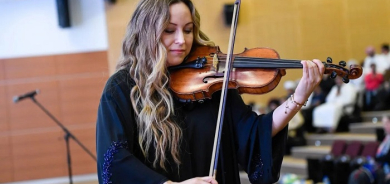
In the world of music, where melodies transcend the boundaries of language and geography, the journey of Mexican violinist Lubella Gaunastands as a remarkable example of the power of art to build bridges between cultures. Born in Lodi, California, and raised in a Mexican family in an environment rich in family traditions, culture, and music Lubella developed an artistic personality shaped by openness to diverse cultures and musical experiences.
Despite her Mexican roots and upbringing in California, Lubella found her way to Arabic music, which became more than simply a new musical genre for her. It evolved into a deeply emotional and cultural experience that has had a profound influence on her artistic journey. Her connection with the Arab world grew stronger through her regular winter visits to Abu Dhabi and Dubai, where she has had the opportunity to experience the culture, connect with its people, and discover its music firsthand.
What makes Lubella Gauna’s artistic journey particularly distinctive is not only her talent as a violinist, but also her ability to view music as an open space where cultures, identities, and human experiences can meet. Rather than seeing the difference between her own background and the music she has embraced as a barrier, she considers this diversity an essential part of her artistic identity. For Lobella, music has the power to transcend borders and speak directly to the human heart, regardless of language, nationality, or place.
In this interview, we take a closer look at Lubella Gauna—the person and the artist—and explore her beginnings with the violin, the influence of her Mexican upbringing on her personality, and how she discovered Arabic music and developed such a deep affection for it. We also discuss her experiences between California, Abu Dhabi, and Dubai, her perspective on the role of music in bringing people and cultures closer together, and her aspirations for the future of her artistic career.
Gulan: When did your relationship with music and the violin begin? Do you remember the moment when you realized that playing the violin would be more than just a hobby and could become a lifelong artistic path for you?
Lubella Gaunato: My relationship with the violin started when I was seven years old, in elementary school. I remember being fascinated by how elegant and beautiful the violin looked, and I immediately wanted to learn how to play it. Funny enough, the instrument I originally wanted to play was actually the harp, but they didn’t offer it where I grew up, so the violin became my next choice.
I remember going home and telling my father that I wanted to learn how to play the violin, and the first thing he said was, “GREAT! You can play mariachi music for me!” And I remember thinking, “I don’t want to play mariachi!”
But ironically, years later, I actually DID end up playing mariachi music. I performed with mariachi groups, went on tours, and traveled with my violin. At that point, I still never imagined just how far that little decision at seven years old would take me.
Eventually, I wanted to explore beyond what was familiar to me. I started discovering Arabic music and completely fell in love with it. I began playing Arabic music on the violin, and that allowed me to break cultural and musical borders in a way I never expected.
So when I look back, it’s kind of funny—my dad jokingly told me when I was seven that I would play mariachi music for him, and years later, I actually did. But I went even further than either of us could have imagined. I went from playing mariachi music to traveling and performing Arabic music, and eventually creating my own identity as an artist.
I never planned any of this when I was seven. I just thought the violin was beautiful and wanted to learn how to play it. Somehow, that little decision turned into a lifelong artistic journey that has taken me across cultures and borders.
Gulan: You became one of the youngest violinists to perform with the San Francisco Symphony. What do you remember most about that experience? How did you feel standing alongside professional musicians while you were still very young?
Lubella Gaunato: Actually, it was the Central Valley Youth Symphony, not the San Francisco Symphony. I remember being SUPER scared and nervous because I was so young, and most of the musicians around me were much older than I was. I remember thinking, “Am I really good enough to be here?”
My teacher believed in me and told me that I was good enough to audition, so I decided to go for it. I auditioned, and I was accepted, which was such a huge moment for me. Being surrounded by musicians who were older and more experienced pushed me to take myself seriously and realize that I really could do this.
What’s amazing is that being part of that group led to experiences I never could have imagined at that age. I ended up performing with the Central Valley Youth Symphony at Carnegie Hall in New York and also at the Sydney Opera House in Australia.
Looking back, I think the biggest thing I remember is how scared I was in the beginning—and how quickly that fear turned into excitement and confidence. Those experiences taught me to believe in myself and to never let being young make me feel like I don’t belong in a room.
Gulan: Why did you choose the violin over other musical instruments? What is it about its sound and expressive possibilities that attracts you? Do you also play or have you studied any traditional Eastern musical instruments?
Lubella Gaunato: Honestly, I think what attracted me to the violin in the beginning was how elegant it looked. There was just something about the instrument that caught my attention when I was a little girl. But as I got older, I also became fascinated by how challenging it is to play. The violin is considered one of the more difficult instruments to master, and I actually love that challenge.
There’s also so much emotion you can express through the violin. You can make it sound soft and beautiful, or very powerful and emotional, depending on how you play it. I think that ability to almost make the instrument “sing” is what really attracted me to it.
I don’t play any other instruments professionally, although I have picked up the oud and tried to play it by ear. I can actually play a little bit that way, but I definitely need proper lessons if I want to become good at it! I would love to study the oud more seriously in the future, especially because of my love for Arabic music.
For now, though, the violin is definitely my instrument. It’s been with me since I was seven years old, and I’ve built my entire musical journey around it.
Gulan: In addition to Western classical music, you have explored the world of Eastern music. Which prominent Eastern artists and musicians have you worked with or performed for? Are they all Arab, or has your musical journey also included artists from different Middle Eastern cultures and backgrounds?
Lubella Gaunato: I haven’t had the opportunity YET to perform with my favorite Arab artists, but Inshallah, I hope that will happen in the future. I know that some of them are aware of my playing—some actually follow me on social media, and some have even liked my videos—which is really exciting for me. So I know my music is reaching them, and hopefully one day I’ll have the opportunity to actually work with them or perform alongside them.
My musical journey has actually crossed many different cultures. Before I became so deeply involved with Arabic music, I had the opportunity to work and perform with some very well-known Latin artists. I’ve worked with artists such as Thalía, Celia Cruz, Alejandro Fernández, Pepe Aguilar, Espinoza Paz, Mariachi Vargas, and many other established artists in the Latin music world.
So, no, my journey definitely hasn’t been limited to one culture. I’ve been very fortunate to experience different musical worlds—from classical and Latin music to eventually discovering Arabic music and making that a very important part of my artistic identity.
I’m still hoping to add some of my favorite Arab artists to that list. Inshallah, one day I’ll be able to say that I not only played their music, but actually had the opportunity to perform with them. That would be a very special moment for me.
Gulan: How did your journey into Eastern music begin? Who played the greatest role in introducing you to this musical tradition and helping you understand its maqamat, rhythms, and distinctive musical styles?
Lubella Gaunato: Funny enough, the way I discovered Arabic music was completely by accident. I was uploading a cover video to YouTube, and while I was uploading it, I noticed a man wearing a white traditional outfit. I realized it was Arabic music, and I remember being curious because I had never really listened to Arabic music before.
So I clicked on it and listened—and I immediately fell in love with it. I remember thinking, “Wait, I can play this on the violin!” I was so fascinated by the melody and the emotion in the music that I decided to learn the song by ear and make my own violin version.
The song was “Habibi” by Mohammed Abdu. I uploaded my cover to YouTube, and completely unexpectedly, it went viral. That was really the beginning of my journey into Arabic music.
At the time, I didn’t know much about maqamat or the technical side of Arabic music. I was learning by listening and trying to understand the melodies naturally through my violin. As I became more interested, I gradually started learning more about maqamat, rhythms, and the different styles within Arabic music.
And from Mohammed Abdu, I was slowly introduced to so many other incredible artists from different Arab countries. One artist led me to another, and another, and before I knew it, I was discovering music from across the Middle East and North Africa. Every country has its own unique sound and style, and I became fascinated by all of it.
So I always say Mohammed Abdu was the person who unknowingly started my journey into Arabic music. I discovered his music completely by chance, but that one moment opened the door to an entire musical world that I’m still exploring today.
Gulan: Eastern music differs in its maqamat, rhythms, and modes of expression from Western classical music. What fascinated or challenged you the most when you first began performing Eastern music? And did this experience change or influence your approach to playing the violin?
Lubella Gaunato: Eastern music is quite different from Western classical music, especially when it comes to the tuning, maqamat, rhythms, and the way the melodies are expressed. One of the biggest differences in my approach is that I keep my violin tuned in the standard Western tuning. I don’t change the tuning when I play Arabic music.
That actually makes it more challenging for me because I have to find a way to create those Eastern sounds and emotions while working within the Western tuning of the violin. It’s not necessarily the traditional way of doing it, but it has become part of my own sound and what makes my playing different.
Of course, over the years I’ve had critics and people who didn’t understand or appreciate what I was trying to do. I’ve also reached out to some well-known Arab violin artists hoping they could give me advice or help me develop my playing. Unfortunately, I was sometimes met with discouragement. I was even told that nobody would support me or like what I was doing, and that being a woman would make it even more difficult.
At some point, I stopped asking for permission or validation and decided to figure it out myself. I listened, experimented, practiced, and developed my own way of approaching Arabic music on the violin.
Seven years later, I’m still doing it, and the response from my followers has been incredible. What makes me especially proud is seeing other musicians in the UAE now doing something similar and being influenced by the style I created. To me, that’s a sign that I must have been doing something right.
So yes, Arabic music definitely changed the way I approach the violin. It pushed me outside of what I already knew and forced me to become more creative, more independent, and more confident in my own sound.
Gulan: What do you know about Kurdish music? Have you ever listened to Kurdish songs or compositions, or explored the maqamat and melodies used in Kurdish musical traditions? What impression has Kurdish music left on you?
Lubella Gaunato: I know that Kurdish music is beautiful, and I find that some of the melodies have similarities to Turkish music, which I also really enjoy. I honestly can’t say that I’ve explored Kurdish music as deeply as I would like to yet, so I may have played something Kurdish before without realizing it, but I haven’t had the opportunity to really study or perform a lot of Kurdish songs.
What’s interesting is that I actually have a very large Kurdish and Turkish following on social media, so I know there is definitely an audience there for my music. I would love to explore that side of music more.
I did perform music from the Turkish series Diriliş: Ertuğrul, and one of those performances actually went viral. That really showed me how much people connect emotionally with this type of music.
So I would honestly love recommendations! If there are particular Kurdish songs or artists that you think would sound beautiful on the violin, I would love for people to send them to me. I’m always looking for new music to discover and challenge myself with, and I think exploring Kurdish music would be a really exciting next step for me.
Gulan: Have you ever met or worked with Kurdish artists or musicians, either in the United States or in the Middle East? Have you ever had the opportunity to collaborate or perform with a Kurdish musician? If not, would you be interested in exploring such a collaboration in the future?
Lubella Gaunato: Yes, I’ve actually had the opportunity to meet a few Kurdish artists in the UAE, and I would absolutely be open to collaborating with Kurdish musicians in the future. Whether it’s performing together, creating a violin version of one of their songs, or even recording something together, I think that would be AMAZING!
I would especially love the opportunity to meet and work with artists like Şivan Perwer and Hakan Ener. I think it would be such an incredible experience to learn from them and bring my violin into Kurdish music.
I’m always open to exploring different cultures and musical traditions, so if the opportunity came up, I would definitely say yes. I think a collaboration between Kurdish music and my style of playing Arabic and Eastern music on the violin could create something really beautiful and unique.
Gulan: After this journey between Western classical music and Eastern musical traditions, what musical project or dream would you still like to achieve? Could we one day see you in a project that brings together the Western violin with Kurdish and broader Eastern musical traditions in one artistic work?
Lubella Gaunato: My dream is actually very big. I would love to record music and eventually be represented in the Middle East. I want to create something that brings Western and Eastern musical traditions together, while also bringing my Mexican culture into that world.
I would love to create music that represents all of those parts of who I am—a Mexican artist from California who plays Western violin but fell in love with Eastern music. And yes, I would absolutely love to do a project that incorporates Kurdish music as well. I think bringing the Western violin together with Kurdish and broader Eastern traditions could create something really beautiful and different.
But beyond the music itself, I want my journey to mean something to other people. I want to be a role model and show people that you don’t have to fit into one box, and you don’t have to give up on your dreams just because other people don’t understand them.
There were people who told me I couldn’t do what I was trying to do, and there were moments when I questioned myself. But I kept going. It took years, and I’m still on that journey.
I want people to look at my story and understand that it doesn’t matter how long it takes. If you truly believe in what you’re doing, keep working toward it. And most importantly, don’t let other people’s opinions decide what you’re capable of. Sometimes you have to believe in yourself before anyone else does.
That’s really the message I want my music and my journey to leave behind: anything is possible if you’re willing to keep going.