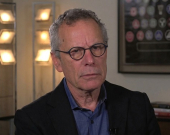
Professor Peter L. Hahn to Gulan: “Kurdish Interests Were Indeed Advanced and Protected More Than Ever Before”

Professor Peter L. Hahn is Distinguished University Professor of History Emeritus at The Ohio State University and one of the foremost scholars of U.S. diplomatic history in the Middle East. An accomplished historian, he has published nine books and scores of articles, essays, and reviews on U.S. foreign relations. His most recent books, both published in 2025, are the second edition of his best-selling Crisis and Crossfire: The United States and the Middle East since 1945 and Libya and the West: What Everyone Needs to Know. His scholarship draws on archival research conducted in the United States, Israel, Britain, and France, and he has delivered scholarly papers and invited lectures in eleven countries. He has also consulted with policymakers in the U.S. Departments of State, Defense, and Justice and with senior officers of the Ohio National Guard, while giving media interviews on six continents. Professor Hahn served as dean of Arts and Humanities at Ohio State from 2015 to 2021 and as chair of its Department of History from 2006 to 2015. He was executive director of the Society for Historians of American Foreign Relations from 2002 to 2015 and was elected its president in 2018. A Fulbright Senior Research Fellow in Jerusalem, he received SHAFR’s first annual prize for distinguished service in 2017; the honor was subsequently renamed the Peter L. Hahn Distinguished Service Award. In 2025, Ohio State’s Board of Trustees conferred on him the title of Distinguished University Professor, the university’s most eminent faculty recognition.
Gulan: In the new edition of Crisis and Crossfire, you trace the expansion of U.S. responsibility for security in the Middle East since the 1940s. Looking across this history, what has the United States most consistently misunderstood about the region, and what lessons should guide policymakers today?
Professor Peter L. Hahn: Naturally, U.S. policymakers favor their own security and economic interests and thus often fail to explore, understand, or advance the interests of other nations. Often, U.S. officials try to bend the will of a local state to U.S. interests. On some past occasions, they found ways to accommodate the competing interests of the Middle East state. At other times, U.S. efforts to shape Middle East developments led to conflict and instability between the United States and a regional people or government.
Gulan: Your book shows how U.S. policymakers repeatedly confronted Arab and Iranian nationalist movements, from the Cold War era through the Iranian Revolution and the Iraq war. Why have outside powers so often treated nationalism primarily as a threat to be contained, rather than a political force to be understood and engaged?
Professor Peter L. Hahn: Some U.S. officials considered nationalism to be a force that would challenge U.S. interests and/or advance the interests of America’s rivals. For instance, during the Cold War, many U.S. leaders feared that Middle East nationalism would facilitate the expansion of Soviet communist influence or threaten such U.S. interests as control of oil production. More recently, nationalism was suspected as a vanguard of Islamic militarism. U.S. officials who shared such views tended to favor suppressing nationalist movements.
Other U.S. officials expressed appreciation and understanding of Arab and Iranian nationalism. These officials observed that resisting nationalism would lead to turmoil damaging to the best interests of the United States and regional powers. They advocated for accommodation with nationalism including recognizing the autonomy of Middle East states and working with them in collaborative schemes.
The long history of U.S. involvement in the Middle East featured a constant tension between these two points of view within the United States.
Gulan: The Kurdish national movement has also shaped Iraq’s modern history, from the post-1991 protection of northern Iraq to the constitutional recognition of the Kurdistan Region after 2003. What does this experience reveal about the possibilities and limits of accommodating strong national identities within a federal Iraqi state?
Professor Peter L. Hahn: Prior to 1991, Kurdish interests tended to be undermined because global and regional superpowers denied their aspirations and viewed them as pawns in their own power struggles. Since 1991, first with the protections afforded under Operation Northern Watch and then in the post-Saddam power-sharing arrangements, Kurdish interests were indeed advanced and protected more than ever before.
Gulan: The 1991 Gulf War and the 2003 invasion of Iraq represented two very different forms of U.S. intervention. In your view, what are the most important lessons policymakers should draw from the contrast between them, particularly regarding military objectives, postwar planning, and political legitimacy?
Professor Peter L. Hahn: In the first Gulf War, the first President Bush defined a limited objective (the liberation of Kuwait), assembled an international coalition to pursue that aim with United Nations approval, and secured the strong support of the American people and Congress for the action undertaken. After liberating Kuwait and depleting Iraqi military power, Bush imposed a containment regime that limited Saddam Hussein’s warmaking capacity and latent destructiveness. That postwar strategy worked fairly well for more than a decade.
The second President Bush inherited the containment regime enacted by his father and continued by President Clinton. Shell-shocked by the 9/11 attacks, however, he concluded that Saddam posed a dire threat because of the fear that a resurgent Iraq might ally with terrorist groups. The second Bush thus launched a full- scale invasion of Iraq, with much less international and domestic support than that expressed in 1991. The 2003 objectives were much more sweeping: they included regime change in Baghdad, the permanent dismantling of Iraqi weapons of mass destruction programs, and, eventually, the building of democratic government and institutions in Iraq.
Gulan: Your book examines the interconnected effects of the Arab Israeli conflict, U.S. relations with Iran, and proxy conflicts in Lebanon, Yemen, Libya, and Syria. Why has the pursuit of a durable regional security order remained so elusive, despite decades of external engagement and diplomatic initiatives?
Professor Peter L. Hahn: At the intersection of three continents, the Middle East region is widely diverse in terms of ethnicity, culture, religion, and history. At the dawn of the modern era, the region was less developed economically than other parts of the world, and it featured a comparatively wide maldistribution of wealth and high birth rate. The combination of these factors generated conflict and instability that were accentuated in many cases by foreign intrusions.