Diplomacy Great Power Competition and the Kurdistan Region in Search of Balance

An exclusive interview with Iver B Neumann on diplomatic practice Russian power multipolarity and the strategic choices facing smaller political actors
In this exclusive interview for GULAN Weekly Magazine, Iver B. Neumann discusses the resilience of diplomacy, Russia's confrontation with Europe, the shape of multipolar order, Moscow's role in the Middle East, and the strategic choices facing the Kurdistan Region in an age of renewed great-power competition.
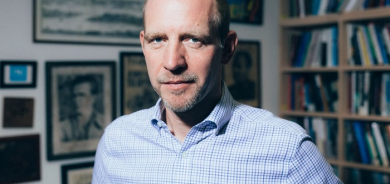
Iver B. Neumann is Director of the Fridtjof Nansen Institute and one of the most widely cited contemporary scholars of diplomacy, great-power politics, Russian foreign policy, Norwegian foreign policy, social theory, and international order. His official FNI profile records more than 21,000 Google Scholar citations and an h-index of 60, reflecting a body of work that has shaped debates across international relations, political anthropology, diplomacy studies, and security studies. He holds a D.Phil. in Politics from the University of Oxford and a Dr. Philos. in Social Anthropology from the University of Oslo. Neumann has served as Director of the Fridtjof Nansen Institute since 2019, and is also Adjunct Professor at the Norwegian Museum of Cultural History, University of Oslo. His previous positions include Montague Burton Professor of International Relations at the London School of Economics and Research Professor and Research Director at the Norwegian Institute of International Affairs. He is a member of the Norwegian Academy of Science and Letters and Academia Europaea, co-editor of Routledge's New International Relations series, and recipient of the 2020 Fridtjof Nansen Award for Outstanding Research. His recent books include Diplomatic Practices: How They Emerge and How They Matter, published by Routledge in 2026.
Gulan: In your 2026 book, Diplomatic Practices: How They Emerge and How They Matter, you examine how diplomatic practices emerge, become institutionalized, and help sustain international order. At a time when relations between major powers are becoming increasingly confrontational and coercion is playing a greater role in international politics, how resilient is diplomacy as an institution? Are we witnessing a transformation of diplomatic practice, or could prolonged great-power confrontation begin to weaken some of the norms and practices that have traditionally allowed rival states to manage their differences?
Iver B Neumann: There is definitely a weakening. The first Internstional Organisation emetged inn1815. A century later, we had two handfuls. Now we have at least 40.000 and perhaps as many as 200.000. This means that a lot of day to day work goes very smoothly indeed.. The investment in institutionalised, multilateral diplomacy has been the big changer. These structures are now weakening, but underneath the condpucuous cases of the US withdrawing from this and persecuting people working for that, the groundswell of activity continues.
Same with bilateral diplomacy. Trump’s US is strangling its own service and availing itself of amateur envois who do notceven take notes, but most services trundle on as before, and evolve new ways of interacting, like before.
I think the tendencyvto watch is how diplomacy becomes less state-to-state and more multi-actor, with state diplomats foing stuff with non-state actors, new actors energing and a netwirk dtructure becoming ever more apparent.
Gulan: Russia has increasingly combined conventional military force with cyber operations, sabotage, disinformation, political influence, and other measures that remain below the threshold of direct war with NATO. From your perspective on Russian statecraft, should these activities primarily be understood as instruments connected to the war in Ukraine, or do they reflect a more permanent Russian approach to confrontation with Europe? And how should European states respond without allowing this competition to escalate into a direct military conflict?
Iver B Neumann: Russia wants to be a great power and that means to be treated as such. It wants to be noticed, it wants to be taken into account and it wants great-power privileges. In order to achievecthis, it confrints Europe and makes itself almost fully dependent on China. It is a short-sighted policy. Europe should respond by simply going on foing what it is doing, and foing it better. More help to Ukraine. More integration. The USDR fell because it doent more on military force than it vould afford. Now we see the same process repeating itself. Don’t interrupt your opponent when he’s making a midtake.
Gulan: You have written extensively about great-power politics and Russia’s understanding of its place in the international system. With the United States increasingly focused on competition with China, Russia challenging the European security order, and other powers seeking greater strategic autonomy, are we moving toward a genuinely multipolar international order? If so, what kind of diplomatic mechanisms will be necessary to prevent great-power competition from producing a more unstable and fragmented international system?
Iver B Neumann: I think we are, with the axis US-China being key. One posdibility is that an old and tested indtitution in international relations, great powers working in concert, will become more important. Europe will want to defend the remnanrs of the old order. India wants to lead thise states that do not want to draw near to either the US or China. Small powers will run for regional shelter.
Gulan: Your research on Russian “repertoires of power” in the Middle East and North Africa examines how Moscow combines different political, military, diplomatic, and economic instruments to pursue influence in the region. Following the pressures created by the war in Ukraine and the changing balance of power in the Middle East, how sustainable is Russia’s role there today? Do you expect Moscow to remain an important regional actor, or will its capacity to compete with the United States, Europe, China, Turkey, and regional powers become increasingly constrained?
Iver B Neumann: In order to be counted as a great power, Russia needs a presence in each and every region of the world, but it cannot afford it. The partial loss of Syria was a catastrophe for Russia, symbolucally and logidtically. Russia will be looking for new allues and it eill offer weapons sales as a carrot.
Gulan: Iraq and the Kurdistan Region sit at the intersection of many of these competing relationships, involving the United States, Europe, Iran, Turkey, the Gulf states, Russia, and increasingly China. From the perspective of a smaller political entity operating within an environment of great-power competition, what diplomatic strategy would best allow the Kurdistan Region to protect its interests while avoiding excessive dependence on any single outside power? And could the Kurdistan Region’s long-standing relationships with Western states give it a constructive role as a diplomatic and political bridge between Europe and the wider Middle East?
Iver B Neumann: The Middle East tradition is to find a patron outside the region. With my admitted limited knowledge, I’d say that could prove catatrrophic for an actor with presence in anumber of different nstion states. Balancing is the obvious alternative.