KRG Council of Ministers Approves High-Level Permanent Coordination Committee to Resolve Outstanding Issues with the Federal Government
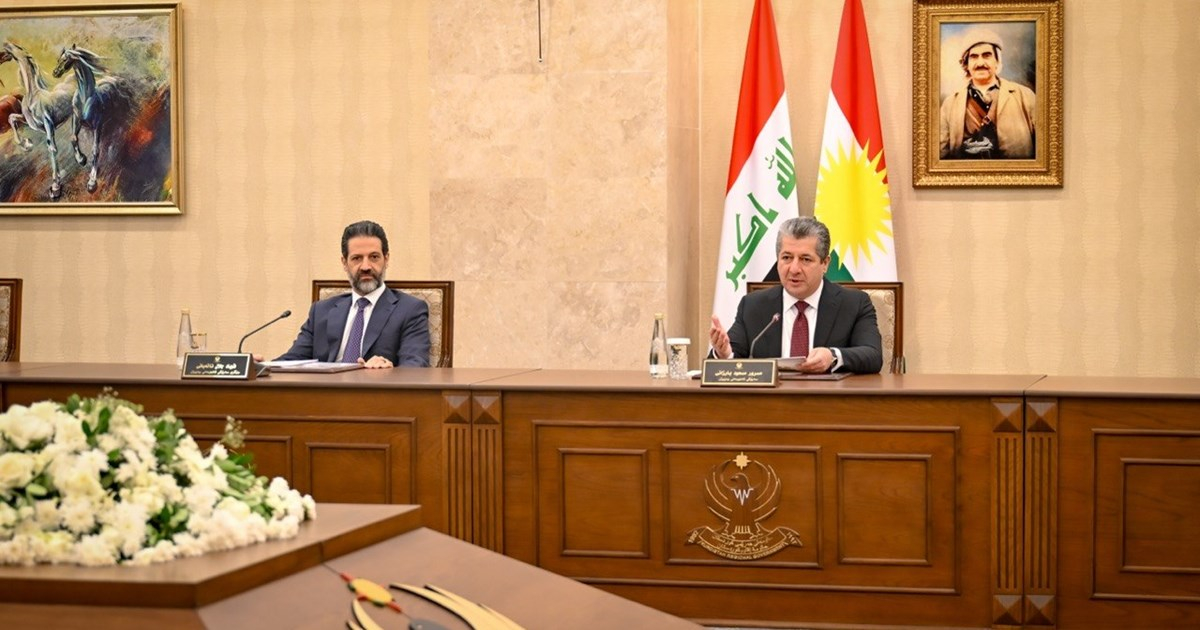
On Wednesday, 10 June 2026, Prime Minister Masrour Barzani chaired a session of the Kurdistan Regional Government (KRG) Council of Ministers, attended by Deputy Prime Minister Qubad Talabani.
In the first segment of the meeting, Prime Minister Barzani highlighted his recent visit to Baghdad, underscoring the importance of formulating a roadmap to sustain negotiations on the outstanding issues between the Kurdistan Region and the Federal Government. In this regard, he proposed the establishment of a high-level permanent coordination committee, comprising relevant ministers and officials from both governments.
Subsequently, Deputy Prime Minister Talabani emphasised the significance of establishing this committee, noting that it represents a critical step towards institutionalising a dispute-resolution mechanism between the Kurdistan Region and the Federal Government. He added that such a mechanism would play a constructive role in facilitating the resolution of outstanding bilateral issues.
Following comprehensive discussions and an exchange of views regarding the committee’s composition and mechanisms of operation, the Council approved the proposal and decided to submit it to the Federal Government for consideration and a joint decision.
In the second segment, the Council reviewed recent developments concerning the oil dossier with the Federal Government. The outcomes of recent meetings held between the KRG delegation, representatives of international oil companies, the Federal Prime Minister, and relevant Federal Government institutions were presented.
Kamal Mohammad Salih Khalil, Acting Minister of Natural Resources, along with members of the negotiating delegation, provided a detailed briefing on their discussions.
After deliberation, the Council of Ministers reaffirmed the Kurdistan Region’s firm position in supporting the new Federal Government, headed by Prime Minister Ali al-Zaidi, in addressing and mitigating the financial challenges facing Iraq resulting from recent regional instability. To this end, the Council instructed the Minister of Natural Resources and the negotiating delegation to expedite all necessary procedures to ensure that maximum oil export levels to global markets are achieved via the Kurdistan Region’s pipeline as swiftly as possible, with the generated revenues returned to the Federal Treasury. The Council also emphasised the continuation of joint and cooperative efforts to maximise federal revenues.
Furthermore, the Council reiterated that, following the Federal Government’s assurances to safeguard the security of the Region’s oil and energy sector and to compensate for any damages resulting from potential attacks on energy infrastructure, as emphasised by Federal Prime Minister al-Zaidi, it is imperative that oil companies commence scaling up production and resume exports in the coming days.
The Council then shifted its focus to the domestic revenues dossier, the implementation procedures for the ASYCUDA system within the Kurdistan Region, and the revenue tables, as well as the broader economic impacts of regional instability and the ASYCUDA transition, including the significant decline in the KRG’s public revenues and its subsequent effect on public sector salaries.
In this context, Awat Janab Noori, Minister of Finance and Economy, presented a comprehensive report detailing the Kurdistan Region’s general revenues for the first five months of 2026. The report highlighted a substantial decline compared to 2025, as reflected in the monthly trial balance, which is currently under audit by a joint team from the Federal Board of Supreme Audit and the Kurdistan Region Board of Supreme Audit. Consequently, an urgent request was made to the Federal Government to review the mandated allocation of IQD 120 billion designated as the Federal Treasury’s share. This review is essential given that the Region’s monthly revenue has declined by over 70 per cent due to the war, the complex geopolitical situation in the region, and the unresolved ASYCUDA implementation framework.
Concluding with the implementation of the ASYCUDA system at the Kurdistan Region’s border crossings, the Council stressed the urgent necessity for the Federal Council of Ministers for the Economy to approve, at the earliest opportunity, the preliminary understanding signed between both sides in April of this year. Resolving this critical dossier will enhance border crossing revenues, revitalise commercial activity, and stimulate the broader market, ultimately serving the supreme national interest of Iraq as a whole.