Pro-European Candidate Peter Magyar Wins Landslide Election in Hungary, Ending Viktor Orbán’s 16-Year Rule
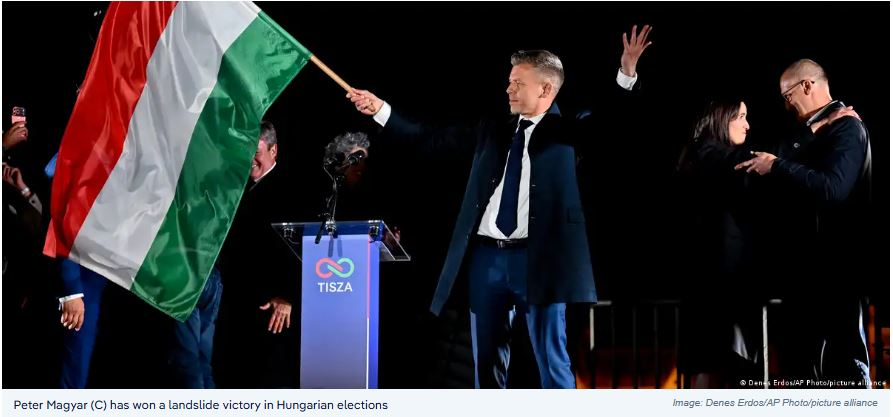
Hungarian voters delivered a decisive political shift on Sunday as pro-European candidate Peter Magyar secured a landslide victory in national elections, ending the 16-year rule of Prime Minister Viktor Orbán.
Magyar’s center-right Tisza Party is projected to win 138 seats in Hungary’s 199-seat parliament, surpassing the two-thirds majority needed to implement constitutional reforms. The result marks a dramatic political change for the Central European country after more than a decade of Orbán’s nationalist and authoritarian-leaning leadership.
According to Hungary’s National Election Office, voter turnout reached nearly 80%, the highest participation rate in any election since the fall of communism. Orbán conceded defeat before supporters in Budapest shortly after the results became clear.
In his victory speech, Magyar pledged to restore democratic checks and balances and rebuild Hungary’s relationship with the European Union and NATO, both of which had become strained during Orbán’s tenure.
“With the two-thirds majority allowing us to amend the constitution, we will restore the system of checks and balances,” Magyar told supporters.
He also promised that Hungary would join the European Public Prosecutor’s Office and strengthen transparency and anti-corruption measures.
Magyar stated that Hungary would “never again allow anyone to hold free Hungary captive,” emphasizing a renewed commitment to democratic governance and European cooperation. During the celebration in Budapest, many supporters chanted “Europe, Europe,” reflecting the country’s potential shift back toward stronger European integration.
Magyar has pledged reforms aimed at unlocking billions of euros in funding from the European Union that had been frozen due to concerns over rule-of-law violations and media restrictions under Orbán’s government.
He also expressed interest in eventually adopting the euro as Hungary’s national currency, though analysts say the new administration will need to demonstrate concrete reforms before EU funds are released.
Magyar is expected to adopt a more cooperative tone toward Ukraine and European partners, though he has maintained positions similar to Orbán on some issues. Like his predecessor, he opposes sending weapons to Ukraine and remains cautious about Ukraine’s rapid accession to the EU.
Under Orbán, Hungary maintained close relations with Russian President Vladimir Putin and often blocked EU initiatives supporting Ukraine following Russia’s full-scale invasion.
During election celebrations, some crowds in Budapest chanted “Ruszkik haza!” (“Russians go home”), echoing slogans from the Hungarian Revolution of 1956 against Soviet influence.
European leaders quickly welcomed the election results.
Ursula von der Leyen, President of the European Commission, wrote that “Europe’s heart is beating stronger in Hungary tonight.”
German Chancellor Friedrich Merz said the result sent a strong signal against right-wing populism, while French President Emmanuel Macron praised Hungary’s democratic participation. Spanish Prime Minister Pedro Sánchez described the vote as a victory for European values.
Ukrainian President Volodymyr Zelenskyy also congratulated Magyar, expressing hope for closer cooperation and regional stability.
Despite his pro-European platform, questions remain about Magyar’s policies on social issues, including LGBTQ+ rights, which were restricted under Orbán. During the campaign, Magyar largely avoided the topic but stated that he supports equality before the law.
With a strong parliamentary majority and high public expectations, Magyar now faces the challenge of translating campaign promises into reforms that could reshape Hungary’s political and economic future.