Syria Completes Integration of Kurdish Institutions, Abdi Says
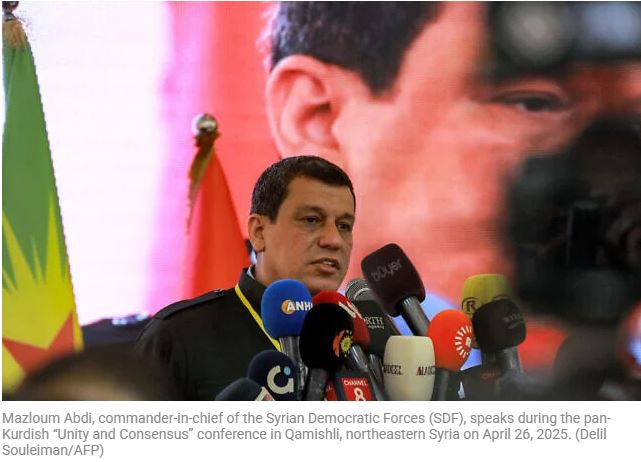
The integration of Kurdish military, security and administrative institutions into Syria’s state structures has been completed, Syrian Kurdish leader Mazloum Abdi said Thursday, signaling the end of the autonomous system that Kurds had built in northeastern Syria over more than a decade.
Abdi, commander of the Kurdish-led Syrian Democratic Forces (SDF), made the announcement at an event in Qamishli, saying the process had now entered a new phase focused on securing Kurdish rights through Syria’s constitution.
“The phase of integrating military, security and administrative institutions into national state institutions is complete,” Abdi said. “From now on, we begin a new phase.”
He added that the Kurdish struggle would continue to ensure that Kurdish rights are protected in the country’s constitution.
The announcement follows months of negotiations stemming from a January agreement between Abdi and Syrian President Ahmed al-Sharaa. The accord called for the incorporation of Kurdish civil and military institutions into the Syrian state and was described by Washington as a “historic” development.
The agreement came after clashes between Kurdish forces and forces loyal to the new Syrian authorities, during which Kurdish fighters lost control of significant territory in northern and northeastern Syria.
Under the deal, Damascus expanded its presence in Kurdish-held areas. Syrian government forces entered Hasakeh and Qamishli, while the central government assumed control of Qamishli airport and several key oil fields.
Kurdish figures have also taken positions within the new state administration. In February, Noureddine Ahmed Eissa, a Kurd from Qamishli, was appointed governor of Hasakeh. A month later, senior Kurdish military commander Sipan Hamo was appointed regional assistant defence minister.
The integration marks a major shift for Syria’s Kurds, who established a largely self-governing administration during the Syrian civil war. The SDF, created in 2015 with US support, became Washington’s principal local partner in the fight against the Islamic State group.
The force grew to roughly 100,000 fighters at its peak, according to Abdi, and included both Kurdish and Arab combatants. Its forces played a central role in defeating Islamic State territorial control in Syria.
However, the SDF subsequently lost significant territory and personnel after forces aligned with the Damascus government seized the provinces of Raqa and Deir Ezzor. Syria specialist Fabrice Balanche has estimated that the force was left with roughly half its previous strength.
The changes also come amid a broader reduction in US military support for the Kurdish administration. US forces have transferred more than 5,700 Islamic State detainees from camps formerly controlled by the SDF to neighboring Iraq.
For Syria’s Kurdish population, the agreement represents both a political gain and a major concession. Successive Syrian governments had restricted Kurdish cultural and political rights, including the use of the Kurdish language and the celebration of Kurdish cultural occasions. In 1962, a controversial census resulted in the loss of citizenship for a significant number of Syrian Kurds.
The new Syrian administration has taken steps to recognize Kurdish rights, including a decree issued in January recognizing Kurdish as a national language and affirming national rights.
Yet the incorporation of Kurdish institutions into the Syrian state effectively ends the autonomous model that had governed much of northeastern Syria.
“Dissolving the SDF means a bitter end,” Washington-based Kurdish affairs analyst Mutlu Civiroglu told AFP, describing the force as a successful military organization that had repeatedly defeated Islamic State militants.
For Damascus, the integration strengthens central state authority. For the Kurds, however, the next battle is likely to shift from the military and administrative sphere to constitutional negotiations over the extent of Kurdish political, cultural and linguistic rights within a unified Syrian state.