Iran Accelerates Secret Nuclear Site Construction After Devastating Airstrikes, Satellite Imagery Shows
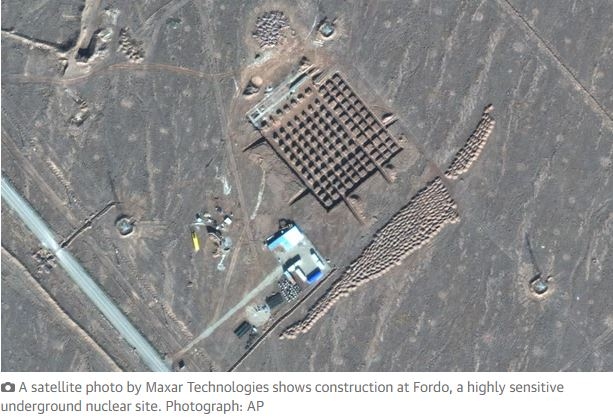
In the wake of devastating U.S. and Israeli military strikes that crippled its primary nuclear facilities in June, Iran has significantly accelerated construction at a mysterious, deeply buried underground complex, according to a new analysis of satellite imagery. The activity suggests Tehran is moving to protect and potentially rebuild sensitive elements of its nuclear program.
The increased work is focused on a site known as Kuh-e Kolang Gaz La, or "Pickaxe Mountain," located just south of the heavily damaged Natanz enrichment plant. A comprehensive review of satellite imagery by The Washington Post, supported by independent experts, reveals that the fortified mountain site—never visited by international inspectors—is seeing rapid development despite the recent attacks.
The imagery points to three major changes since the June 22 strikes: the near-completion of a massive security perimeter, the reinforcement of a tunnel entrance with dirt and rock to harden it against airstrikes, and a clear increase in excavated earth, indicating ongoing tunneling deep inside the mountain.
"The fact they’re continuing to build this is significant," Sarah Burkhard of the Institute for Science and International Security (ISIS) told The Post.
The purpose of the Pickaxe Mountain facility remains officially unconfirmed. Iran initially stated in 2020 that it would house a new centrifuge assembly plant to replace a destroyed surface-level site at Natanz. However, the vast scale and depth of the complex—with halls estimated to be buried 260 to 330 feet underground—have led to speculation that it is intended for a far more sensitive role, such as a new covert enrichment facility or a secure storage site for Iran's stockpiles of near-weapons-grade uranium.
The acceleration at Pickaxe Mountain follows a report from ISIS on September 8 that concluded the June attacks had destroyed or rendered inoperable all of Iran's nearly 22,000 centrifuges at its known facilities in Natanz, Fordow, and Isfahan. "For the first time in over 15 years, Iran has no identifiable route to produce weapon-grade uranium … in its centrifuge plants," the report stated.
While President Trump claimed Iran's nuclear capabilities were "totally obliterated," secret U.S. intelligence assessments have been more cautious. The uncertainty extends to the fate of Iran's pre-strike stockpile of nearly 900 pounds of uranium enriched to 60% purity—a short step from weapons-grade. The International Atomic Energy Agency (IAEA) believes the material is now buried underground, but its exact location and accessibility remain unknown.
Analysts suggest the accelerated work at the hidden Pickaxe Mountain site indicates Iran is adapting its strategy to avoid future strikes. "Post attack, Iran may have decided to enlarge the facility to move additional activities underground," said Jeffrey Lewis, a nuclear expert at the James Martin Center for Nonproliferation Studies.
Iran's intentions are further clouded by its wavering cooperation with the IAEA. Although a agreement for renewed access was reached on September 9, senior Iranian official Ali Larijani threatened this week to end cooperation if sanctions are reimposed. When asked about Pickaxe Mountain, Larijani gave an ambiguous reply, stating, "We haven’t abandoned any of those locations. But in the future they could possibly continue to run as they currently do or be shut down."
The White House stated it is monitoring the situation closely. "The administration will continue to monitor any attempt by Iran to rebuild its nuclear program. As President Trump has said, he will never allow Iran to obtain a nuclear weapon," an official told The Post.