German Parliamentary Delegation Arrives in Erbil for High-Level Talks on Kurdish Affairs and Regional Stability
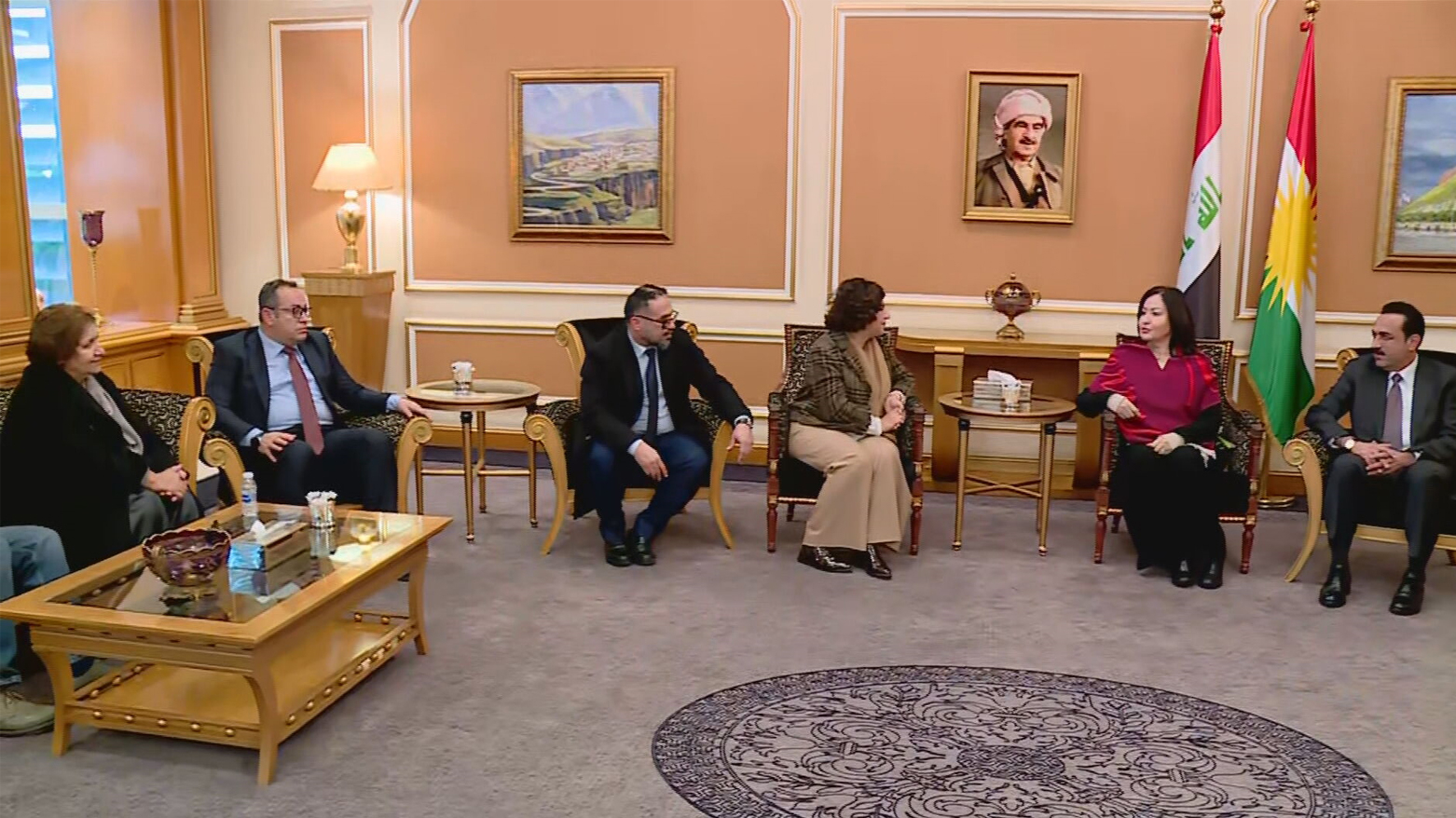
A delegation of German parliamentarians, led by Berivan Eymaz, deputy speaker of North Rhine-Westphalia’s regional parliament, arrived in Erbil on Saturday for a series of high-level meetings with leaders of the Kurdistan Region.
The delegation was received upon arrival by Erbil Governor Omed Khoshnaw, along with Kurdish lawmakers including Vala Farid and other members of the Kurdistan Parliament.
Renas Jano, a diaspora representative at the Barzani Headquarters, said the visit follows a detailed agenda that includes meetings with Kurdistan Democratic Party leader Masoud Barzani, Kurdistan Region President Nechirvan Barzani, and Prime Minister Masrour Barzani.
According to officials, the German delegation is also expected to tour several Kurdistan Regional Government (KRG) institutions. Discussions will focus primarily on developments in Western Kurdistan (northeastern Syria) and on strengthening political, diplomatic, and friendly relations between the Kurdistan Region and Germany.
The visit highlights ongoing efforts by both Erbil and Berlin to deepen cooperation in political, economic, and diplomatic fields, particularly in the context of regional stability and Kurdish-German relations.
The Kurdistan Region has long positioned itself as a key actor in promoting security and stability in Iraq and the wider Middle East, serving as a reliable partner for international stakeholders and, at times, a mediator in regional disputes.
In recent years, especially amid evolving dynamics in Western Kurdistan, the KRG has played an active role in supporting civilian protection, coordinating humanitarian assistance, and encouraging dialogue among local and international actors. The deployment of Peshmerga forces to assist the Syrian city of Kobani in 2014, along with sustained diplomatic engagement by KRG leadership, has been widely viewed as a significant stabilizing contribution during and after the fight against ISIS.
More recently, the KRG has used its political influence to advocate ceasefires, promote cross-border coordination, and support constitutional and civil rights for Kurdish populations in Syria, reinforcing its role as a trusted interlocutor in a volatile regional environment.
The German visit comes shortly after a major development in Syria. On Friday, the Syrian Democratic Forces (SDF) and the Syrian government announced a comprehensive agreement aimed at ending hostilities and integrating military, security, and administrative structures in Western Kurdistan.
The agreement includes a full ceasefire, the withdrawal of forces from front lines, and the deployment of Syrian Interior Ministry units to the cities of Hasakah and Qamishlo. It also provides for the formation of a new military division comprising three SDF brigades and a special Kobani brigade under Aleppo province.
Administratively, institutions of the Democratic Autonomous Administration are to be placed under Syrian state authority, with provisions to ensure the continuation of civil services, the protection of Kurdish civil and educational rights, and the return of internally displaced persons.