Half of Runaki households in Kurdistan were billed less than 27,000 IQD in August
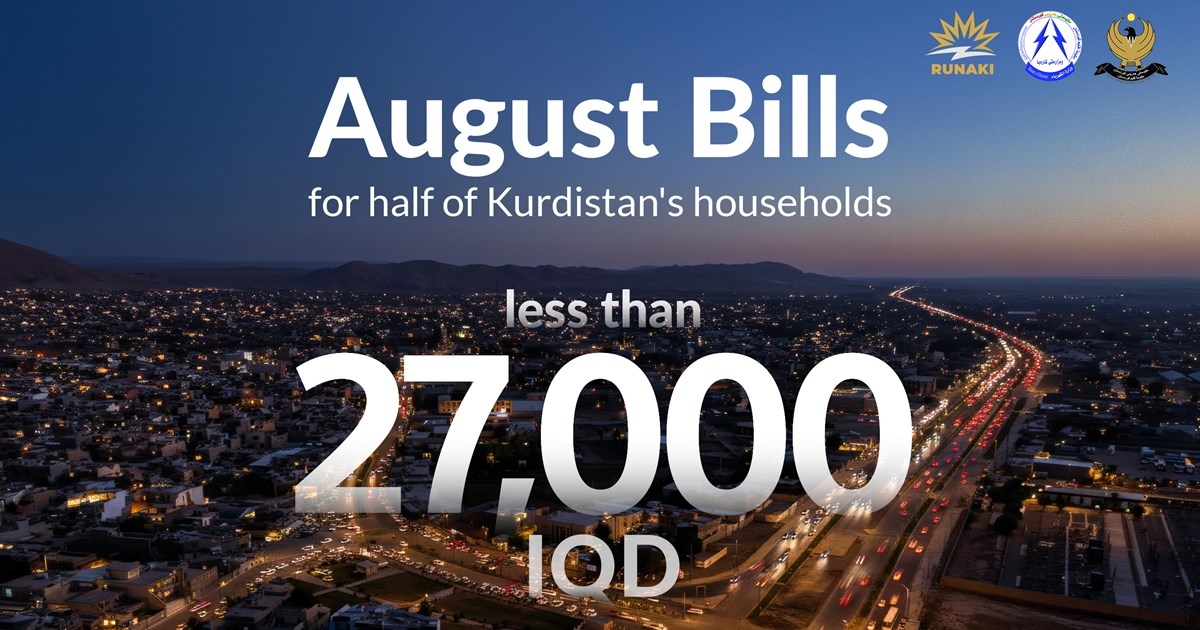
The Ministry of Electricity is pleased to announce that households and businesses under the Runaki programme received record-low electricity bills for August.
Across the Kurdistan Region, households in Slemani’s city centre received the lowest billed amounts.
Table 1: half of Runaki households and businesses paid less than the following in August
Kurdistan 27,000 IQD Households 79,000 IQD Businesses
Erbil 37,000 IQD Households 88,000 IQD Businesses
Slemani 15,000 IQD Households 72,000 IQD Businesses
Duhok 38,000 IQD Households 67,000 IQD Businesses
Table 2 The number of citizens and businesses currently on Runaki by governorate
Kurdistan 3,770,000 Citizens 120,000 Businesses
Erbil 1,935,000 Citizens 61,000 Businesses
Slemani 1,345,500 Citizens 35,000 Businesses
Duhok 351,000 Citizens 20,000 Businesses
Halabja 139,000 Citizens 4,000 Businesses
To date, nearly 4 million people across the Kurdistan Region, or more than 50% of the population, enjoy access to 24-hour electricity.
Based on the data available from Runaki, around 80% of households, and in particular low-income households, pay less now than they previously did for the national grid and neighbourhood diesel generators combined.
Prime Minister Masrour Barzani announced the Runaki programme in October 2024. The KRG Council of Ministers unanimously adopted the programme and new progressive tariffs in May 2025.
The KRG is planning to deliver 24-hour electricity to every home and business in the Kurdistan Region by the end of 2026. All major city centres in Kurdistan already enjoy 24-hour access to electricity.