Jailed PKK Leader Ocalan Reaffirms End to Armed Struggle, Calls for Legislative Peace Commission
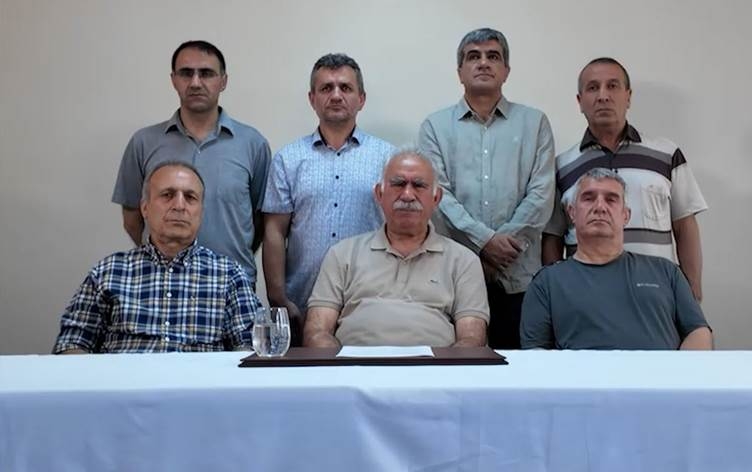
In a pivotal video message released on Wednesday, Abdullah Ocalan, the imprisoned leader of the Kurdistan Workers’ Party (PKK), reiterated the group’s historic abandonment of armed struggle and urged the formation of a legal commission to oversee peace negotiations with the Turkish state.
The message, recorded on June 19, described the current moment as a “highly valuable and historic” opportunity, reaffirming Ocalan’s February appeal for a peaceful resolution to the decades-long Kurdish conflict. He called on PKK members to fully embrace political avenues for securing Kurdish rights, moving away from armed resistance.
In May, the PKK officially declared its adherence to Ocalan’s peace call—a decision he praised as a “historic response.” The jailed leader explicitly declared an end to the PKK’s national liberation war strategy, stating that armed struggle had become an “excessive repetition and a dead end” following the recognition of Kurdish identity.
Ocalan credited recent discussions with Turkey’s pro-Kurdish Peoples’ Equality and Democracy Party (DEM Party) for facilitating the shift, emphasizing that the talks were held “on the basis of free will.” The DEM Party has spearheaded a months-long peace initiative aimed at resolving the 40-year conflict, which has claimed over 40,000 lives, mostly PKK fighters. Ankara has framed the initiative within its broader “Free-Terror Turkey” campaign.
Ocalan revealed that a “manifesto for a democratic society” has been prepared, marking a “historic turning point.” He outlined the next steps, including “voluntary disarmament” and the establishment of a legally authorized parliamentary commission to oversee the peace process.
The PKK leader stressed that the group has now abandoned its goal of establishing a Kurdish nation-state, transitioning instead toward “democratic politics and law.”
In late June, the DEM Party informed Rudaw that it plans to propose a 40 to 50-member parliamentary commission to formalize the peace process. Ocalan’s latest message reinforces this push, underscoring the need for legal and political frameworks to ensure lasting peace.
Ocalan emphasized the interdependence of individual and societal freedom, stating: “Society can be free to the extent that the individual is free, and the individual can be free to the extent that society is free.”
Expressing confidence in “the power of politics and social peace, not weapons,” he called for the full implementation of the peace plan.
The timing of Ocalan’s message is significant, coming just days before a scheduled disarmament ceremony on Friday, July 11, in Sulaimani province, in the Kurdistan Region of Iraq. The event is expected to see the first group of 30 to 40 PKK fighters formally lay down their arms and destroy their weapons.
Founded in 1978, the PKK initially sought an independent Kurdish state but has shifted focus in recent decades toward securing political and cultural rights for Kurds in Turkey. The group is designated as a terrorist organization by Turkey, the U.S., and the EU.