Kurdish National Council and SDF Unite to Address Kurdish Rights in Syria’s Constitutional Framework
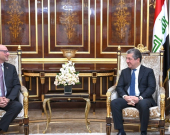
A delegation from the Kurdish National Council in Syria (KNCS) met with Syrian Democratic Forces (SDF) Commander Mazloum Abdi on Thursday to discuss recent political developments, including Syria’s newly announced constitutional declaration. KNCS spokesperson Faisal Yusuf confirmed the meeting, stating that both sides exchanged views on the evolving political situation in the country.
The talks focused on an agreement between Syrian President Ahmed al-Sharaa and Abdi, which seeks to address the legal and political status of Syria’s Kurdish population. As a key outcome of the discussions, the KNCS and SDF agreed to form a unified delegation to negotiate with Syrian authorities in Damascus. The delegation’s primary objective will be to ensure that Kurdish rights are recognized in Syria’s future political framework.
The recent constitutional declaration by the Syrian government has drawn criticism from ethnic and religious minorities, including the KNCS, which argues that the document fails to acknowledge Syria’s pluralistic identity. The council stated that the declaration does not reflect "the aspirations of a multi-ethnic and multi-religious Syria," particularly neglecting the rights of Kurds, Assyrians, and Syriacs.
The Democratic Autonomous Administration of North and East Syria (DAANES), which governs Kurdish-majority regions, has also voiced strong concerns. In an official statement, DAANES condemned the declaration for not explicitly recognizing the political, cultural, and linguistic rights of Syria’s diverse communities. Kurdish officials fear the new framework could undermine their hard-won autonomy.
The KNCS-SDF meeting marks a strategic effort to consolidate Kurdish representation in future negotiations with Damascus. As political tensions rise over the constitutional declaration, Kurdish groups are seeking a unified approach to secure a more inclusive and equitable political resolution that reflects Syria’s ethnic and religious diversity.
The formation of a joint delegation signals a significant step toward strengthening Kurdish advocacy in Syria’s political landscape. However, the path to achieving recognition of Kurdish rights remains fraught with challenges, as Damascus has historically resisted granting greater autonomy to minority groups.
The international community is closely monitoring the situation, with many urging Syrian authorities to engage in meaningful dialogue with all stakeholders to ensure a lasting and inclusive political solution.