Turkish court sentences journalist Can Dundar to nearly three decades
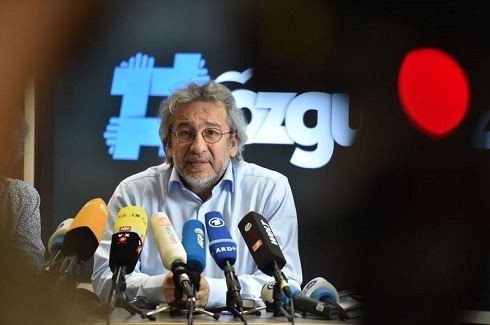
Dundar was sentenced to 18 years and nine months for obtaining state secrets for the purpose of political or military espionage.
However, he was acquitted of the allegations of "disclosing" secret information.
The court also sentenced him to an additional eight years and nine months for supporting an armed terrorist organization, without being a member.
The former editor-in-chief of Turkish newspaper Cumhuriyet fled to Germany in 2016 and was tried in absentia.
"This was a decision we expected. Because, we all live to see the cost of doing journalism in Turkey. I am not the first of these [examples] and probably will not be the last," Dundar told Turkish broadcaster Arti TV.
"These are the results of an unending anger and feeling of revenge. It has nothing to do with justice. These are entirely political decisions taken with a sentiment of political revenge," he added.
"We knew that this would not be a fair trial," Dundar's lawyer Abbas Yalcin told dpa. He described the verdict as politically motivated, citing President Recep Tayyip Erdogan's recent remarks targeting the journalist.
Yalcin also said the defence will appeal against the ruling at Turkey's Supreme Court of Appeal.
Dundar said that "we do not find a sentence given by such a guillotine of judiciary or a hitman of Erdogan as lawful."
German Foreign Minister Heiko Maas called the verdict "a hard blow for independent journalistic work in Turkey."
"Journalism is an indispensable service to society - also and especially when it takes a critical look at those in power," he tweeted.
The court has demanded Dundar's arrest and repatriation.
To call Dundar "a journalist — and his sentence, a blow to free speech — is an insult to real journalists everywhere," said Fahrettin Altun, Erdogan's communications director.
"Instead of endorsing his crimes, our counterparts should extradite him to Turkey," Altun tweeted.
The trial centres around Cumhuriyet's coverage in 2015 of Turkish intelligence sending arms shipments in trucks to Islamist rebels in Syria.
In 2014, gendarmerie officers stopped National Intelligence Service (MIT) trucks at the Turkish border town of Hatay on their way to Syria, in defiance of government orders.
The officers were accused of links to US-based Islamic cleric Fethullah Gulen, and some of them were handed jail sentences in 2019 related to the truck incident.
Ankara blames Gulen for a coup attempt in 2016 by a faction in the military and labels his movement a terrorist group.
Dundar's lawyers were not present at the hearing in Caglayan courthouse, saying they did not "want to be part of a practice to legitimize a previously decided, political verdict."
In October, the court declared Dundar a fugitive, seizing all his assets in Turkey.