China slams 'gross interference' in Hong Kong by US, Britain, EU
China expressed "strong dissatisfaction and resolute opposition" to statements made by the United States, Britain and the European Union in support of Hong Kong protesters, according to a statement released Tuesday by the Chinese Foreign Ministry's office in Hong Kong.
"When large-scale demonstrations took place in your country, police did not hesitate to dispatch explosion-proof vehicles, high-pressure water [cannon], batons, tear gas, rubber bullets ... but why are you so tolerant of violent criminals in Hong Kong?" it said.
Beijing believes other countries are using human rights as a "false veil" for interference in internal affairs and urged foreign governments to "immediately stop their wrong words and deeds."
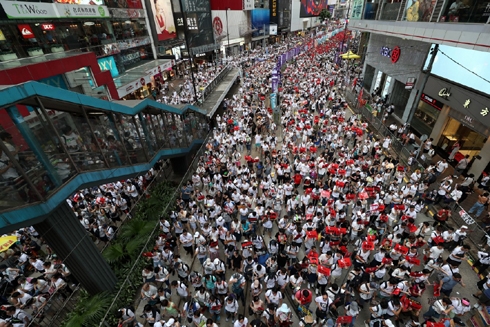
Beijing also condemned protesters who broke in and vandalized the Hong Kong government offices on Monday, amid continuing tumult surrounding a controversial extradition bill that has brought millions to the streets.
The Hong Kong Liaison Office said in a statement that protesters’ "atrocities are a great provocation and trampling of the rule of law ... and cannot be tolerated."
The Chinese government said it supported the Hong Kong government and police in investigating the violent protesters and restoring social order.
The rebuttal came hours after hundreds of demonstrators stormed the Legislative Council, occupying the building after destroying the glass front and parts of a fence.
They were part of a massive anti-government protest and gained entry after hours of battering doors and glass panels with metal poles and other items.
Once inside, they spray-painted slogans on the walls and trashed parts of the interior.
The violence took place on the 22nd anniversary of the July 1, 1997, handover of the former British colony to China.
Hong Kong Chief Executive Carrie Lam early Tuesday criticized the violence, drawing a distinction between good and bad protesters.
"We have seen two entirely different public scenes," she said. One was a "regular march on July 1" which she described as "peaceful and generally orderly."
"The second scene that we have seen, which really saddens a lot of people and shocks a lot of people, is the extreme use of violence and vandalism by protesters who stormed into the Legislative Council building over a period of time," Lam said.
"Nothing is more important than the rule of law in Hong Kong," the chief executive stressed. She said those responsible for violently entering the building and vandalizing the interior would be punished.
There have been no immediate reports of arrests in the wake of the violence. Thirteen police officers were injured, officials said.
Lam reiterated that the contested bill allowing the extradition of criminals to mainland China had been suspended and is not coming back for consideration by lawmakers.
"By suspending the bill at this point in time with no timetable and no plan to resume the debate of the bill in the Legislative Council, the bill will expire, or the bill will die in July 2020 when the current LegCo term expires," Lam added, according to a transcript of the press conference.
Every year a march takes place on July 1 to protest against the Chinese government. This year's anniversary was particularly tense due to demonstrations against the extradition bill.
Hong Kong is a special administrative region of China and was guaranteed autonomy until 2047 when it returns to Chinese sovereignty.
With the extradition bill, opponents see the long arm of Beijing interfering in Hong Kong's domestic politics.
The bill, known as the Fugitive Offender’s Ordinance, was introduced following a case last year when a local man allegedly killed his pregnant girlfriend while on holiday in Taiwan, but could not be extradited as Taipei and Hong Kong do not share an extradition agreement.
It would allow Hong Kong to extradite to jurisdictions where it does not maintain a long-term extradition agreement on a case-by-case basis.
The bill has sparked three major marches, two of them peaceful with participants numbering in the millions. Another march on June 12 saw police deploy pepper spray, rubber bullets and tear gas against protesters.