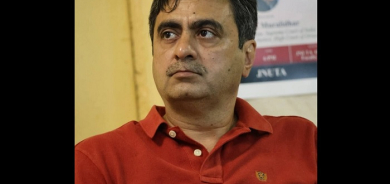
Dr Andreas Krieg to GULAN: The Kurdistan Region Should Be “Indispensable to Everyone, Threatening to No One”

By Kobin ferhad
In an exclusive interview with GULAN Weekly Magazine, Dr Andreas Krieg examines the emerging security order in the Gulf and wider Middle East, the growing importance of regional security partnerships, the changing relationship between Iran and aligned armed groups, and the challenges facing Iraq as it seeks to strengthen state sovereignty.
He also discusses how Iraq could transform itself from an arena of regional competition into a strategic bridge and argues that the Kurdistan Region can turn its geographic exposure into strategic relevance by becoming “indispensable to everyone, threatening to no one.”
About Dr Andreas Krieg
Dr Andreas Krieg is a Senior Lecturer in Defence Studies at King’s College London and a Fellow at the university’s Institute of Middle Eastern Studies. With more than a decade of experience living, studying and working across the Middle East and North Africa, his academic and professional career combines rigorous security research with extensive first-hand engagement in the region.
His research focuses on some of the most consequential questions shaping contemporary Middle Eastern security, including Gulf security, violent non-state actors, network-centred statecraft, information warfare, security-sector reform, surrogate warfare and the evolving relationship between states and armed non-state actors.
Dr Krieg has also worked in Qatar in connection with defence cooperation between the United Kingdom and Qatar, contributing to professional military education and the development of Qatar’s Joint Command and Staff College.
He is the co-author, with Jean-Marc Rickli, of Surrogate Warfare: The Transformation of War in the Twenty-First Century, editor of Divided Gulf: The Anatomy of a Crisis, and author of Subversion: The Strategic Weaponization of Narratives, alongside other publications examining security, conflict and political order in the Arab world.
A frequent commentator on Middle Eastern security and geopolitics, Dr Krieg’s work has contributed extensively to debates surrounding the changing nature of power, security partnerships and conflict across the Gulf and wider Middle East.
GULAN: In your recent comments to Al Jazeera, you said that the old Gulf security model, with Washington at the centre, is gradually being replaced by greater “horizontal connectivity” among regional powers. Does the new defence partnership between Saudi Arabia, Türkiye and Pakistan represent the beginning of a genuinely regional security order, or does it remain dependent on American intelligence, technology and military protection?
Dr Andreas Krieg: It is the beginning of a genuinely regional order, but it is not yet a genuinely autonomous one. I would describe the Makkah agreement as a prototype of regional security ownership rather than a finished alliance. Its greatest significance is political. Three important regional states have declared that security relationships no longer have to run vertically through Washington. They can also run horizontally between regional capitals.
The agreement is more important as a precedent than as an immediately deployable military architecture. It contains a collective-defence commitment and its members have announced plans for ministerial coordination, joint exercises, defence-industrial cooperation, technology development, maintenance and logistics. But these mechanisms have not yet been tested in a major crisis. There is no integrated command comparable to NATO, no mature common operational picture and no settled answer to what kind of attack would trigger which form of assistance.
The partnership will remain dependent on the United States for high-end intelligence, strategic surveillance, space-based sensing, some missile-defence architecture, strategic lift and replenishment of particular munitions. Türkiye's continued reliance on Washington to arbitrate its confrontation with Israel in Syria also demonstrates that American political and military leverage has not disappeared.
But dependence and autonomy are not binary conditions. The real question is whether American capabilities remain a veto over regional action or become an enabling layer that regional governments can use without surrendering control of their political priorities.
The Makkah partnership becomes a real security institution when its members can respond to an attack without first waiting for Washington to define the event, attribute responsibility and decide what level of retaliation is acceptable. That requires permanent liaison structures, common early-warning procedures, pre-agreed defensive force packages, shared logistics, credible consultation mechanisms and defence-industrial supply chains that can survive political disruption.
It is not an Islamic NATO, nor should it try to become one. The emerging Middle Eastern order will not be organised around a single threat or a rigid division into blocs. Saudi Arabia is primarily concerned about Iranian coercion and critical infrastructure. Türkiye increasingly sees Israel and instability in Syria as the more immediate strategic problems. Pakistan remains fundamentally preoccupied with India.
Their cooperation will consequently be modular rather than automatic. They will align where their interests overlap and retain room for independent action elsewhere.
GULAN: In your July 2026 analysis of the Strait of Hormuz, you argued that military coercion alone cannot secure the waterway and called for a Gulf-led framework combining Qatari diplomacy, Oman’s maritime role and Saudi engagement with Iran. What would make such a security arrangement credible and enforceable, particularly when Gulf states continue to differ in how they perceive Iran?
Dr Andreas Krieg: A credible Hormuz arrangement must include Iran. Any framework designed against Iran will reproduce the security dilemma that made the Strait vulnerable in the first place. Military forces can escort vessels and clear mines, but they cannot permanently secure a waterway when one of its two principal littoral states believes disruption is its most effective strategic leverage.
The emerging Iran-Oman maritime understanding may be useful as immediate crisis management, but a bilateral traffic arrangement is not a regional security order. It can create a corridor, establish temporary navigational procedures and buy diplomatic time. It cannot resolve the wider confrontation over sanctions, military deployments, freedom of navigation, attacks on shipping and Iran's use of the Strait as an instrument of coercion.
A durable framework would need five foundations.
First, the participants must agree on prohibited conduct: no mining of recognised shipping lanes, no toll-taking outside internationally recognised arrangements, no seizure of commercial vessels for political leverage, no deliberate attacks on civilian shipping and no use of ostensibly commercial vessels for covert military activity. Gulf governments do not need a common definition of Iran. They need a common definition of unacceptable behaviour.
Second, there must be a shared maritime picture. Oman should provide much of the operational maritime leadership, but it cannot be the sole interpreter of events. A permanent information and incident centre should combine radar, automatic identification system data, satellite imagery, naval liaison officers and commercial shipping information. Iran, Oman, Saudi Arabia, the UAE, Qatar, Kuwait, Bahrain and Iraq should all be represented. Verified attribution is essential because ambiguity and deniability are themselves weapons in the Strait.
Third, enforcement must be graduated and agreed in advance. Violations should trigger an investigation, public attribution, compensation and arbitration, followed where necessary by restrictions, collective escort arrangements or targeted defensive measures. Consequences cannot be improvised after every incident because political differences will otherwise paralyse the system.
Fourth, Iran must receive a stake in compliance. This does not mean conceding Iranian sovereignty over international navigation. It means recognising Iran as a legitimate security actor in the waterway, providing economic incentives for uninterrupted transit and connecting maritime restraint to a wider process of sanctions relief and regional de-escalation. An arrangement based entirely on threats will eventually fail because Tehran will continue to regard disruption as more valuable than compliance.
Fifth, external powers should support the system without owning it. The United States, China, Europe, India and other major trading actors could provide surveillance, demining, insurance and technical support. They should not determine the rules on behalf of the littoral states.
Qatar's role should be political rather than naval. Doha can convene the actors who do not trust one another, provide financial guarantees or escrow arrangements, facilitate compensation mechanisms and maintain channels during crises. Oman brings maritime geography and institutional knowledge. Saudi Arabia brings the political and economic weight necessary to make a Gulf bargain consequential. The UAE brings commercial and port expertise. Iran brings the capacity either to sustain or destroy the arrangement.
GULAN: Much of your research examines network-centred statecraft, in which influence is exercised through military partnerships, economic interdependence, ports, technology, information and informal relationships. In the emerging Gulf order, which of these instruments will matter most, and are traditional military alliances becoming less important?
Dr Andreas Krieg: The decisive instrument will be control over connectivity. By that I mean the ability to see, route, finance, protect and, where necessary, redirect the flows on which other actors depend.
Information will be the first component. In a region dominated by missiles, drones, cyber operations, covert networks and deniable armed groups, the actor that identifies an attack, attributes responsibility and establishes the first credible narrative gains an enormous advantage. Intelligence, surveillance, commercial data, satellite access and information credibility will matter as much as the weapon used to intercept the attack.
Infrastructure will be the second component. Ports, pipelines, airlines, electricity grids, data centres, fibre-optic cables, payment systems, insurance markets and logistics corridors are no longer secondary economic assets. They are the physical architecture of regional power. A state that controls a crucial port, energy route or financial gateway acquires leverage without having to issue a threat. It can provide access, create redundancy, impose friction or become so indispensable that disrupting it becomes prohibitively costly. This is the essence of network-centred statecraft.
Technology and defence industry will be the third component. Regional states are discovering that purchasing advanced platforms does not necessarily create autonomous power. Power comes from maintenance, munitions, software, training, integration and the ability to adapt systems locally.
The most consequential part of the Saudi-Turkish-Pakistani partnership may consequently be industrial rather than operational. Joint production, counter-drone technology, electronic warfare, autonomous systems and maintenance networks could create lasting interdependence even when the three states disagree politically.
Informal relationships remain equally important. Formal alliances often stop at the boundary of politically acceptable engagement. Informal channels can connect governments to armed groups, adversaries and actors who cannot publicly meet. Qatar, Oman, Iraq and the Kurdistan Region derive much of their potential influence from their ability to bridge such structural gaps.
Traditional military alliances are not disappearing. They are becoming less sufficient and less exclusive. Hard power remains the firewall that prevents coercion from becoming conquest. But alliances will increasingly be modular, issue-specific and nested inside wider networks. A state may cooperate with one partner on missile defence, another on maritime security, another on technology and another on mediation.
GULAN: Iran-aligned armed groups are frequently described as members of a single proxy network. However, many of these groups have developed their own political, military and economic interests. Are they becoming more autonomous from Tehran, and how does this transformation complicate deterrence, negotiation and regional de-escalation?
Dr Andreas Krieg: Yes. They are becoming more autonomous, and the conventional proxy label now obscures more than it explains.
Autonomy does not mean separation from Iran. Tehran remains an important source of weapons technology, training, finance, political support and strategic narrative. But Hezbollah, the Houthis and Iraqi armed factions have developed their own constituencies, revenue streams, political institutions, commercial interests and calculations of survival. Their relationship with Tehran increasingly resembles a network of strategic partners rather than a simple patron issuing orders to dependent clients.
Iran's network works through broad mission command. Tehran provides an ideological frame, technical capabilities and a general strategic direction, while individual nodes decide how, when and where to act. They frequently act independently but in broad alignment. During moments of acute pressure, local actors do not automatically sacrifice their own position to rescue Iran. They calculate the costs for their own leaderships, communities and political projects.
The paradox is that weakening Tehran can make parts of the network less controllable rather than immediately less dangerous. A node deprived of Iranian funding may develop new criminal economies, seek alternative sponsors or behave more aggressively to demonstrate its relevance. Decapitation of the hub does not automatically switch off the network.
This complicates deterrence because punishment directed at Tehran may not stop an autonomous local actor. Equally, attacking a local faction may not alter Iran's strategic calculations. Deterrence must operate at several levels simultaneously. Tehran must be held responsible for the capabilities and strategic support it supplies. Individual groups must face consequences tailored to their local assets and interests. Host governments must also be incentivised and pressured to control armed activity conducted from their territory.
Negotiation must follow the same logic. A regional agreement with Iran cannot by itself settle the political and economic interests of the Houthis, Hezbollah or Iraqi factions. De-escalation requires network disaggregation: separate channels, incentives and political pathways that encourage individual nodes to prioritise local institutionalisation over regional confrontation.
The proxy label produces strategic laziness. It encourages governments to believe that everything can be solved by coercing Tehran. The more accurate approach is to treat these organisations as aligned nodes whose relationships with Iran vary by domain and circumstance.
GULAN: In Iraq, the Popular Mobilisation Forces are formally incorporated into the state security system, while some factions retain separate command structures and powerful regional relationships. Is complete disarmament a realistic objective, or should Baghdad pursue a different model based on integration, unified command and political accountability?
Dr Andreas Krieg: Complete disarmament is not realistic in the foreseeable future and making it the immediate test of Iraqi sovereignty would be counterproductive. It could provoke armed resistance, drive networks underground and repeat the error of trying to remove deeply embedded institutions through administrative decree.
The right objective is not the immediate elimination of every weapon. It is the restoration of the state's monopoly over the decision to use organised force. Iraq needs one state, one chain of command, one defence budget and one system of legal accountability.
The Popular Mobilisation Forces should not be treated as a single organisation. Some units are more professional and nationally oriented. Others remain tied to political parties, clerical authorities or external networks. A serious reform process must distinguish between units that can be integrated, personnel who should be demobilised or retrained, and factions whose leaderships refuse state authority and must consequently be treated as illegal armed organisations.
Integration must mean more than putting state insignia on factional structures. It requires unified payrolls and biometric registration, transparent procurement, common military education, state control of promotions and appointments, audited commercial activities and operational subordination to the Joint Operations Command. Heavy weapons should be held in state-controlled facilities. Political parties should be prohibited from owning armed formations or using public security institutions as electoral and economic machines.
The decisive red line is straightforward. No formation should be able to receive salaries from the Iraqi state while following an external or factional chain of command. Units that accept state command can retain an institutional role. Those that refuse must lose public funding, legal status and freedom of operation.
Recent Iraqi efforts to bring unauthorised weapons under state control illustrate both the opportunity and the conceptual difficulty. The PMF is already legally considered part of the security apparatus, while the government's stated target is armed authority operating outside official command. The challenge is that formal incorporation has not always dissolved parallel leadership structures.
The aim should therefore be defactionalisation and not simply disarmament. Iraq must transform semi-autonomous coercive networks into accountable partners of the state. That will take years and will require political bargains, support from Najaf, economic alternatives for personnel and credible enforcement against commanders who refuse integration.
What Iraq must avoid is a blanket purge that destroys livelihoods and institutional memory while leaving the underlying networks intact.
GULAN: Iraq is often treated as an arena for competition among Iran, the Gulf states, Türkiye and the United States. Could Iraq instead become a bridge and an active participant in a new regional security architecture? What would Baghdad need to do to prevent armed groups from using Iraqi territory as a pressure point against neighbouring states?
Dr Andreas Krieg: Yes. Iraq is not condemned to remain an arena. It is structurally the best candidate to become the hinge of a new regional order.
Iraq connects the Arab Gulf to Iran, Türkiye to the Arabian Peninsula, the Levant to the Gulf and the Kurdish political space to four sovereign states. It possesses major religious institutions, energy resources, markets, transport corridors and relationships with almost every significant regional and international actor. What has historically made Iraq vulnerable to external competition can also make it indispensable to regional connectivity.
But Iraq becomes a bridge only when both banks trust that it will not be used to fire across the river. Baghdad needs a doctrine of sovereign connectivity: open economic and diplomatic relationships with all sides, combined with an unambiguous prohibition on using Iraqi territory to attack neighbouring states.
That requires practical enforcement. Iraq needs integrated surveillance of launch areas and airspace, a national missile and drone incident cell, unified border commands and criminal liability for unauthorised cross-border attacks. The rule must apply regardless of whether the target is Iran, Türkiye, Saudi Arabia, Kuwait, Jordan, Syria or an American installation. Selective sovereignty is not sovereignty.
Baghdad should also convert economic infrastructure into regional security architecture. Electricity interconnections, railway projects, oil and gas pipelines, port access and trade corridors generate constituencies with an interest in stability. The restoration of flows through the Kirkuk-Ceyhan route demonstrated that Baghdad, Erbil, Ankara and commercial actors can be pushed towards cooperation when the costs of disconnection become sufficiently high.
Iraq should become an active participant in regional diplomacy rather than merely a venue for other states' negotiations. It could host a permanent forum on non-interference, cross-border armed activity, energy security and incident management. It can maintain channels with Iran that Gulf governments cannot, while also offering Tehran access to Arab political and economic networks. It can communicate with Türkiye, Saudi Arabia, Qatar, the UAE and the United States without requiring any one relationship to exclude the others.
The United States should support this role rather than insist on exclusive alignment. A sovereign Iraq able to control its territory and mediate among its neighbours would serve American interests better than an Iraq permanently forced to choose between Washington and Tehran.
Iraq's future power will not come from becoming the strongest military state in the region. It will come from becoming the state without which regional energy, trade, diplomacy and security cannot be organised.
GULAN: The Kurdistan Region is exposed to regional tensions through its geography, energy infrastructure and relationships with the United States, Europe, Türkiye and the Gulf states. How can the Kurdistan Region use these relationships to strengthen its security and resilience without being drawn into wider regional confrontations, and what roles should closer coordination with Baghdad and continued Peshmerga reform play?
Dr Andreas Krieg: The Kurdistan Region should pursue a simple doctrine: indispensable to everyone, threatening to no one.
Its comparative advantage is connectivity. It has relationships with Washington, European governments, Türkiye, the Gulf states, Baghdad and Iran. It is an energy and commercial gateway, a potential logistical corridor and a discreet political channel between actors who often cannot communicate openly. But every one of these relationships creates exposure when an external power attempts to convert the Region into a platform against another actor.
The Kurdistan Regional Government should impose the same rule on every partner: no bilateral relationship may be used to organise kinetic, intelligence or political coercion against a neighbouring state. The Region can facilitate dialogue, training, investment and commerce. It should not become a forward base for someone else's confrontation.
Closer coordination with Baghdad is indispensable. Strategic autonomy for the Kurdistan Region cannot be achieved through permanent ambiguity about federal sovereignty. Erbil needs durable agreements with Baghdad on hydrocarbons, revenues, airspace, border security and foreign military relationships. Joint crisis cells should operate continuously rather than being improvised after an Iranian or Turkish strike. Federal institutions provide the sovereign umbrella that the Region cannot reproduce by itself.
Peshmerga reform is central to this. It is not a bureaucratic condition imposed by Western donors. It is the foundation of Kurdish strategic autonomy. Forces that ultimately answer to competing political parties cannot provide coherent territorial defence or convince Baghdad and neighbouring states that the Region acts as a single security entity. Payrolls, procurement, intelligence, training and operational command must be unified under the Ministry of Peshmerga Affairs. Joint federal and Kurdish commands in disputed territories should replace the security vacuums that armed groups and external actors repeatedly exploit.
The Region must also invest in resilience rather than rely on deterrence alone. Energy infrastructure should be dispersed and hardened. Export routes and electricity sources should be diversified. Drone detection, air defence, cyber resilience, civil protection and strategic fuel reserves are at least as important as conventional ground forces. The Region cannot prevent every strike, but it can make disruption less politically and economically effective.
Relationships should be functionally differentiated. The United States and Europe are most valuable for military professionalisation, intelligence cooperation and institutional reform. Türkiye is essential for trade, energy and physical access to international markets. Gulf states can supply investment, logistics and economic redundancy. Iran must remain part of a permanent deconfliction channel. Baghdad must provide the legal and sovereign framework connecting all of them.
The Kurdistan Region should not choose one network against another. It should become the connector whose stability serves all of them.
That is how it converts geographic exposure into strategic relevance without becoming the battlefield on which its partners settle their disputes.