Iran Reopens Majority of Underground Missile Bases After US-Israeli Strikes, CNN Reports
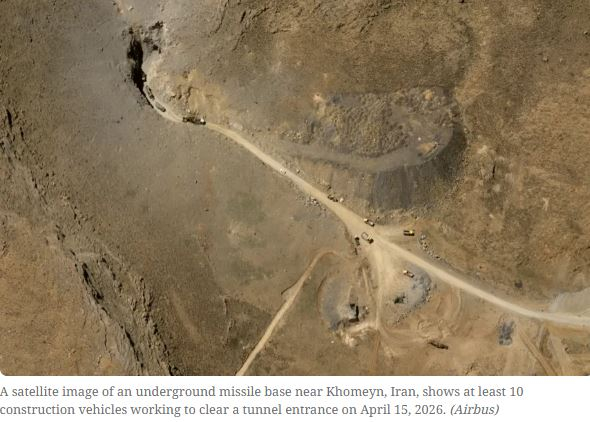
Iran has rapidly restored access to much of its underground missile infrastructure following months of US and Israeli airstrikes, demonstrating the difficulty of neutralizing Tehran's strategic missile network through conventional bombing campaigns, according to a CNN analysis of recent satellite imagery.
CNN reported that Iranian crews have reopened dozens of tunnel entrances and repaired key access roads at underground missile facilities that were heavily targeted during the conflict. The network, built over more than two decades, is considered one of the pillars of Iran's military deterrence strategy.
According to CNN's review of satellite images, Iran has cleared and reopened 50 of the 69 tunnel entrances struck at 18 underground missile facilities. The images also showed extensive repairs to roads damaged during the bombing campaign, allowing missile launchers and support vehicles to regain access to the sites.
The restoration effort has relied largely on basic construction equipment, including bulldozers, front-end loaders, and dump trucks. CNN reported that despite repeated attacks on excavation crews during the conflict, reconstruction work accelerated significantly after the ceasefire took effect.
Military analysts told CNN that the findings highlight a key limitation of the US-Israeli strategy. While strikes successfully blocked tunnel entrances and disrupted missile operations, they did not necessarily destroy the large stockpiles of missiles believed to remain deep underground.
"There’s nothing to prevent the launchers from being armed with the ample stockpile of missiles that the Iranians still have," Sam Lair, a research associate at the James Martin Center for Nonproliferation Studies, told CNN.
President Donald Trump had previously identified the destruction of Iran's missile arsenal as one of the central objectives of the military campaign. However, experts cited by CNN said Iran's underground facilities were specifically designed to withstand prolonged conflict and preserve strategic capabilities even under sustained attack.
Satellite imagery examined by CNN showed extensive repair activity at missile bases near Kermanshah, Isfahan and Khomeyn. In several cases, bomb craters had been filled, tunnel entrances cleared of debris and damaged roads restored or repaved.
Experts estimate that roughly 1,000 missiles may still be stored within the underground network, according to CNN. Because many of the facilities are buried beneath hundreds of meters of rock, analysts believe much of the missile inventory likely survived the attacks.
CNN also reported that US intelligence assessments indicate Iran has already begun rebuilding key military capabilities, including drone production and missile-launcher manufacturing. One US official told the network that Tehran had exceeded previous intelligence estimates for the speed of its military recovery.
The developments have fueled debate among defense analysts over the long-term effectiveness of the campaign. While the strikes imposed significant tactical costs on Iran and temporarily reduced missile-launch rates, analysts interviewed by CNN argued that the country's ability to rapidly restore access to its underground infrastructure raises questions about whether strategic objectives were fully achieved.
"You have to use very sophisticated, very expensive weapons to do this kind of damage, and the recovery is very low-tech — it's just bulldozers," missile expert Timur Kadyshev told CNN.