Kurdish-Led Asayish Arrest Tribal Leader After Shooting at Kurdish Political Flag in Qamishli
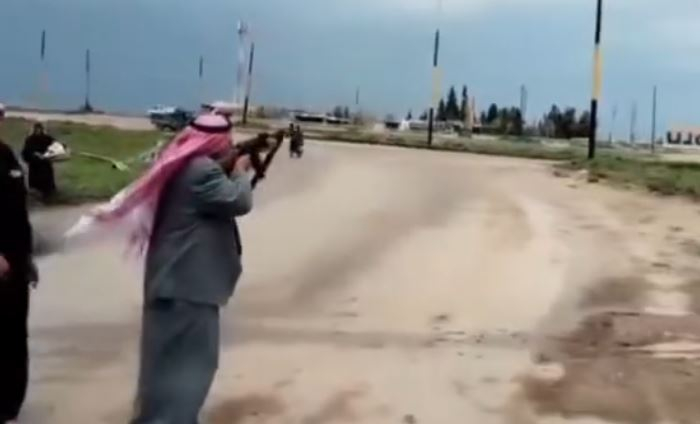
Kurdish-led internal security forces, known as Asayish, announced early Sunday the arrest of an Arab tribal leader accused of firing gunshots at a Kurdish political flag in the city of Qamishli.
In a statement, the Asayish said their forces detained Hussein al-Hassou, describing him as responsible for “acts of aggression targeting Kurdish symbols” in the city.
According to the statement, Hassou — reportedly a tribal leader based in southern Qamishli — appeared in a widely circulated social media video firing bullets at the flag of the Movement for a Democratic Society, a left-wing coalition of Kurdish political parties that includes the ruling Democratic Union Party.
The Asayish said the arrest was carried out in “close coordination” with the security apparatus of Syria’s interim authorities in Damascus.
“Initial investigations and available data indicate that the main motive behind these acts of sabotage is a desperate attempt to destabilize the region, sow discord, and create confusion among the components of the region,” the statement said.
Authorities added that investigations will continue in order to determine all circumstances surrounding the incident before Hassou is brought to justice under applicable legal procedures.
The Asayish operates under the authority of the Kurdish-led Syrian Democratic Forces, the de facto military force in northeastern Syria.
The arrest comes amid a sensitive political and military transition in the region. The SDF is currently undergoing an integration process into Syria’s state security structures following a landmark agreement reached in March 2025 between SDF commander Mazloum Abdi and Syrian interim president Ahmed al-Sharaa.
The agreement followed months of escalating tensions. In mid-January, a coalition of Damascus-aligned forces launched a major offensive against SDF-controlled territories, eventually retaking eastern Aleppo, Deir ez-Zor, Raqqa, and parts of Hasaka Province.
During the campaign, several Arab tribes in Deir ez-Zor and Raqqa reportedly defected from the SDF and supported advancing government forces, allowing Damascus to capture major cities with limited resistance. Kurdish officials at the time said pro-government forces had advanced under the cover of “Arab tribes.”
Following the clashes, Damascus and the SDF reached an agreement in late January that enabled a phased prisoner exchange and accelerated the integration of Kurdish military and administrative institutions into the Syrian state.
Under the deal, three SDF brigades are expected to be formed within Syria’s national forces, while the Democratic Autonomous Administration of North and East Syria will gradually be integrated into state institutions.
Prior to Syria’s interim government joining the U.S.-led Global Coalition to Defeat ISIS in November, the SDF had been Washington’s primary on-the-ground partner in the fight against the extremist group.