China’s Domestic Oil Output Offers Little Cushion as US Moves Threaten Key Suppliers
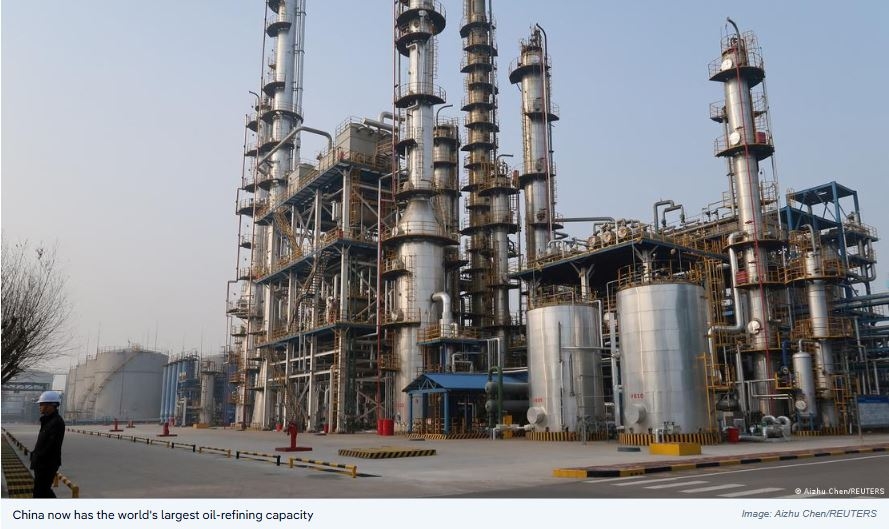
US President Donald Trump’s renewed pressure on Iran and Venezuela has reignited concerns over China’s energy security, exposing the limited capacity Beijing has to raise domestic oil production as imported supplies come under threat.
China currently sources up to one-fifth of its imported crude from Iran and a further 4% to 5% from Venezuela, much of it through clandestine channels designed to evade US sanctions. But Washington’s latest actions — including moves to unseat Venezuela’s President Nicolás Maduro, redirect Venezuelan oil toward the US, and impose 25% tariffs on Iran-linked trade — have disrupted those flows and prompted fresh scrutiny of China’s fragile oil balance.
Oil prices briefly surged on fears that China’s discounted Iranian supplies could be curtailed, while analysts warned that US seizures of Venezuela-linked tankers may further constrict deliveries. Beijing, however, has little room to compensate through increased domestic production.
China’s oil output has risen modestly in recent years, climbing from 3.8 million barrels per day (bpd) in 2018 to around 4.32 million bpd last year. The increase followed a directive from President Xi Jinping in 2019 to boost domestic exploration and refining under the Seven-Year Action Plan, backed by billions of dollars in investment from state-owned oil giants CNPC, Sinopec and CNOOC.
Yet much of the new production — including tight oil and shale extracted through fracking — has merely offset declines at aging legacy fields such as Daqing in Heilongjiang Province and Shengli in the Yellow River Delta.
June Goh, a Singapore-based senior oil market analyst at Sparta Commodities, described the cumulative output growth of 8.9% since 2021 as significant, noting that it exceeded Beijing’s target of 4 million bpd.
“The recent supply risk serves to prove that what they are doing is right,” Goh told DW. However, she cautioned that future growth was unlikely to be “exponential,” citing difficulties in discovering new reserves.
Other analysts are more skeptical. Lauri Myllyvirta, lead analyst at the Center for Research on Energy and Clean Air, said China’s domestic oil sector has struggled to achieve meaningful gains despite sustained investment.
“[Despite] a huge amount of investment over the past 15 years or more, output has largely been running to stay still,” Myllyvirta said, adding that production “has not budged” in a way that would materially reduce reliance on imports.
China imports the majority of its oil via the congested Malacca Strait — a strategic chokepoint long viewed in Beijing as a vulnerability due to its patrol by the US Navy. The issue became particularly sensitive during Trump’s first term, when tensions with Washington escalated.
With limited domestic supply upside, China has increasingly relied on strategic stockpiling to mitigate external shocks. Since late 2023, authorities have accelerated the expansion and filling of strategic petroleum reserves (SPR), driven by heightened geopolitical risks following Russia’s invasion of Ukraine and volatile global energy markets.
China initially cushioned itself by securing discounted crude from sanctioned suppliers, including Iran and Russia. Moscow briefly became Beijing’s top oil supplier before US sanctions on Russian companies and tankers reduced shipments last year.
Iran subsequently filled much of the gap, exporting nearly all of its crude — at times close to 2 million bpd — to China through shadow fleets, ship-to-ship transfers and relabeling to disguise origins.
According to Reuters, China expanded its reserves further in 2025, with 11 new storage sites expected to come online by early this year.
Goh estimates that China now has around 110 days of oil cover from combined strategic and commercial reserves, exceeding the OECD benchmark of 90 days. Beijing has set a longer-term target of 180 days.
“Stockpiling rather than production increases will do the heavy lifting,” Goh said, particularly if supplies from Iran, Venezuela and Russia continue to face disruption.
Beyond reserves, China’s longer-term strategy focuses on reducing oil demand through electrification and an unprecedented expansion of renewable energy.
Oil consumption in the transport sector peaked in 2023, according to CNPC, as electric vehicles (EVs gained market share. EVs now account for more than half of new car sales nationwide, supported by the rollout of over one million charging stations.
Major cities including Shenzhen and Guangzhou have already fully electrified their public bus fleets, helping cap gasoline demand even as economic activity expands.
Meanwhile, China has led global renewable deployment. In 2024 and 2025, it added more solar capacity than the rest of the world combined, alongside record wind installations in Inner Mongolia, Xinjiang and coastal regions.
“China’s wind and solar capacity growth has exceeded 300 gigawatts annually over the past three years and likely reached 400 gigawatts last year,” Myllyvirta said.
While these measures cannot eliminate China’s reliance on imported crude, analysts say they significantly reduce exposure to geopolitical disruptions from heavily sanctioned suppliers.
As Beijing prepares to unveil its next five-year plan in March — setting economic and energy priorities into the early 2030s — further investments in domestic fossil fuel production, strategic storage, electrification and renewables are expected.
“Combined with additional oil storage, maintaining that rate of renewable growth could substitute a lot of gas or coal in power generation,” Myllyvirta said. “Electrification can replace fossil fuels across industry, transport and buildings.”