France Discusses SDF–Damascus Talks, Accountability, and Syria’s Transition with Syrian Counterpart
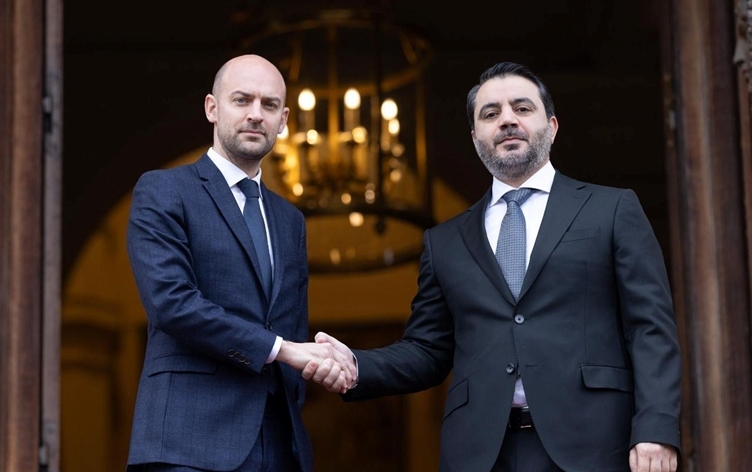
French Foreign Minister Jean-Noël Barrot discussed the state of negotiations between Kurdish-led forces and Damascus during talks with Syrian Foreign Minister Asaad al-Shaibani in Paris on Monday, according to a statement from the French Foreign Ministry.
The two ministers reviewed “the progress of negotiations between the transitional authorities and the Syrian Democratic Forces (SDF) with a view to fully implementing the March 10, 2025 agreement,” the statement said.
The agreement, signed on March 10 by SDF commander-in-chief Mazloum Abdi and Syria’s interim president Ahmed al-Sharaa, aims to integrate the SDF and the Kurdish-led autonomous administration in northeast Syria (Rojava) into Syria’s state institutions.
Negotiations over implementation are ongoing, but key differences remain. Kurdish negotiators have pushed for the SDF to be integrated as a unified military force, while the Syrian government favors absorbing SDF fighters individually into regular army units.
On Sunday, Abdi led a delegation to Damascus to discuss the integration of his forces into Syria’s new security framework. Although both sides issued statements suggesting positive developments, no concrete progress was announced following the talks. Damascus has not publicly commented on the meeting, which was reportedly mediated by the United States.
Beyond the SDF talks, Barrot and Shaibani discussed several other issues, including Syria’s decision to join the US-led coalition against the Islamic State (ISIS) and accountability for atrocities committed against civilians in Suwayda province in March and July of last year.
Barrot expressed France’s “full support” for efforts by the Syrian Transitional Authority to investigate abuses committed against civilians on the coast and in Suwayda, according to the French Foreign Ministry. He also emphasized support for “a transition conducted in a manner that respects all segments of Syrian society.”
Violence has continued in parts of Syria following the ouster of former president Bashar al-Assad by the now-dissolved jihadist group Hay’at Tahrir al-Sham (HTS). The group’s former leader, Ahmad al-Sharaa, currently serves as interim president.
In mid-July, clashes erupted between Druze fighters and Sunni Bedouin tribes in Suwayda province, escalating after Syrian government forces intervened. A ceasefire was reached on July 19. The UK-based Syrian Observatory for Human Rights reported that nearly 2,000 people were killed, including about 765 Druze civilians, many of whom were allegedly executed by defense and interior ministry forces. Sporadic clashes have continued since between Druze fighters and Damascus-affiliated units.
Earlier, in March, fighting broke out in Alawite-majority coastal regions after Assad loyalists attacked forces aligned with the interim leadership. That violence left around 1,700 people dead—mostly Alawite civilians—with many deaths attributed to pro-government forces.
“The two ministers further stressed the importance of working toward the restoration of a stable, unified, and sovereign Syria,” the French Foreign Ministry said.