Damascus Talks Between Syrian Government and Kurdish-Led Forces End Without Breakthrough
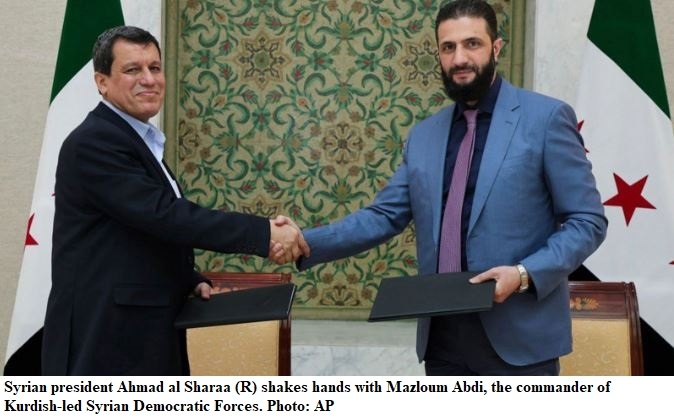
High-level discussions aimed at integrating the Kurdish-led Syrian Democratic Forces (SDF) into Syria’s national military concluded on Sunday without tangible progress, state media reported, highlighting deep-seated challenges in a process critical to the country’s future stability.
The talks in the Syrian capital between a delegation headed by SDF Commander-in-Chief Mazloum Abdi and Syrian government officials ended with no concrete steps forward on implementing a previously signed integration agreement. Syrian state television, citing a government source, stated the meeting “did not produce tangible results on speeding up the implementation of the agreement on the ground.”
The negotiations are part of a framework established in March, when Abdi and Syrian President Ahmed al-Sharaa signed a deal to merge the civil and military institutions of the semi-autonomous Kurdish administration into the central government by the end of 2025. Persistent disagreements, however, have stalled the process.
In a statement, the SDF confirmed its leadership delegation had met government officials “as part of discussions related to the military integration process,” adding that details would be released later. Damascus did not issue an official statement.
The integration of the SDF—which controls vast, resource-rich territories in northern and northeastern Syria (referred to by Kurds as Western Kurdistan)—has been a complex and contentious issue. The force, backed by a U.S.-led coalition, was instrumental in the territorial defeat of ISIS in 2019. Since the ouster of long-time ruler Bashar al-Assad a year ago, mutual accusations of obstructing the integration pact have been frequent.
A core point of contention is governance. Commander Abdi has consistently advocated for a decentralized political system, a model rejected by Syria’s new Islamist-led authorities in Damascus. These political differences have occasionally flared into armed clashes, most recently in Aleppo last month.
According to a Kurdish official who spoke anonymously to AFP in December, Damascus had proposed restructuring the Kurdish-led forces into three divisions and several brigades—including a dedicated women’s brigade—to be deployed in Kurdish areas under SDF command. Syria’s foreign minister later said the government was awaiting a Kurdish response to this proposal.
Regional dynamics further complicate the talks. Turkey, a key ally of Syria’s current government, considers the SDF and its main Kurdish component a security threat along its 900-kilometer border. Turkish Foreign Minister Hakan Fidan last month publicly urged the SDF not to hinder Syria’s stability, warning that Ankara’s patience was wearing thin. Turkey has conducted multiple military operations in northern Syria aimed at pushing Kurdish forces away from its frontier.
Despite the impasse, both sides agreed to hold further meetings. Abdi stated in December that “all efforts are being made to prevent the collapse of this process,” expressing confidence that failure could be avoided.