Kurdish-Led Forces Reach Landmark Deal to Join Syrian National Army
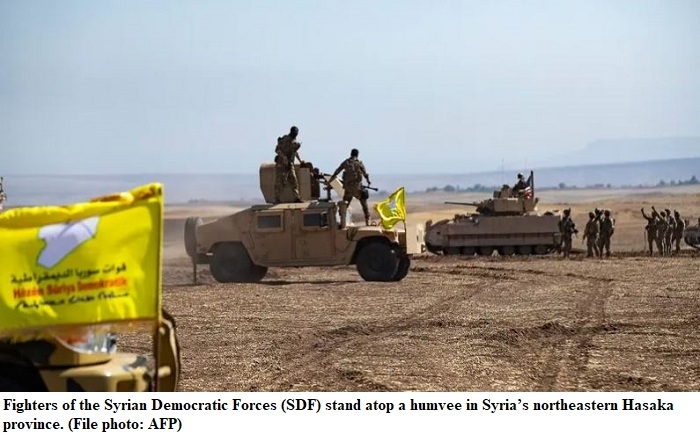
In a significant step toward ending Syria’s long-running civil war, the Kurdish-led Syrian Democratic Forces (SDF) have reached an agreement in principle to integrate their fighters as cohesive units into the country's new national army, the group’s commander announced Thursday.
The deal, revealed by SDF commander Mazloum Abdi in an interview with the Associated Press, signals a major breakthrough after months of stalled negotiations with the Damascus government. It aims to reintegrate tens of thousands of fighters from northeast Syria into the state’s formal military structure.
"We are talking about a large number, tens of thousands of soldiers, as well as thousands of internal security forces," Abdi said. "These forces cannot join the Syrian army individually... Rather, they will join as large military formations formed according to the rules of the Defense Ministry."
Abdi emphasized that SDF commanders would be given "respectable posts" within the Defense Ministry and army command, recognizing the force's pivotal role in the fight against the Islamic State group.
The agreement follows a period of profound political change in Syria. In December 2024, insurgents led by the Islamist Hayat Tahrir al-Sham (HTS) captured Damascus, toppling the government of President Bashar Assad and ending his family's five-decade rule.
The new interim government, led by President Ahmad al-Sharaa, a former HTS leader, initially struck a deal with the SDF in March to merge the forces. However, negotiations had since stalled over a key point of contention: whether the SDF would be dissolved entirely or preserved as a distinct bloc within the army.
Abdi stated that his recent trip to Damascus earlier this month resulted in progress after meetings with al-Sharaa and key ministers. Both sides have now agreed on a "mechanism" for implementing the March agreement, allowing the SDF to join as organized formations.
The pact comes amid ongoing tensions. SDF-controlled areas boycotted recent parliamentary elections, and clashes have erupted in Aleppo. Abdi acknowledged that sectarian violence in coastal regions and Sweida province earlier this year fueled fears among the Kurdish population and delayed the deal.
He stressed that a durable settlement must guarantee equal rights for all Syrians and allow for a decentralized form of governance. "We believe that if progress is made in the March agreement and all its provisions are practically implemented, we will be able to prevent the recurrence of such events," Abdi said.
A major question hanging over the agreement is the response from Turkey. Ankara considers the SDF an extension of the Kurdistan Workers' Party (PKK), a designated terrorist group that has waged a long-running insurgency in Turkey. Turkey has vehemently opposed any arrangement that legitimizes the SDF.
Abdi suggested, however, that Turkey's position may be evolving. "I believe that if we Syrians agree — as is happening now — Turkey will have no excuse to interfere inside Syria," he said, adding that he has "noticed some flexibility" in Ankara's stance.
If successfully implemented, the integration deal would mark one of the most dramatic steps toward reunifying Syria's fractured military and reshaping the country's power structure after nearly 14 years of conflict.