“Who Cares What America Sees for the Middle East?” – Richard Bulliet on U.S. Decline, Regional Fragmentation, and the End of the Sykes–Picot Era
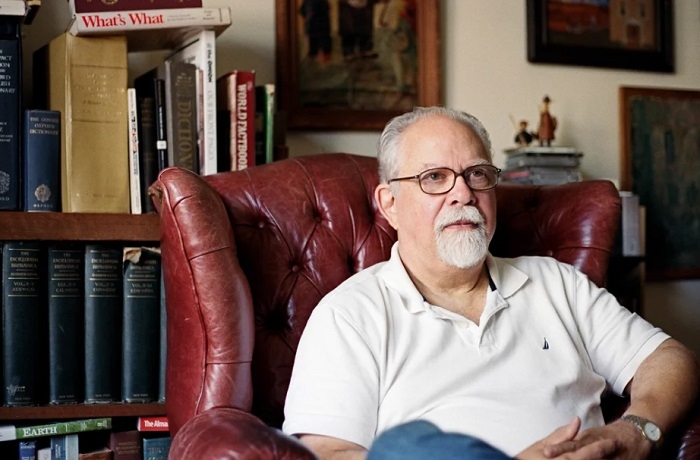
Professor Richard W. Bulliet is Professor Emeritus of History at Columbia University, where he has taught since 1976. A leading historian of the Middle East and Islamic world, his scholarship spans medieval Islamic society, the history of technology, and the long relationship between Islam and the West. He is the author of numerous influential works, including The Case for Islamo-Christian Civilization, The Camel and the Wheel, and Islam: The View from the Edge. Over his decades-long career, Bulliet has been a prominent voice in debates on Islamic politics, U.S. foreign policy, and the role of religion in global affairs. In a recent interview with us, Ambassador Dennis Ross stressed that today’s crises in the Middle East cannot be solved within the old Sykes–Picot framework, yet he also noted that drawing a new map for the region is far from simple.
Gulan: As a historian of the Middle East, do you believe that the Trump administration’s emphasis on “peace through force” was ever a viable path toward stability?
Richard Bulliet:The dissolution of the British Empire had a powerful impact on the British psyche at all social levels. This culminated with Brexit, festering hostility toward non-whites, and the evaporation of international influence. The British saw themselves reduced to a not very wealthy island nation with a great but burdensome cultural heritage.
It seems to me as though the United States is undergoing an analogous, though less economically desperate, psychological transformation triggered by the dissolution of the world system defined by America’s post-World War II economic hegemony.
The Middle East wars, both international and civil, that began in 1967 and continue to this day, have been marked by profound American failure at many levels. Many people in my profession—American Middle East specialists—believed in the 1960s that they could “understand” the many regional variables and prescribe viable pathways to peace and stability. I believe this was a manifestation of intellectual hubris resulting from the American political elite feeling that they, and they alone, deserved credit for the Allies winning World War II.
In fact, the United States not only failed in its understanding of the region, particularly after the Iranian Revolution, but as its grasp of regional realities fell apart, it came to rely increasingly on regional political entities that flattered the American self-image as a buttress of free-market capitalism and democratic aspiration.
The post-9/11 era has seen the final collapse of America’s claim to expert knowledge of the region. As war replaced diplomacy and economic influence, American weakness became ever more obvious. Policy choices were increasingly handed over, by both Republicans and Democrats, to the Israel and Gulf lobbies.
Domestically, this has resulted in most Americans looking with disgust at political situations that continually arise in the region and expressing an ever stronger desire to have nothing to do with them. Pivoting toward China and away from the Middle East makes a great deal of sense for the small minority of Americans who continue to think about the place of the United States in international affairs.
Donald Trump has neither the mental acuity nor sufficient interest in the world to think through, adopt, and implement a regional Middle East strategy. He cares exclusively about money for himself and the oligarchs he surrounds himself with, even though his age and health make it unlikely that he will survive his current term in office. Given the extremely narrow and capricious focus of his economic and military outlook, it makes perfect sense for regional leaders to compete with one another in flattering him and promising to make him and his friends rich, while chaos lurks just below the surface.
Since it is certain that very few years remain to the Trump era, what can be expected of America in a post-Trump world? Right now, the continual noise of the Trump propaganda machinery drowns out most efforts to consider where the United States and the Middle East will be five years from today. However, like post-imperial Britain of a generation ago, isolationism and xenophobia are clearly on the rise.
To be sure, these attitudes are most common among the least educated and most bigoted segments of our population. But this amounts to one-third of our electorate; and by virtue of constitutional quirks, like granting two senators to every state regardless of population, that one-third wields more than half of the policy-determining influence in the halls of power.
Consequently, I predict that “the Middle East” as we have come to know it will become less and less coherent as a world area in the decades to come. This will benefit Israel and the Arabs of the small-population oil states, but leave the rest of the Mashriq to languish. Continuity with the era of Sykes–Picot, Camp David, and Desert Storm will become the irrelevant domain of historians, with no continuing force within the region. Iran will go with China, and Turkey will dream neo-Ottoman dreams.
Gulan: When the United States invaded Iraq in 2003, it claimed to be laying the foundations for democracy. Yet instead, Iraq and the wider region became fertile ground for jihadist movements, from al-Qaeda to ISIS. Why did this project produce the opposite result? What structural factors in the Middle East allow extremism to thrive instead of peace and stability?
Richard Bulliet: Classical Islamic political theory maintains that all Muslims are subject to shari‘a, including rulers. It also says that ruling institutions inevitably tend toward tyranny and that the role of Muslim law is to put a brake on this tyrannical drive. Though this is an over-simplification, I think it helps explain why Islam took on a renewed political role in the aftermath of World War I.
First, some people began to look to Islam as a means of resisting colonial impositions operationalized by post-Ottoman puppet rulers; and then, after World War II and the rise of militarized Neo-Mamluk fascism in the Nasser era, more and more people saw Islam as the only venue for resistance to tyranny.
From the Tanzimat onward, however, the traditional vectors for expressing Muslim political influence, namely courts of law and religious schooling, had been progressively taken over by the state in the name of “modernization.” Thus, the people who sought to mobilize pious discontent with growing tyranny came less often from tame state religious institutions than from the new communications media (magazine and radio muftis and the like) and cult-like gurus organizing their followers following the pattern of Sufi shaikhs.
This phenomenon led to a spectrum of religious leaders, ranging from those who espoused at least the appearance of democratic participation in public affairs to those who advocated terrorism and atrocity in the name of Islam.
Ironically, while the Christian world had largely exchanged religion as a determinant of governance in favor of royal dynasties and then secular revolutions after the Peace of Westphalia in 1648, evangelical Christian religious revival in the twenty-first century seems to be imitating some of the Muslim currents of the previous century. Just as the state muftis lost ground to more activist expressions of political Islam, in today’s America, traditional Protestant denominations are steadily declining as megachurch leaders and television preachers of dubious piety push ever more vigorously into politics as advocates of Christian nationalism. This is having a growing impact in terms of Islamophobia and Christian Zionism.
Gulan: Since October 2023, Israel has been engaged in prolonged conflict with Hamas, Hezbollah, the Houthis, and even elements of Iran, with no significant diplomatic breakthroughs in sight. Do you think these crises are becoming entrenched as permanent wars rather than solvable conflicts?
Richard Bulliet: I did not directly address this question. My broader reflections on U.S. decline, the influence of lobbies, and the limits of American expertise speak indirectly to the entrenchment of conflict.
Gulan: How important is it for the international community to actively support this pluralism so that it can expand and serve as a template for coexistence elsewhere in the region?
Richard Bulliet: I believe we are now, as a nation, in the process of disassembling the Middle East area studies educational network we worked so hard to build after the passage of the National Defense Education Act in response to the Soviet Sputnik launch of 1957. Trump’s efforts to take control of elite universities are a straw in the wind, but cutbacks in the teaching of Arabic and other “exotic” languages at places like Indiana University and Chicago University are straws in the wind.
As America First grows stronger and the Chinese Belt and Road vision offers an alternative way of looking at the future, speculation about “What does America see for the Middle East?” may soon give way to “Who cares what America sees for the Middle East?”