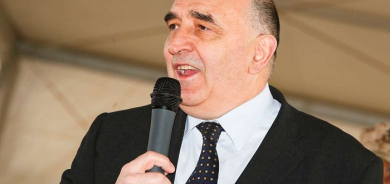
Professor Dr. Allison McCulloch to Gulan: Power-sharing and other forms of inclusive governance can be important strategies for ending conflict

Allison McCulloch is a Professor of Political Science, Brandon University. Her research considers the politics of ethnically divided societies, peace processes and democratization in post-conflict states. Broadly, she is interested in the processes and institutions that facilitate democracy, security and stability in post-conflict settings, with a focus on power-sharing arrangements. Specifically, she is interested in how power-sharing governments handle political crises, the incentive structures for ethnopolitical moderation and extremism that power-sharing offers, and how power-sharing arrangements can be made more inclusive of identities beyond the ethnonational divide. In an exclusive interview she answered our questions like the following:
Gulan: In deeply divided societies like Iraq and Lebanon, power-sharing has often been used as a tool to prevent renewed conflict, yet it also seems to entrench sectarian divisions. From your research, what conditions make power-sharing arrangements more resilient during political crises, and what factors push them toward collapse?
Professor Dr. Allison McCulloch: This is the perennial struggle of power-sharing systems: they can help end war and conflict, but, depending on their design, they can risk entrenching or locking in sectarian divisions. Whether a system can be resilient during political crises or whether they are pushed towards collapse depends on a number of factors: the balance of power between moderates and hardliners, the use of deadlock-breaking mechanisms for when parties find themselves at an impasse, and whether or not there is a political will or a ‘spirit of accommodation’ to work together to resolve political crises. The more rigid the power-sharing system – often referred to as corporate power-sharing – the more parties will be prone to approach matters in zero-sum terms. This can make the kind of compromise needed to weather political crisis rather elusive.
Gulan: Lebanon’s ongoing crises have revealed weaknesses in its sectarian power-sharing. Do you think these crises are evidence of the failure of consociationalism, or of the absence of deeper institutional reforms to complement it?
Professor Dr. Allison McCulloch: I think that the ongoing and intersecting crises in Lebanon are a failure of many things, rather than just one. This would include a post-war reconstruction model premised on neoliberal ideas, a failure to reckon with the legacies of the civil war via robust transitional justice processes, and a failure of political will to undertake much-needed institutional reforms, along with consociationalism which can make reform more challenging. Some of this comes out of the inherent tension between what is needed at the end of a war and what is needed a generation or two later. Sustainable post-conflict governance systems need to be adaptable – to include new constituencies and to respond to new policy issues – but many, including Lebanon’s, are rather ‘sticky’ or hard to reform in the direction of further democracy, accountability, and justice.
Gulan: In Iraq, Lebanon, and Syria, power-sharing is often reduced to ethnic and sectarian quotas, sidelining civic, gender, and generational identities. What institutional innovations do you see as promising for expanding inclusivity beyond ethnonational cleavages?
Professor Dr. Allison McCulloch: First, it is important to recognize that power-sharing institutions can be designed in very different form. Some forms of power-sharing do lock in ethnic or sectarian representation in very rigid ways that can make it difficult for other political identities to be effectively represented in the political system. But some other forms of power-sharing can still protect and represent ethnic and sectarian groups, while making space for other identity groups. Some institutional innovations for more effective representation of gender, civic, or generational identities can be quotas or reserved seats for women, youth or very small ethnic groups. Electoral rules around constituency size or the electoral threshold, or whether a party list is open or closed can also make a big difference for who gets elected. Something called sequential portfolio allocation, where a party’s ability to participate in the executive or government is tied to its seat-share in parliament, and where each party picks a ministerial portfolio in rotation starting with the largest party, then the second largest, and so on, can often help to bring civic parties into government. Similar rules can be used by parties to ensure gender and generational diversity as well. We can also think about all-party women’s caucuses, mentorship programmes, as well as the sitting hours of parliament to think about making it a more welcoming space. It is the combination of different institutional innovations that can help support inclusive power-sharing.
Gulan: Can we imagine a model of power-sharing that gradually transitions from identity-based guarantees to issue-based or performance-based politics, and if so, how might such a transition be designed in fragile post-conflict contexts?
Professor Dr. Allison McCulloch: Such a process is possible, but it is not easy. I think it can only ever be gradual and iterative over time. This makes it hard to design, and it probably has to be an organic process that resonates with citizens and moves from the bottom up. The Tishreen protests in Iraq, the Thawra protests in Lebanon, and the growing support for civic parties in Northern Ireland are some early signs that suggest that citizens want more issue-based, performance-based politics. But it won’t happen all at once. In terms of ‘design,’ institutions that support adaptability include constitutional review clauses, parliamentary committees tasked with considering different reform options, and other mechanisms that support transparency and accountability.
Gulan: Looking comparatively at Iraq, Lebanon, do you see their challenges as primarily failures of power-sharing design, or failures of political will and leadership within those arrangements?
Professor Dr. Allison McCulloch: I would say that the challenges facing Iraq and Lebanon, along with other divided or post-conflict places, is always a combination of factors that can include power-sharing design, failures of political will, and conflict legacies. Power-sharing agreements are often negotiated in conditions of crisis and urgency: the kinds of emergency conditions that exist at war’s end, after authoritarian collapse, or in the context of deep ethnic divisions. Negotiations often operate on expedited timelines that are meant to heighten the sense of urgency to get a deal done, but this can create implementation problems down the road. Sometimes this means that constitutional clauses are written in vague terms or mean different things to different parties or even that they bracket or leave particularly contentious issues to their later selves. We can see this, for example, with the clauses on the creation of a Senate in Lebanon or Federation Council in Iraq, neither of which has happened. It’s also important to recognize that institutional design has its limits. It can enable or constrain certain kinds of political behaviors – it can support compromise or discourage the use of violence – but it is not a magic solution on its own.
Gulan: Do you think there are lessons from other post-conflict societies—such as Bosnia, Northern Ireland, or South Africa—that could be realistically applied to the Middle Eastern context, or are the dynamics there uniquely resistant to such borrowing?
Professor Dr. Allison McCulloch: I think there is always benefit in learning from each other, even if the application of ‘lessons learned’ is never straightforward and needs to be approached with caution and informed case knowledge. Different parts of the world face different contextual factors, both constraining and enabling, when it comes to building peace and inclusive governance, including histories of intervention – both colonial and neo-colonial – as well as varying levels of economic development and state capacity, and different cultural practices and preferences. These differences need to be part of the conversation in terms of how political institutions are designed. There is no single template for designing inclusive peace, but there are many tools in the peacebuilding toolbox, and it is worthwhile to have a sense of what has been applied elsewhere, what has worked and what has not.
Gulan: Finally, as identities evolve and demands for reform grow, how can power-sharing systems avoid becoming frozen in outdated structures and instead adapt to new social realities?
Professor Dr. Allison McCulloch: Power-sharing and other forms of inclusive governance can be important strategies for ending conflict, supporting democratization, and potentially repairing community relations. But they can sometimes be ‘sticky’ or ‘frozen’ and institutional patterns do not always keep up with societal change. One of the challenges it has yet to effectively confront is a kind of elite-citizens gap, where some of the day-to-day challenges faced by citizens in post-conflict settings are not effectively taken up or addressed by the government. Having a government that looks like the society it is meant to represent is important, but so too is effective, consistent, and fair public service delivery. Improving living standards and better ways of communicating between citizens and elites can be key pathways to institutional adaptability.