Syria Announces Parliamentary Seat Allocation, Postpones Elections in Kurdish Regions Amid Criticism
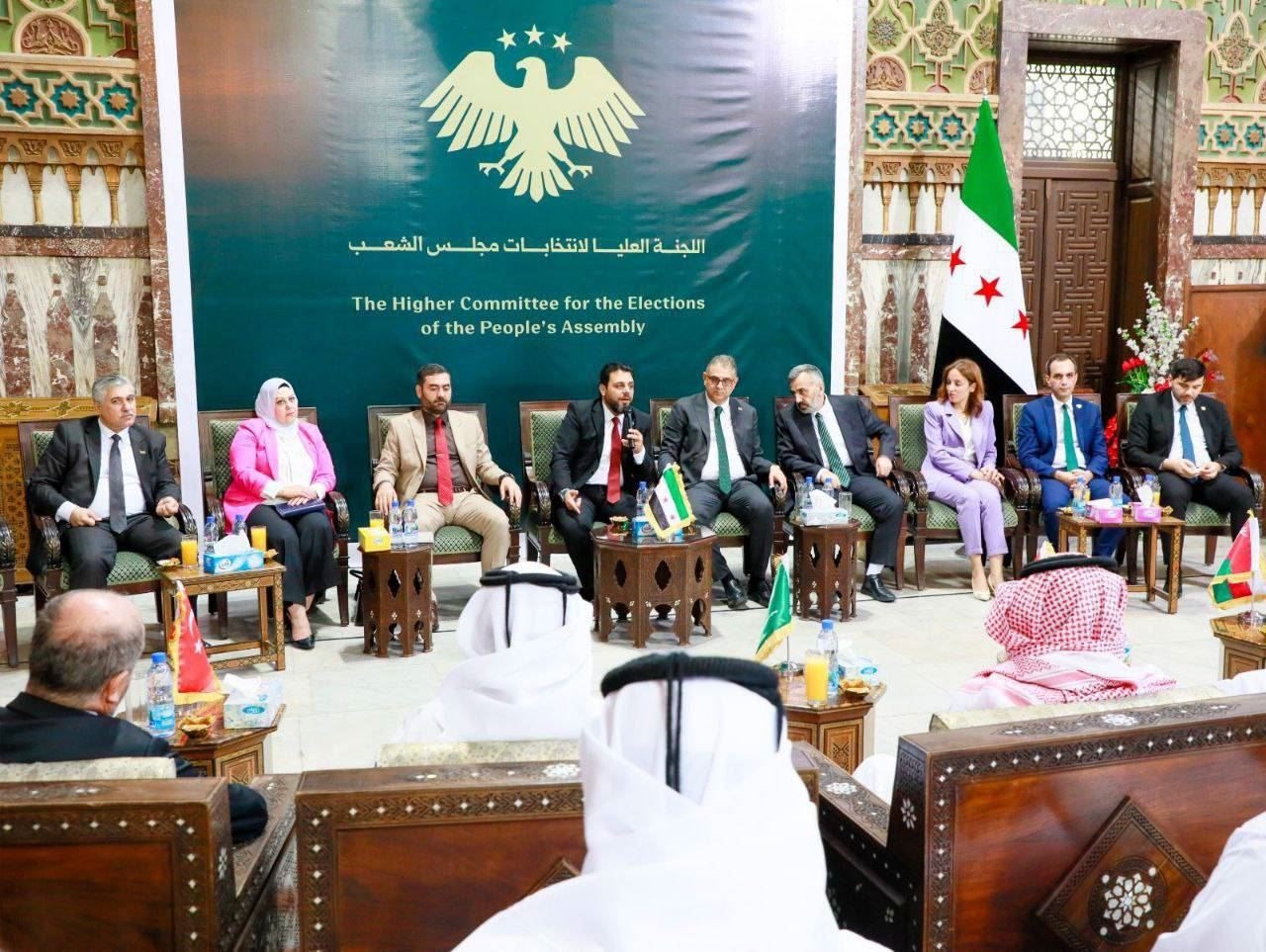
Syria’s state electoral agency has finalized the distribution of seats for the upcoming People’s Assembly elections scheduled for mid-September, though voting in several provinces, including Kurdish-majority areas, has been postponed, citing security concerns—a move that has sparked strong condemnation from Kurdish groups.
In a resolution issued on Tuesday, the Higher Committee for the People’s Assembly Elections detailed the allocation of 210 parliamentary seats across Syria’s provinces. The northern province of Aleppo received the largest share with 32 seats. Rif Dimashq, Homs, Hama, and Idlib followed with 12 seats each. The capital, Damascus, and Deir ez-Zor were allocated ten seats each, while the Alawite-majority provinces of Latakia and Tartus received seven and five seats, respectively.
In the northeast, the Kurdish-majority Hasaka and Arab-majority Raqqa were assigned ten and six seats, respectively. The southern Druze-majority province of Suwayda received three seats.
However, in a statement on Saturday, the Higher Committee announced that elections in Hasaka, Raqqa, and Suwayda would be postponed due to what it described as a “lack of a secure and stable environment.” Committee spokesperson Nawar Najmeh stated in an interview that voting in these provinces would be held only once “appropriate security and political conditions” are restored. He emphasized that the Syrian state “must have a genuine sovereign presence in those regions” to ensure the integrity and transparency of the electoral process.
Najmeh also noted that one-third of the 210-member People’s Assembly would be appointed by interim President Ahmed al-Sharaa, as per the interim constitutional declaration approved in March. He suggested that it is “possible for the appointed members to come from these provinces.”
The decision has drawn sharp criticism from the Democratic Autonomous Administration of North and East Syria (DAANES), which governs Kurdish-majority regions. In a statement on Sunday, DAANES rejected the committee’s reasoning, asserting that northeastern Syria is “the most secure” compared to other parts of the country. The administration condemned the electoral process as “exclusionary and undemocratic” and accused Damascus of perpetuating “marginalization and exclusion.”
DAANES further argued that the steps taken by the Syrian interim administration contradict the objectives of the Syrian revolution, which called for “justice, democracy, equality, and freedom.” It urged the international community and the United Nations to reject the electoral process and instead support a comprehensive political solution involving all Syrians to achieve a “democratic, pluralistic, decentralized Syria.”
The upcoming elections, scheduled for September 15–20, will be the first under the Sharaa-led interim administration. Last week, Sharaa signed a provisional electoral system comprising 13 chapters and 54 articles, establishing the legal framework for the vote. The new system introduces two categories of representatives: “competencies” (requiring a university degree) and “notables” (requiring a high school diploma). Seventy percent of seats are reserved for competencies, and thirty percent for notables.
The Higher Committee also outlined eligibility criteria for voters and candidates. Candidates must have obtained Syrian citizenship before May 1, 2011—a cutoff linked to Decree No. 49, which granted citizenship to many stateless Kurds. They must be at least 25 years old, legally competent, and of good moral standing. Those associated with the former Ba’ath regime, serving in the People’s Assembly post-2011 without defecting, or linked to groups labeled as “terrorist organizations” are disqualified. Additionally, candidates must be either registered in their electoral district or have lived there for at least five consecutive years before 2011.