European Unity Shields Zelenskyy in Washington, Extracts Key Pledges from Trump
In a high-stakes display of trans-Atlantic solidarity, European leaders successfully backed Ukrainian President Volodymyr Zelenskyy in securing a critical public pledge from U.S. President Donald Trump on security guarantees, while effectively blocking any immediate discussion of territorial concessions to Russia.
The mood in the Oval Office on Monday stood in stark contrast to a previous meeting earlier this year, which was marked by public admonishments. Zelenskyy, eschewing his military fatigues for a formal suit, set a diplomatic tone by delivering a personal letter from his wife to First Lady Melania Trump, thanking her for raising the issue of Ukraine's abducted children.
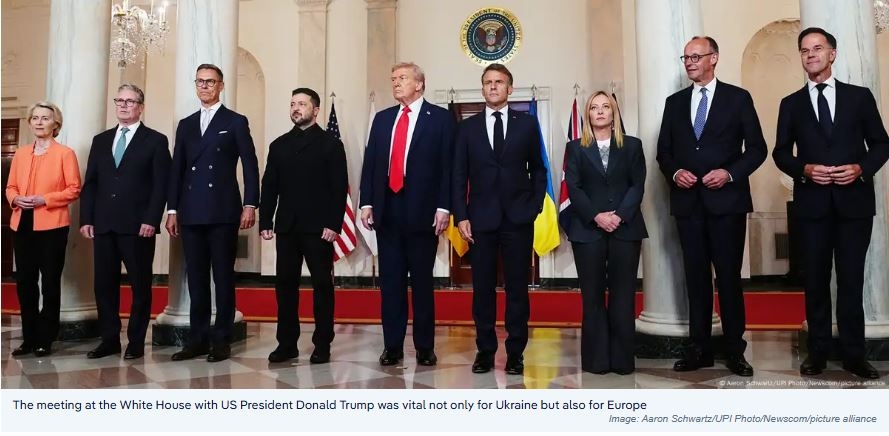
The visit was strategically bolstered by the surprise presence of a powerful European delegation, including German Chancellor Friedrich Merz, French President Emmanuel Macron, UK Prime Minister Keir Starmer, and European Commission President Ursula von der Leyen. They formed a protective semicircle around the Ukrainian leader, determined to prevent another humiliation and affirm a united Western front.
“This was a meeting where Europeans had the chance to show their unity and determination,” Almut Möller of the European Policy Centre told DW. “Europe is not powerless.”
The primary European objective was a clear U.S. endorsement of long-term security guarantees for Ukraine. President Trump delivered, publicly pledging that the U.S. would "coordinate" with Europe on protections for Ukraine.
NATO Secretary-General Mark Rutte described the envisioned pact as offering “Article 5-type guarantees” without granting Ukraine full NATO membership. This refers to the alliance's core mutual defense clause.
The reassurance was vital for European capitals, where anxiety had spiked after Trump met with Russian President Vladimir Putin in Alaska just days prior. However, the specifics of these guarantees—including their scope, signatories, and enforcement—remain entirely undefined. A group of up to 30 nations, dubbed a "Coalition of the Willing," is expected to have defense ministers meet as early as this week to begin drafting the agreement. Zelenskyy expressed optimism, stating the guarantees could be "formalized on paper within the next week to 10 days."
Analyst Tinatin Akhvlediani from the CEPS think tank called the announcement an essential step, but warned that U.S. military backing is irreplaceable for Europe.
Equally significant was what was not discussed. According to the Financial Times, a European official stated that Trump explicitly said forcing territorial concessions was "not my business, that is a matter for Ukraine," effectively taking land swaps off the table for now.
Despite this, analysts caution the risk persists. "We will have to see what happens next, as we don't know what exactly happened behind closed doors," Akhvlediani maintained. French President Macron openly doubted the Kremlin's intentions, warning that Putin's ultimate goal remains seizing as much territory as possible.
In a dramatic development, the Kremlin revealed that Trump paused the meeting to conduct a 40-minute call with Putin. The U.S. president then proposed a trilateral summit with himself, Zelenskyy, and Putin, potentially within weeks.
While no details were finalized, European leaders said they would support such a meeting provided it reinforces Ukraine's sovereignty and avoids externally imposed concessions. Analysts agree the summit would be a pivotal moment, forcing Putin to show if he genuinely wants peace.
Beyond the immediate outcomes, the meeting signaled a shift in Europe's role from bystander to determined security guarantor. Chancellor Merz stated the conflict is about “the political order of Europe,” and that Germany bears a major responsibility.
The mood in Europe was cautiously optimistic. Akhvlediani noted that the trans-Atlantic alliance appears stronger now than at any point since Trump's return to office, crediting European leaders with steering him back toward traditional allies.
However, the outcome is provisional. Möller cautioned that “Trump can change his views very quickly,” and described the situation as still evolving. The challenge is immense, she added, but “Europe has no alternative but to try, and they are doing the right things.”