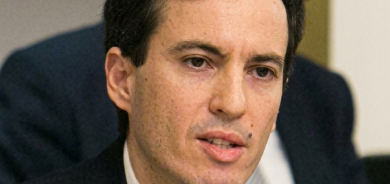
PROFESSOR JIM SPERLING TO GULAN: Arguably the US role in the Middle East has always been transactional

Jim Sperling is professor of political science at the University of Akron. He has taught at Akron since 1988. Prior to that time he held appointments at Davidson College and the James Madison College, Michigan State University. He teaches World Politics and Government (the introductory course to comparative politics and international relations), International Politics and Institutions, and Comparative Security Policy. His publications have explored various facets of German foreign economic and security policy over the course of the postwar period as well as the problem of the new security agenda, global security multilateralism, and regional security governance in the contemporary international system. His publications include the coauthored NATO’s Trajectory into the 21st Century (Palgrave 2012) and EU Security Governance (Manchester University Press 2007) and the coedited NATO after Sixty Years (Kent State University Press), National Security Cultures: Patterns of Global Governance (Routledge 2010), European Security Governance: The European Union in a Westphalian World (Routledge 2009), and Global Security Governance (Routledge 2009). He is editor of Handbook on Governance and Security (Edward Elgar 2014) and is currently coauthoring with Mark Webber NATO: What’s wrong with it? How to fix it? (Polity Press). In a written interview he answered our questions as the following:
Gulan: In your perspective has the Mr. Trump’s visit to the Middle East achieved its stated goals?
Professor Dr. Jim Sperling: There are four apparent targets of the Trump tour of the Middle East: initiating a new round of Saudi, UAE, and Qatari arms purchases; procuring a steady stream of those nations’ investments in US technology and weapons industries; self-aggrandizement and self-enrichment via securing Persian gulf state investments in Trump-related real estate ventures or not-quite-transparent direct financial transfers; the creation of an effective coalition of Middle Eastern states to ‘solve’ the Iran problem; and creating the context for the Gulf nations to accept a greater Israel occupying parts of the West Bank and Gaza. The White House accounting of the announced agreements suggests that Trump was successful with respect to the first and second goals, although a bit of skepticism is in order. The Saudi’s signed contracts for $142 billion in defense modernization expenditures while Qatar will purchase $92 billion in commercial jets. The UAE committed to $1.4 trillion, 10-year ‘investment framework’, Saudi Arabia promised to invest $600 billion in the American economy, and Qatar promised to invest $1.2 trillion in the American economy. According to news services, those investment commitments are overstated: Bloomberg reported that the Saudi’s only committed $300 billion while Qatar only signed contracts worth $243.5 billion. Allowing for the inflated and self-congratulatory benefits of the trip, those investments, if realized, would certainly enable those nations to penetrate those industries which are critical to the future of American defense capabilities, could be easily diffused to adversaries and competitors alike, and represent a strategically risky penetration of the US economy by authoritarian governments. While it is impossible to know if or how Trump benefited directly from this trip, he did receive a $400 million passenger airliner for his official (and potentially private use once he leaves office) and the industrial and tech entrepreneurs profiting from the Trump administration’s transactional diplomacy abased themselves when stroking Trump’s ego at the conclusion of the trip. Where Trump’s approach to the region has not yet yielded the outcomes that matter most—striking an agreement with Iran and the normalization relations with the United States, a resolution of the chaos in Gaza, and limiting China’s penetration of the region—it is difficult to find any result that indicates that regional peace is imminent or that China’s ambitions in the region have been blunted.
Gulan: Do you agree that the transactional approach adopted by Mr. Trump, represents a novel method, and contributes to the long-term prosperity and peace in the Middle East?
Professor Dr. Jim Sperling: Arguably the US role in the Middle East has always been transactional, largely owing to the civilizational gulf between the US and the Muslim nations of the Saudi Peninsula and America’s steadfast support of Israel in times of war and peace. Saudi Arabia, the United Arab Emirates, and Qatar have depended upon a close security relationship with the United States, particularly given the Iranian desire to emerge as the dominant regional power in the Gulf—an ambition the US and UK encouraged prior to the Shah’s downfall and has since continued in post-revolution Iran. One aspect of the Trump foreign policy rhetoric (and likely practice) may contribute to regional security insofar as he has promised that the US will no longer be driven by norms or ideals but by self-interest alone; he asserted that “In recent years, far too many American presidents have been afflicted with the notion that it’s our job to look into the souls of foreign leaders and use U.S. policy to dispense justice for their sins … my job [is] to defend America and to promote the fundamental interests of stability, prosperity, and peace.” This approach will reduce the probability of US intervention in that region of the world unless untoward developments emerge that directly threaten US security. Although many in the traditional US foreign policy elite might find so bald a rejection of America’s democratic mission objectionable, it is also the case that such a foreign policy strategy would minimize the prospect of US interventions in the domestic politics of those nations and the range of reasons justifying a US military operation. Trump’s nakedly transactional approach in the Middle East merely strips away the ideational veneer of traditional US foreign policy in the Middle East. The difficulty in assessing this ‘new’ approach to the Middle East is the extent to which Trump conflates his own self-interest(or that of the so-called 1 percent) with the national interests of the United States. If his behavior domestically is indicative, it is unlikely that the transactional approach will bolster neither prosperity nor prospects for peace in the Middle East.
Gulan: Can we safely say that the Middle East has ushered into a new era? If so, what are the fundamental features of this new Middle East?
Professor Dr. Jim Sperling: It is too early to make such a claim, these economic and financial commitments continue rather than change the pattern of US diplomacy with those nations, and it is not clear how a brief visit could initiate such a change, even if desirable, when conducted by an administration notable for its mediocrity and mendacity. There are too many cross-cutting and persistent conflicts in the region, barriers to regional amity that have existed since or been fostered by the break-up of the Ottoman Empire, the establishment of Israel, the unwillingness of its neighbours to accept its legitimacy, internal political instability throughout the region, and the competition between Iran, Iraq, Syria, and Saudi Arabia to emerge as the dominate regional power.
Gulan: To what extent do you believe that the visited countries in the Gulf, have shifted their trajectories and have been able to influence US Middle Eastern policy, and shape the outcome of the regional developments?
Professor Dr. Jim Sperling: It would be premature to believe that the Trump tour of the Middle East will have a permanent impact on US foreign policy, although it is possible that any of the countries visited could redeem their support of Trump for American acquiescence on issues of tertiary relevance to US security concerns in the Persian Gulf region. What this trip may have done is shift the balance of power between the Gulf States and the United States; the former may emerge as financial or economic actors capable of leveraging their role in the US economy to achieve foreign policy goals that would otherwise fall outside the chalk lines of US policy in the region. The role of Iran in the Persian Gulf and the security of Israel are two foreign policy domains that point to the opportunities and limits of the Trump-led effort to achieve prosperity and security in the region: the Americans are ‘naturally’ aligned with the Gulf nations in opposing the emergence of Iran as a nuclear weapons state or the dominant Persian Gulf state, while the gap between the American security guarantee extended to Israel and the Gulf state desire to realize a Palestinian is unlikely to close.
Gulan: Some say that by not visiting Israel, Mr. Trump has ruffled the Israeli government’s feathers? Is it fair to say there is tension these two countries, and what would be the implications of this tension?
Professor Dr. Jim Sperling: I suspect that Israelis were disappointed that Trump skipped a visit to Israel but I don’t think it amounts to much in terms of the US alignment with Israel or signals a weakened US commitment to Israeli or suggests that the US will become more even-handed on matters affecting the fate of the Palestinians. Any tension that exists today is between Trump and Netanyahu rather than the US and Israel. The former is interested in bringing ‘peace’ to the Middle East to further his ambition to be awarded a Nobel Prize and to curry favor with the oil-rich kingdoms and emirates of the Gulf, while the latter is interested in a peace that leaves Israel in control of Gaza and more of the West Bank. A serious breach could occur, however, if Israel were to attack Iranian nuclear installations without American complicity or tacit support. Otherwise, one of the sure bets in American foreign policy is support for Israel regardless of the latter’s actions in the region.