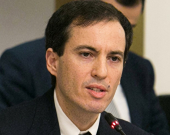
PROFESSOR MICHAEL MOUSSEAU TO GULAN: The world should brace for more economic downturn, but the disruption will not last

Michael Mousseau is professor of international relations who specializes on the link between economy, society, and conflict. His economic norms theory has been published in dozens of articles, including Conflict Management and Peace Science (2005, 2018), Democratization (2016), European Journal of International Relations (2003), International Interactions (2002, 2010), International Security (2002, 2003, 2009, 2019), International Studies Quarterly (2003, 2012, 2013), Journal of Conflict Resolution (1998, 2000), the Journal of Human Rights (2022), the Journal of Peace Research (1997, 1999, 2008, 2011), and Structural Change and Economic Dynamics (2023). Mousseau has been a research fellow at the United Nations Studies Program, Yale University (2003); the Belfer Center International Security Program, Harvard University (2005 – 2006); and the Saltzman Institute of War and Peace Studies, Columbia University (2010-2011). His PhD is from Binghamton University (1998). Prior to coming to UCF in 2013 he was a professor of international relations at Koç University in Istanbul. Mousseau was a founder of the Eurasian Peace Science Network (2010). In 2020 he was awarded the Excellence in Graduate Teaching Award by the College of Sciences at UCF. In a written interview he answered our questions like the following:
Gulan: In terms of economics, are Mr. Trump’s tariffs sensible? Do they seem to be a wise choice?
Professor Michael Mousseau: It is hard to make sense of Trump’s tariffs. Foremost, they go flatly against the normal trade relations principle that lies at the basis of the global trading order since WWII. In this principle, tariffs are set per product, not per nation, and every country offers every other country the tariff rate they give their ‘most favored’ nation. Trump is now upending this 80-year norm by setting tariff rates per nation. Worse, he is setting the rates per nation according to the U.S. trade balance with that nation, with the objective of achieving a trade balance with each and every country. This makes no economic sense because countries produce and trade different things and are, therefore, bound to have trade imbalances. For instance, American consumers may prefer chocolate from Ghana even as Ghanaians may be too poor to purchase the equivalent amount of goods from the U.S. The result will be Americans consuming less chocolate and paying more customs taxes. Finally, Trump’s overall goal of achieving a trade balance is a major mistake because the U.S. acts as the engine of the global economy. With the economic depression of the 1930s, American leaders learned that the U.S. was too big to sustain a trade surplus, as doing so harms the global economy and comes back to harm the American economy. The U.S. is better off with a trade deficit, which is always matched with foreign investment. Commerce is a win-win for everyone, regardless of trade deficit or surplus.
Gulan: By creating a narrative of alleged exploitation by both allies and adversaries, Donald Trump announced an economic war on the world on Wednesday. With the use of emergency powers in unprecedented ways, do you agree with premise of his allegations?
Professor Michael Mousseau: Donald Trump’s narrative is misleading and simplistic. However, like most narratives, there is some element of truth to it. Generally, the U.S. is a relatively open trading nation, especially regarding manufactured goods from developing countries. The U.S. built the global trading order after World War II and instituted some principled disadvantages for itself regarding tariff-making and currency valuations. U.S. leaders did this partly because of the belief that if other countries do well, the U.S. will also, and partly because of the American strategy of containment against the Soviet Union during the Cold War. Many countries have successfully developed their economies with substantial U.S. help, and some of these countries have various tariff and non-tariff trade barriers that are arguably targeted at U.S. products. However, the U.S. also has multiple tariff and non-tariff trade barriers that can be arguably described as targeted at blocking imports. While the U.S. overall has acted as a generous provider of markets and capital to other countries, many American domestic producers have managed to get multiple tariff, non-tariff, and quota protections from foreign competition, including American farmers and textile and automobile manufacturers. In short, there is some element of truth to the claims that the U.S. has historically been more generous with other countries than many are now with the U.S. However, Trump seems to think that U.S. historical generosity has harmed the U.S. economy when most economists would agree that U.S. historical generosity has substantially boosted the U.S. economy since WWII and continues to do so.
Gulan: Was it not possible for Mr. Trump to opt for measures that were less drastic in order to achieve his objectives?
Professor Michael Mousseau: There are many less drastic measures Trump could have adopted. If his objective was to reduce the U.S.’s trade deficit, he could seek to end the U.S. annual budget deficit, which exacerbates the U.S. trade deficit by increasing the demand for imports. Also, under IMF and WTO rules, the U.S. could seek to weaken the dollar's value compared with other global currencies, making U.S. exports more competitive in global markets. The U.S. could also have used the procedures in place at the World Trade Organization to charge countries allegedly undercutting U.S. exports with non-tariff barriers. Alternatively, the Trump Administration could have engaged in more targeted tariffs aimed at countries that may be clearer offenders, such as China. Finally, and perhaps most importantly, Trump could have acted more slowly, giving investors and countries time to adjust to the significant global changes.
Gulan: Does this economic tug of war among established democracies weaken the core principles of democratic peace, or is it of no consequence?
Professor Michael Mousseau: The alliance among the established democracies will not weaken. This alliance is not a function of U.S. leadership or what some call U.S. ‘soft’ power: it is a function of common values and interests. Therefore, the other established democracies will continue working closely together even if the U.S. relinquishes its leadership role and reduces its commercial role.
Gulan: Some analysts say that the U.S. president dismantled nearly a century’s worth of initiatives aimed at establishing a largely peaceful and prosperous global economic order, should the world brace for more economic downturn and disruption?
Professor Michael Mousseau: The world should brace for more economic downturn, but the disruption will not last. Trump is an extreme and unusual case, and Trumpism will be gone after the 2028 U.S. elections, if not sooner. The other established democracies will continue working closely together. Combined, their populations and economies still swamp Russia and China; thus, the world order will hold fast. Still, the next few years will be bumpy because the global economy depends on confidence, and the fact that one person in the office of president of the U.S. can create such chaos and unpredictability has shaken this confidence. The restoration of confidence will require some credible limitations on the tariff power of the U.S. president.
Gulan: Economic nuclear war is how some critics have described the potential outcome of this policy. Do you think that’s an accurate description?
Professor Michael Mousseau: The leaders of the established democracies have calculated that they must avoid a trade war with the U.S., one way or another. Many have seen that their best strategy is to stay quiet and let the stock and bond markets restrain Trump. China is different: its leadership is not constrained by stock and bond markets, and they have hegemonic ambitions. They are also constrained by domestic nationalist sentiment to not look submissive to U.S. demands. However, if there is a major trade war and a decoupling of the U.S. and Chinese economies, China will lose far more than the U.S., and this will substantially impede China’s quest for hegemonic status. China’s leadership must realize this, and thus, they might decide to negotiate quietly.
Gulan: Are we not stepping into a time when political decisions are entirely governed by economic factors?
Professor Michael Mousseau: It is helpful to grasp the bigger historical picture. The U.S. never wanted to be the world's leader, and the American people would be happiest if they could be like Switzerland, neutral in everything and uninvolved in global affairs. The problem the Americans have is that they are too big to be Switzerland. This lesson was learned in the 1930s when the U.S. sought trade surplus and political neutrality. This caused global economic collapse, political extremism, and World War II. After this war, U.S. leaders realized that the U.S. must not sustain a trade surplus and must instead act as the engine of the global economy as the largest buyer of global goods. The U.S. would also have to act as the keeper of global order, as it was the only country large and widely trusted enough to do that. The problem today is that American voters seem to have forgotten the lessons of the 1930s. Trump walked into this sentiment and won the presidency with it. Unfortunately, it will take some pain, such as an economic recession, before American voters substantially relearn that the U.S. needs the world, and the world needs the U.S.