Iraqi Parliament to Begin Debate on Contentious PMF Service and Retirement Law
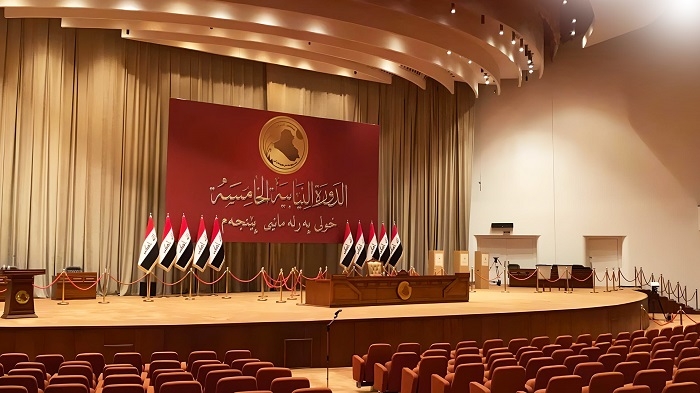
The Iraqi Parliament is set to reconvene on Monday at 8:00 PM for a highly anticipated session, with the controversial Popular Mobilization Forces (PMF) Service and Retirement Law taking center stage for its first reading. The proposed legislation, comprising 18 articles, aims to regulate the PMF’s internal structure, including service terms, retirement procedures, promotions, leave policies, and financial entitlements.
The bill has been a source of intense political friction among Iraq’s Shia factions, with State of Law coalition leader Nouri al-Maliki and the Sadiqoun bloc, affiliated with Asaib Ahl al-Haq, previously boycotting sessions in protest of the law’s delayed inclusion on the legislative agenda. Their disputes revolve around key structural and financial provisions, particularly regarding which factions within the PMF will benefit most.
A Turning Point for Iraq’s Security Landscape
The PMF, an umbrella group of mostly Shia militias formed in 2014 to combat ISIS, has long sought equal status with Iraq’s formal security institutions. The new legislation is seen as a pivotal step in either integrating or further entrenching the PMF within Iraq’s military structure. Supporters argue that institutionalizing the PMF under state authority would enhance transparency and oversight, while critics warn that the bill could deepen parallel chains of command and politicize the armed forces.
According to a report by The Washington Institute for Near East Policy, the law is less about reform and more about securing political and financial advantages for Iran-aligned factions. Analysts Hamdi Malik and Michael Knights caution that the bill could solidify the PMF’s role as a parallel military force akin to Iran’s Islamic Revolutionary Guard Corps (IRGC), especially as the organization remains under the leadership of U.S.-designated figures like Faleh al-Fayyad and Abu Fadak of Kataib Hezbollah.
The law has faced significant opposition over its lack of alignment with Iraq’s existing Military Service and Retirement Law (Law No. 3 of 2010). Instead, the PMF has sought its own independent legislation since 2019, with previous drafts expanding from 39 to over 100 articles before being retracted earlier this year.
Financial and Political Implications
The bill also carries major financial implications, as the PMF’s budget has surged in recent years. The group’s personnel count has expanded from 122,000 to 238,000, while its state funding has exceeded $3.4 billion in 2024. The Council of Ministers approved a revised version of the bill on February 25, 2025, amid concerns that the United States might impose further sanctions on PMF-affiliated groups.
While the new draft proposes restructuring the PMF to mirror Iraq’s official security institutions, it remains vague on key details, fueling speculation that it is designed to maintain the group’s autonomy. Internal disagreements persist over retirement age provisions and the extent of government oversight, with factions in the Shia Coordination Framework expressing concerns that stricter regulations could undermine the PMF’s strategic independence.
A Contentious Debate Expected
Monday’s session is expected to generate heated debate, reflecting broader power struggles within Iraq’s post-ISIS security and political landscape. The first reading will set the stage for future amendments, with potential ramifications for Iraq’s governance, stability, and relations with the international community.
The United States has signaled that it will be closely monitoring developments, warning that it will distinguish between superficial adjustments and genuine reforms aimed at curbing the influence of terrorist-designated groups within Iraq’s security institutions.