Germany's 2025 Federal Election: CDU Emerges Victorious as Coalition Talks Loom
Germany’s federal election has concluded with the Christian Democratic Union (CDU) and its Bavarian sister party, the Christian Social Union (CSU), securing the largest share of the vote. CDU leader Friedrich Merz is poised to become Germany’s next chancellor, but the path to forming a government remains uncertain as coalition negotiations begin.
Election Results and Turnout
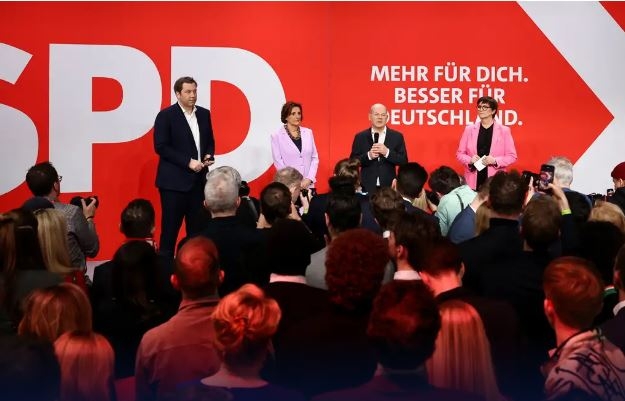
The CDU/CSU bloc won 20.8% of the vote, narrowly edging out the far-right Alternative for Germany (AfD), which secured 19.5%. The center-left Social Democrats (SPD) suffered a significant setback, dropping to 16.4%, while the Greens and the socialist Left Party also saw mixed results.
Voter turnout reached 82.5%, the highest since German reunification in 1990, signaling strong public engagement in the democratic process. This marks a notable increase from the 76.4% turnout in the 2021 election.
Coalition Talks Begin
With no party securing a majority, Merz has begun talks to form a coalition government. He has ruled out cooperation with the AfD, reiterating his commitment to democratic norms. The most likely scenario is a revival of the "grand coalition" between the CDU/CSU and the SPD, despite tensions between the two parties.
SPD General-Secretary Matthias Miersch acknowledged the challenges ahead, stating, "The democratic center must try to work together in times like these." However, SPD members will ultimately decide whether to join the coalition.
AfD’s Strong Performance in the East
The AfD celebrated significant gains, particularly in eastern Germany, where it won nearly every constituency. The party’s co-chair, Tino Chrupalla, hailed the results as a rejection of the "firewall" against far-right participation in government. The AfD’s success has raised concerns among centrist parties and civil society groups, with the Bavarian Jewish community expressing alarm over the party’s antisemitic rhetoric.
Left Party’s Resurgence
The socialist Left Party emerged as the strongest force in Berlin, securing 19.9% of the vote, nearly double its 2021 result. Party leader Jan van Aken dismissed the breakaway Sahra Wagenknecht Alliance (BSW), which failed to clear the 5% threshold, as a "flash in the pan." The Left Party has vowed to push for progressive policies, including rent control and social welfare expansion.
International Reactions
World leaders, including French President Emmanuel Macron and Ukrainian President Volodymyr Zelenskyy, congratulated Merz on his victory. Macron emphasized the importance of Franco-German cooperation for a "strong and sovereign Europe," while Zelenskyy expressed hope for continued support in Ukraine’s defense against Russia.
U.S. President Donald Trump, despite Merz’s criticism of his administration, congratulated German conservatives, stating, "The people of Germany got tired of the no common sense agenda, especially on energy and immigration."
Coalition negotiations are expected to be lengthy, with the CDU/CSU needing to secure 316 seats for a majority. The process could take weeks or even months, as seen in 2017 when Germany went without a government for nearly six months. Once a coalition is formed, German President Frank-Walter Steinmeier will nominate Merz as chancellor, subject to a vote in the Bundestag.
As Germany navigates this political transition, the rise of the AfD and the resurgence of the Left Party highlight the deepening polarization within the country. The new government will face significant challenges, including economic recovery, energy policy, and maintaining unity in the face of growing far-right influence.