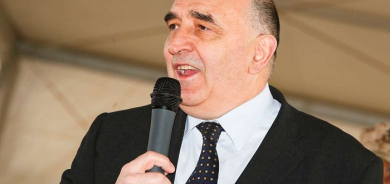
Dr. Hanna Ojanen to Gulan: The EU Has Been Considerably Speeding Up… The EU Needs Both, Civilian and Military Power

Dr. Hanna Ojanen is a Finnish political scientist and an expert on European Union foreign, security, and defence policy. She has held senior research and academic positions at leading European institutions and has advised policymakers on EU security, NATO–EU relations, and European strategic culture. Her research focuses on EU geopolitics, crisis management, international institutions, and the evolution of European security cooperation.
Gulan: Over the past decade, the EU has launched sanctions regimes, security missions, and unprecedented financial and military support packages, most visibly in response to Russia’s invasion of Ukraine. Taken together, do these actions indicate that the EU has genuinely evolved into a geopolitical and security actor, or do they still reflect a reactive system dependent on crises to generate unity?
Dr. Hanna Ojanen: I think the evolution of the EU towards more of a security actor has been considerably speeding up because of crises that show that something really needs to change. While Russia’s war of aggression on Ukraine was, and is, one such major crisis, the past weeks show that President Trump’s speeches and actions amount to a crisis, too. Notably, the way he ignores or dismisses existing institutions and treaties means that this is a crisis inside transatlantic cooperation. It has wide implications, economic and trade as well as security and defence.
Gulan: Ukraine is often described as the EU’s most consequential foreign policy test. Despite strong economic sanctions and political support, Europe has remained heavily reliant on U.S. military leadership. Does the Ukraine war expose structural limits in the EU’s capacity to act independently in high-intensity conflicts, or is this dependence a strategic choice rather than a weakness?
Dr. Hanna Ojanen: Here, again, I see two different sides to the question. On the foreign policy side, the Russian war on Ukraine has led to important decision-making innovations, in part finding ways to circumvent unanimity, in part finding ground for the use of qualified majority voting. This makes the EU stronger, and, when majority voting starts to extend to the realm of foreign and security policy, it makes the EU also a unique international organisation or actor, as that has never happened before.
The second side, depending on the US in the field of defence has been to a large extent something that both sides happily agreed on. It meant that the USA could have a very strong say in European defence through NATO, while the EU could concentrate on matters other than military, at least for a long time. Now, if the USA under President Trump is becoming unreliable, the need for more independence grows. One way of answering that need is through ad hoc cooperation, such as the Coalition of the Willing, that includes both EU and non-EU countries.
Gulan: The EU consistently frames its foreign policy around international law and a rules-based order, particularly in Ukraine. Yet in other conflicts, such as Gaza, enforcement of these norms appears far more contested and selective. How sustainable is the EU’s normative credibility when legal principles collide with geopolitical alliances and strategic interests?
Dr. Hanna Ojanen: The EU does struggle in upholding its overall image of a Union that is a staunch supporter of international rules-based order. Traditionally, one reason for the selective picture has been that the common policies have not covered all foreign policy, but only what the member countries agree on. Thus, there has been no common policy on Russia, on the USA, or on, say, Israel, to start with. Different member states have been adamant about their bilateral relations with such countries. The example of Russia might be a positive sign here, though: even though some member countries position themselves on Russia’s side – say, Hungary – they have not been able to stop the new measures taken.
Gulan: How have the wars in Ukraine and Gaza, alongside escalating Middle Eastern tensions, reshaped European thinking on deterrence, borders, sovereignty, and the legitimacy of force? Are we witnessing a deeper transformation in Europe’s strategic culture, or merely temporary adjustments driven by exceptional crises?
Dr. Hanna Ojanen: A European strategic culture might be on its way. Thus far, strategic culture scholars have been looking mainly at single states’ strategic cultures and then tried to find something similar in the EU, or in NATO. I would say we now see much more how countries with traditionally different strategic cultures (Germany, France) need to come together and there is much more interaction at that deeper level of strategic thinking, too. Now, the Greenland case seems to bring up clear unity when it comes to borders and sovereignty. When it comes to deterrence and use of force, thinking is changing overall, as the European countries start seeing that they might need to play a bigger role.
Gulan: For decades, Europe emphasized crisis management, civilian power, and restraint in the use of force. In light of recent conflicts, do you see a shift toward a more traditional understanding of power and intervention, or does Europe still fundamentally resist hard-security logic despite growing instability?
Dr. Hanna Ojanen: I think the EU needs both, civilian and military power. A significant change is from crisis management outside the EU to security and defence of the EU’s own territory. Interestingly, the times in late 1990s and still in the 2000s were such that one did not even ponder on the use of, e.g., EU Battle Groups, on the EU’s territory. Now, the discussion is very different, as manifested for instance by the investment in military mobility within the EU.
Gulan: For European states that are not great powers, participation in EU and NATO frameworks offers security guarantees but also constrains independent decision-making. In today’s polarized international system, how do these states balance alliance loyalty with national risk management, especially when conflicts escalate beyond Europe’s immediate borders?
Dr. Hanna Ojanen: There is a big difference between the two frameworks as NATO is purely intergovernmental, takes decisions by consensus that leaves a lot of leeway for the member states, while the EU is partially supranational with binding decisions. For the smaller member states, the task is to spell out their views and needs inside these two frameworks. They need cooperation even more than before, also in new formats and subregionally, for instance, the Nordic countries among themselves.