Abdel Fattah el-Sisi threatens to invade Libya to support warlord ally Khalifa Hafta
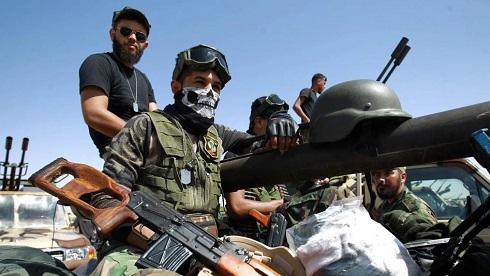
Meanwhile, Ankara has urged forces led by the eastern-based Field Marshal Haftar to withdraw from the strategic city for a ceasefire agreement to be reached.
The UN-recognised Government of National Accord in Tripoli has made major military gains against Marshal Haftar’s forces recently thanks to increased support from its backer Turkey.
The key city of Sirte, 450km east of the capital Tripoli, is under the control of Marshal Haftar’s forces, who last year launched a recently aborted attempt to seize control of western Libya.
In a televised address, Egyptian President Abdel Fattah el-Sisi said Sirte was a “red line” for Egypt, citing the need to protect its porous border as grounds for “direct intervention” in Libya.
“If the Libyan people asked us to intervene, it is a signal to the world that Egypt and Libya share … common interests, security and stability,” Mr Sisi said late on Saturday.
The GNA denounced Mr Sisi’s warning, saying any intervention would be a threat to Libya’s security. “We strongly reject what was said by el-Sisi and consider it a continuation of the war on the Libyan people, interference in Libyan affairs and a dangerous threat to national security,” said Mohammed Amari Zayed, a member of the GNA’s presidential council. “There can be no ‘red line’ within our borders. We reject any bid aimed at dividing the Libyan people or their territory and we categorically reject any bid to impose guardianship on Libya,” he added.
Turkey also vowed to continue supporting the GNA’s push for Sirte and demanded the evacuation of Marshal Haftar’s forces from the city for a “sustainable ceasefire.”
Libya has been torn by violence, drawing in tribal militias, jihadists and mercenaries since the 2011 toppling and killing of longtime dictator Muammar Gaddafi in a Western-backed uprising. The oil-rich country is split between rival administrations in the east and west, with the conflict attracting increasing foreign involvement. Besides Egypt, Russia and the United Arab Emirates back Marshal Haftar, while the GNA is supported by Turkey and Qatar.
“Any direct intervention by Egypt now has international legitimacy, whether under the UN charter on self defence or at the discretion of the only legitimate elected authority in Libya: the Libyan parliament,” Mr Sisi said.
Like Marshal Haftar, the head of the Libyan parliament is based in the east of the country, where they are both supported by Egypt.
The GNA has vowed to take Sirte, Marshal Kadhafi’s hometown and a strategic access point to Libya’s key oilfields. It is also the last major settlement before the traditional boundary between western Libya and Marshal Haftar’s stronghold in the east.
“Some think they can trespass on the Sirte or Al-Jura frontline. This for us is a red line,” Mr Sisi said.
Turkish presidential spokesman Ibrahim Kalin said a ceasefire in Libya would be possible if Marshal Haftar’s forces withdrew from Sirte and Al-Jufra.
“It should be a sustainable ceasefire, meaning that the other side, the LNA (Libyan National Army), should not be in a position to launch another attack on the legitimate Libyan government any time it wants,” Mr Kalin said.
Later, Saudi Arabia and the UAE voiced their backing for Mr Sisi. Cairo proposed its own ceasefire in Libya earlier this month but it was dismissed by the GNA. That proposal also called for withdrawal of foreign mercenaries, and disbanding of Libyan militias.
AFP