Germany and France propose 500-bn-euro coronavirus package for Europe
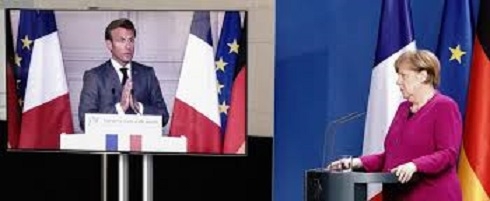
The billions should be raised as debt on the markets in the name of the EU, then distributed as direct budgetary funds to the worst-hit regions and sectors, French President Emmanuel Macron and German Chancellor Angela Merkel said.
The plan represents a bid by the two leading members of the bloc, which is headed for a recession of historic proportions, to speed up progress on setting up a recovery programme.
Close allies Germany and France had previously been on opposing sides of the debate on EU fiscal stimulus, with Paris pushing for a far more ambitious vision than Berlin.
The European Commission is due to present its an official proposal for EU leaders to consider on May 27 after a delay of some weeks.
A first package of short-term loan assistance of up to 540 billion euros had already been agreed by the EU countries in early April.
The new plan would have to win the support of all 27 member states of the European Union, but Macron said Paris and Berlin wanted to help ensure unanimity by offering a vision of "the necessity of this response, the mechanism for it, and its scale."
The new initiative was "a real change of philosophy," Macron said in a joint press conference by video link from the Elysee with Merkel in Berlin.
"For the first time together, what we propose is to raise a common debt in the market" in order to transfer budgetary funds to the worst-affected sectors sectors and regions, he added.
Merkel, more cautiously, described the plan an "extraordinary, one-time effort."
"The goal is that Europe comes out of this crisis strengthened, cohesive and in solidarity," the chancellor said.
The commission, which is responsible for proposing how integrate the recovery mechanism within the bloc's next long-term EU budget, welcomed the Franco-German proposal.
"It acknowledges the scope and the size of the economic challenge that Europe faces, and rightly puts the emphasis on the need to work on a solution with the European budget at its core," President Ursula von der Leyen said in a statement.
The Franco-German suggestion "goes in the direction" of what the commission branch is working on itself, von der Leyen said.
The Franco-German plan also calls for more health powers for the EU, and measures to ensure the bloc's strategic independence.
The EU should be empowered to build up stocks of masks and tests, set up joint purchasing and production schemes for treatments and vaccines, and establish "joint pandemic prevention plans" as well as shared methods to identify cases, Macron said.
"This Europe of health has never existed. It must become our priority," he urged.
Merkel said European countries should focus on strengthening their companies on the global market while overcoming the coronavirus pandemic.
The EU already supports strategic projects, such as the domestic production of computer chips and batteries. "These efforts will now be strengthened," Merkel said in Berlin.
Other countries make great efforts to make world champions of their companies, Merkel said, and the EU will do the same with its coronavirus fund.