Historic trial of suspected Syrian war criminals begins in Germany
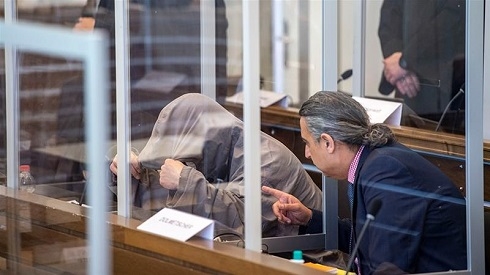
One of the defendants, identified only as 57-year-old Anwar R under German privacy laws, is said to be a former intelligence service official who is accused of organizing the brutal maltreatment of thousands of people in a prison in Damascus.
The other, identified as 43-year-old Eyad A, allegedly brought dozens of protesters to the prison.
The German attorney general says the trial, which is taking place in the city of Koblenz, was the "first criminal trial worldwide of members of the Assad regime for crimes against humanity."
Patrick Kroker, the lawyer representing several suspected victims of torture as joint plaintiffs, said, "Some of them still carry today the marks of torture on their body."
His clients are expected to give detailed testimony of their treatment in court.
"The blame goes up to the highest echelons of government," Kroker later said after the trial started.
Amnesty International hailed the trial as a "milestone" in the fight for justice for war crimes committed in Syria.
The defendants appeared unmoved as the gruesome allegations were read out by the prosecution on day one of the trial.
The 104-page indictment is based on witness testimonies from two dozen people claiming to be victims.
The indictment against Anwar R refers to crimes against humanity allegedly committed in 2011 and 2012. He is faces 58 counts of murder, as well as rape and serious sexual assault charges.
He said via his lawyer that he will respond to the charges in writing at a hearing on April 27.
Eyad A, who has been charged with acting as an accessory to 2011 crimes against humanity, is to remain silent.
Prosecutors say Anwar R was responsible for the torture of at least 4,000 people in the Damascus prison, run by the General Intelligence Directorate, in which he is said to have held a top role. At least 58 people allegedly died as a result.
Eyad A allegedly brought at least 30 people to the facility in the Syrian capital, where prosecutors say inmates were subjected to inhumane conditions as well as physical and psychological torture.
Victims were allegedly beaten with sticks, cables and whips, and given electric shocks. Some prisoners had their wrists strapped to the ceiling so that their toes were barely touching the ground, while others were kept awake for days, according to the charges.
The two defendants left Syria in 2012 and 2013, according to prosecutors. They are said to have arrived in Germany in 2018.
They were arrested in February by German police in Berlin and the state of Rhineland Palatinate after being recognized by refugees who said they had been targeted by the men in their home country.
Al-Assad has fought to maintain control over his country since peaceful protests in March 2011 spiralled into civil war. The initial protest movement of the Arab Spring was brutally repressed.
On the sidelines of the trial, senior public prosecutor Jasper Klinge spoke about the trial in the context of Germany's dark past as a wartime dictatorship.
"We owe it to the victims, some of whom live among us, but also in terms of our historic responsibility, to bring those responsible to justice it this is within our capabilities," he said.
Such atrocities can be tried in Germany even if they took place outside the country and the victims were not German.
According to the German Judges' Association, the attorney general is currently investigating 100 suspected crimes against humanity, including in Syria, Iraq, Libya, Afghanistan, Mali, Nigeria, The Gambia, Ivory Coast and Congo.
"War criminals find no shelter in Germany," association head Sven Rebehn told dpa. "The work of the German justice system in the field of international criminal law sets a global standard."
Thursday's trial got under way with anti-coronavirus measures in place. The court gallery was open at a third of its regular capacity and many participants were wearing face masks.