Syrian regime behind 2017 chemical attacks: watchdog
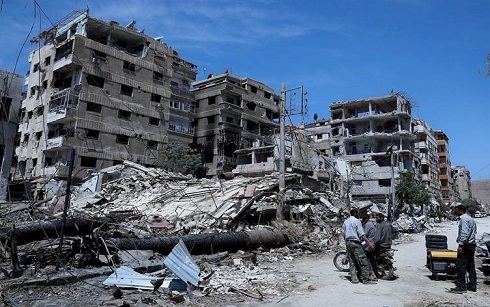
The Organisation for the Prohibition of Chemical Weapons (OPCW) announced on Wednesday that "there are reasonable grounds" to blame Syrian President Bashar al-Assad's regime for the use of nerve agent sarin and chlorine gas in attacks on the town of Ltamenah, Hama province.
The findings come in the first report since the OPCW's Investigation and Identification Team (IITT) began work in June 2019 to identify the perpetrators of the chemical attacks.
According to the IITT, military fighter jets dropped sarin gas over the town on March 24 and March 30, affecting at least 120 people. It also accused a Syrian Arab Air Force helicopter of dropping a chlorine gas cylinder on the roof of a hospital on March 25, affecting at least 30 people.
"Military operations of such a strategic nature as these three attacks only occur pursuant to orders from the highest levels of the Syrian Arab Armed Forces," the OPCW said, adding they will submit the report to the United Nations for their consideration.
The OPCW, however, said that that their investigation was unable to identify the precise chain of command.
"Even if authority can be delegated, responsibility cannot. In the end, the IIT was unable to identify any other plausible explanation," said IIT coordinator Santiago Onate-Laborde.
Western countries and rights groups condemned the Assad regime following the release of the report, according to AFP.
"No amount of disinformation from Assad's enablers in Russia and Iran can hide the fact that the Assad regime is responsible for numerous chemical weapons attacks," AFP quoted the US Secretary of State Mike Pompeo as saying.
"Such a blatant violation of international law must not go unpunished, "added German Foreign Minister Heiko Maas.
Damascus has categorically denied the use of chemical weapons and claimed that it has handed over its weapons stockpiles under a 2013 agreement, following a suspected sarin gas attack which killed 1,400 people in the Damascus suburb of Ghouta.
Russia, a staunch ally of Assad has too on multiple occasions rejected claims that Syria was responsible for chemical attacks.
Despite objections from Damascus and Moscow, OPCW member states agreed in 2018 to give the organisation powers to investigate who was responsible for the chemical attacks in the country. The organisation previously only had a mandate to say whether or not an attack had occurred.
A joint investigative mechanism between the United Nations and the OPCW was disbanded after accusing Damascus of using chlorine gas in at least two attacks in 2014 and 2015, as well as the 2017 sarin gas attack on Khan Sheikhoun that killed approximately 100 people.
Rudaw