EU dampens hopes for quick border solution ahead of Erdogan visit
European Commission President Ursula von der Leyen and European Council President Charles Michel are expected to insist in the meeting scheduled for early evening that Turkey adhere to the joint refugee agreement of 2016.
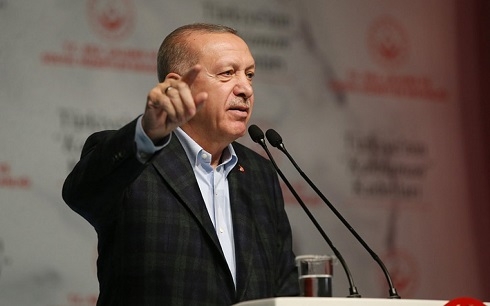
Erdogan, in turn, is likely to demand further financial aid.
The Turkish leader called for clear support from NATO during his meeting with Secretary General Jens Stoltenberg on Monday afternoon.
Erdogan had already given NATO a list of 10 requests including greater air support on the Turkish-Syrian border, more reconnaissance aircraft, surveillance drones and more ships in the eastern Mediterranean, according to diplomatic sources.
On Monday, Stoltenberg said the alliance was already supporting Turkey and would continue to do so.
Ahead of her later meeting with Erdogan, von der Leyen said that the situation appeared deadlocked. "Today we are in the middle of a deep dilemma," she said.
The events clearly indicated politically motivated pressure on the EU's external borders, she added. At the same time, the migrants who were holding out at the border needed help, as did Greece.
Von der Leyen dampened hopes that a solution could be found quickly. "This is only the beginning of talks," she said, adding that she did not know which demands Erdogan would bring to the table.
Erdogan had declared on February 29 that the border with the EU was open to migrants, which is a violation of the EU-Turkey agreement.
Greek Prime Minister Kyriakos Mitsotakis, speaking at a German-Greek economic forum in Berlin, said Greece and the EU will not allow themselves to be "blackmailed" by Turkey over the migrant crisis.
Mitsotakis said that this was a "critical" moment for Greece and Europe and demanded that Erdogan contribute to de-escalation during his visit to Brussels on Monday.
He said that Turkey was trying to turn tens of thousands of migrants into "illegal intruders." The EU's external border had to be protected, Mitsotakis said, and he urged Turkey to take back illegal migrants who have been arrested on Greek territory.
German Chancellor Angela Merkel, speaking at the same forum in Berlin, expressed determination to prevent a repeat of the European refugee crisis, saying that "2020 is not 2015" and calling Turkey's actions "unacceptable."
She assured citizens that politicians are holding myriad meetings in order to find a solution to the problem and to get migration under control, a goal that has so far evaded the divided EU member states.
Thousands of migrants recently set off towards the EU border in Greece, where Greek border troops prevented them from crossing. Greece suspended asylum procedures for new applicants one month.
After a week of skirmishes with migrants attempting to break through the border fence, tear gas flying both ways and alleged provocation by Turkish patrols, the border zone was quieter on the day of Erdogan's trip.
Greek state broadcaster ERT quoted police as saying that only a few stone-throwing incidents occurred between Sunday evening and Monday morning
Athens authorities said that they prevented around 1,650 attempts to cross the border illegally at the Kastanies/Pazarkule crossing and detained two who managed to make it onto Greek soil. Arrivals were also lower than usual on the Greek Aegean islands.
Finding a solution required taking pressure off the borders while respecting the right to seek asylum, von der Leyen said, and also helping Greece and Turkey.
With regard to unaccompanied refugee children on the Greek Aegean islands, von der Leyen affirmed that the most vulnerable must be helped. It was urgent to bring people to the European mainland, she said.
Last week she appealed to EU members to take in children. Several states, among them France, Portugal, Luxembourg, Finland, Croatia and Germany, indicated they were willing to help.
On Monday the German coalition decided to offer Greece support from Berlin for up to 1,500 children.
The EU-Turkey agreement of 2016 stipulates that Ankara will prevent illegal migration towards the EU. In return, the bloc promised 6 billion euros (6.8 billion dollars) to care for Syrian refugees in Turkey.