Local leaders in Nineveh reject Iraq's decision to move ISIS-affiliates from Syria to Amla camp
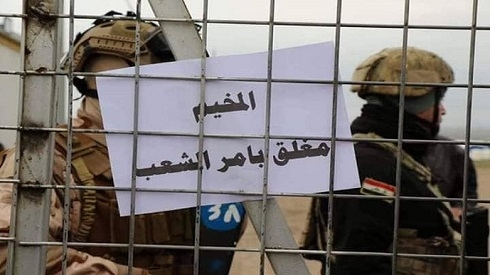
Tribal leaders and civilians from the Zummar and Rabia sub-districts of Nineveh Province participated in the event at the camp, commonly referred to as al-Amla. The facility falls in northwest Nineveh Province in Zummar sub-district. Baghdad reportedly began building the facility three months ago and has so far completed half of it.
The protest comes after Baghdad recently partially concluded construction of the new facility and agreed with the Kurdish-led authorities in eastern Syria to host ISIS-affiliated families—most of whom are reportedly women and children—at the camp.
Although the move is only planned to take place in early March, locals have expressed their disagreement and fears of a potential security risk should the federal government go through with its decision.
Read More: Iraq quietly building camp to hold families of ISIS fighters held in Syria, MP says
“In a joint decision by all of the [local] tribal leaders, we closed down the gate of the camp,” Masoud Sleman, the head of the Gargari tribe in the area, was quoted as saying on Saturday in Iraqi media. He said they expected the government to revoke its decision, “Otherwise we will have other initiatives.”
“We assure the Iraqi government that we will not allow any of Da’esh [ISIS] women and children to be transferred here,” Sleman added, speaking at the gathering in the camp.
Ahmed Jaafer, a senior official in the Zummar sub-district local government, told local media that “the decision is a unanimous one by the tribes living in the area, and we will not allow construction to continue at the camp.”
In the gathering of the tribes of Zummar and Rabia in, the deputy of Nineveh’s Governor, and members of the national parliament were present as they directed a request to Iraq’s Ministry of Migration and Displacement (MoMD) representation office to revoke the decision of transfer.
The al-Hol camp in northeastern Syria currently holds roughly 30,000 Iraqis, a majority of them women and children. Some previously fled from the Islamic State in Iraq while others lived under the terror group’s rule in Syria until its military defeat in March 2019.