Political shock in Germany as Merkel's would-be successor stands down
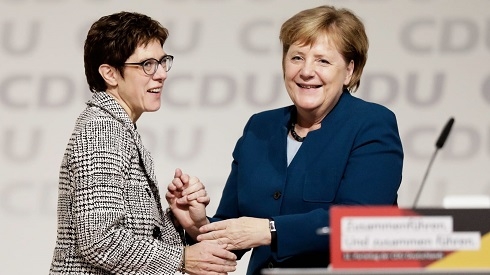
The news came amid political turmoil involving the CDU in the state of Thuringia, but Kramp-Karrenbauer said that her decision to not run for German chancellor and to soon relinquish leadership of the CDU was not a spontaneous one.
"This decision has been ripening and growing in me for some time," she told journalists in Berlin.
She said splitting the posts of chancellor candidate and CDU leader - a move backed by Merkel - had been a mistake: "The open question of the chancellor candidacy is weakening the CDU at a time when politics in Germany...depends on a strong CDU."
The party chairmanship and the candidacy should again be held by the same person, Kramp-Karrenbauer argued. She said she will remain party leader until a party conference decides on who should seek to replace Merkel.
Kramp-Karrenbauer also announced that she will remain Germany's defence minister at Merkel's request. The post is often seen as tricky due to the country's ageing military equipment and its often-conflicted position on foreign military intervention.
The 57-year-old, who progressed from local politics in the small southern state of Saarland to take on a leading role at national level, had been tipped for the top job of chancellor even before she was elected CDU leader in 2018 as part of Merkel's plan to gradually bow out of German politics. The next elections are expected in 2021.
However AKK, as she is colloquially known, has since been hit by a number of scandals, not least following a vote in Thuringia last week that saw members of her CDU vote alongside the far right in order to elect the head of government there.
Only 14 months after Kramp-Karrenbauer took its reins, the CDU now risks a new power struggle, which could make things difficult for Merkel and have repercussions for the CDU's governing coalition with the Social Democratic Party (SPD).
Kramp-Karrenbauer stressed that she saw no implications for the coalition. But SPD leader Norbert Walter-Borjans called for urgent clarity on the CDU's direction.
"The events at the helm of the CDU are very worrying," he said. "The CDU is in a factional dispute, and has been for some time visibly without leadership."
Carsten Linnemann, deputy leader of the CDU parliamentary group, spoke of a "deep crisis" in his party: "It is split like rarely before." He said there is a need for "a strong personality that can reconcile, but also lead."
Walter-Borjans called for the CDU to clarify its relationship with the far right.
Kramp-Karrenbauer and Merkel both sharply criticized the election of Thomas Kemmerich as Thuringia state premier last week, which saw him voted into office by the CDU, far-right Alternative for Germany (AfD) and his pro-business Free Liberals.
But Kramp-Karrenbauer did not prevail in the Thuringia CDU with her call for new elections to quickly be held.
According to CDU sources, Kramp-Karrenbauer told senior party figures that there is "an unexplained relationship" between parts of the CDU, the AfD and far-left party Die Linke.
Kramp-Karrenbauer had come under pressure over her refusal to work with both parties. Die Linke won the Thuringia vote but has struggled to form a coalition.
Working with the AfD is seen as a red line for German political parties but many left-of-centre establishment parties have argued that Die Linke cannot be equated with the AfD, which has been accused of harbouring Nazi sympathizers and fuelling anti-Semitism.
Party sources told dpa that she had not informed senior CDU figures of her decision to stand down ahead of time. Her shock announcement met a long silence from her colleagues, sources said, adding that no one immediately threw their hat into the ring to be the leading election candidate for Germany's strongest party.
CDU deputy leader Armin Laschet, seen as a possible chancellor, was not at the meeting because of a winter storm that hit Germany at the weekend.
Kramp-Karrenbauer was chosen to lead Merkel's party following a narrow victory over long-time CDU politician Friedrich Merz. Health Minister Jens Spahn came third.
Speculation around the next CDU chancellor candidate has focused on Laschet, Merz and Spahn, as well as on Markus Soeder, the leader of the CDU's Bavarian sister party, the Christian Social Union (CSU).
Merkel said on Monday that she took note of Kramp-Karrenbauer's decision "with the utmost respect."
"But I would also say that I regret it," she added.
Merkel pointed to Kramp-Karrenbauer's successes as CDU leader, mentioning the improvement of cooperation with the CSU. There had been "significant difficulties" there, the chancellor said.
But Kramp-Karrenbauer has also faced her share of criticism.
She suffered her first scandal shortly after being elected head of the party in late 2018, when she made an off-colour joke about toilets for intersex people.
She then faced a wave of criticism after apparently calling for stricter regulation of social media after a 26-year-old YouTuber called Rezo posted an hour-long video roasting the CDU.
More recently, Kramp-Karrenbauer's attempts to boost her international credibility, including a plan for a security zone in war-torn Syria, fell flat.
The crisis in Thuringia, which has been without a state government since October, appears to have finally toppled her, following criticism that she showed weak leadership in responding to the issue.
The leader of the Green Party, Annalena Baerbock, spoke of a "dramatic situation" for Germany.
"There is the danger of an even bigger power vacuum developing," she said. "The CDU has to clarify how it can sustain a stable government under these conditions."
In Thuringia, meanwhile, parties continued to hold talks on Monday to find a way out of the crisis after Kemmerich stepped down under immense pressure.
The SPD, the Greens and Die Linke want to discuss with representatives from the CDU how to end the Thuringia crisis. A meeting is slated for February 17, SPD regional boss Wolfgang Tiefensee said on Monday. The issue of new elections are to be discussed.
The secretary general of the CDU in Thuringia, Raymond Walk, meanwhile called for his party to debate the decision to forbid any cooperation with the AfD and Die Linke. This is forcing the CDU into "a straitjacket" and "a vice," he said on Monday.
The next occasion to hold this debate would be at the CDU party conference at the end of 2020.