World Leaders Call for Responsible AI Governance at New Delhi Summit
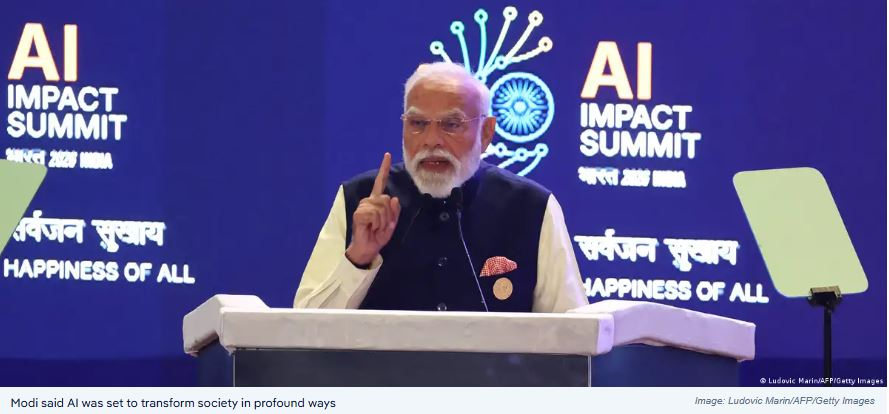
World leaders and top technology executives gathered in India’s capital on Thursday for the AI Impact Summit, where discussions centered on balancing innovation with responsible governance of artificial intelligence.
India’s Prime Minister Narendra Modi called for global frameworks to regulate AI while ensuring that the technology remains accessible to all. Speaking at the summit, Modi emphasized the need for ethical development.
“We must democratize AI,” Modi said, warning that humans should not “just become a data point or remain raw material for AI.”
During his address, Modi introduced India’s new MANAV framework for AI governance. The acronym stands for:
Moral and ethical systems
Accountable governance and robust oversight
National sovereignty
Accessible and inclusive
Valid and legitimate
Organizers described the summit as the first major AI gathering of its kind held in the Global South. Previous editions were hosted in France, the United Kingdom and South Korea.
Indian officials highlighted the country’s experience in building large-scale public digital infrastructure, suggesting it could serve as a model for deploying AI affordably and at scale.
Among the political leaders present were Emmanuel Macron of France, Pedro Sánchez of Spain, and Luiz Inácio Lula da Silva of Brazil.
Technology leaders included Sam Altman of OpenAI and Sundar Pichai of Google.
However, several high-profile figures withdrew at the last minute. Bill Gates canceled his keynote address hours before it was scheduled. His foundation said the decision was made “to ensure the focus remains on the AI Summit’s key priorities.” The cancellation comes amid renewed scrutiny over Gates’s past association with the late financier Jeffrey Epstein.
Jensen Huang, CEO of Nvidia, also canceled his appearance. Nvidia is a global leader in chips essential for artificial intelligence systems.
In his speech, Macron stressed the importance of safety and regulation while maintaining innovation.
“We are determined to continue to shape the rules of the game… with our allies such as India,” Macron said, adding that Europe aims to remain both innovative and secure in its digital policies.
The European Union’s data privacy watchdog has recently launched an investigation into X, the social media platform owned by Elon Musk, over concerns related to sexualized images generated by its AI chatbot, Grok.
Macron added that protecting children from digital abuse would be a priority for the G7 nations. Several countries, including France and India, are considering new legislation to safeguard minors online.
United Nations Secretary-General António Guterres highlighted both the promise and the dangers of artificial intelligence.
“Done right, AI can accelerate breakthroughs in medicine, expand learning opportunities, strengthen food security, bolster climate action and disaster preparedness and improve access to vital public services,” he said.
“Done wrong, it could fuel harm.”
The summit reflected the growing global effort to strike a careful balance between technological innovation and ethical responsibility as AI continues to reshape economies and societies worldwide.