Iraq Has Never Actually Had a System of Federalism, Says Liam Anderson
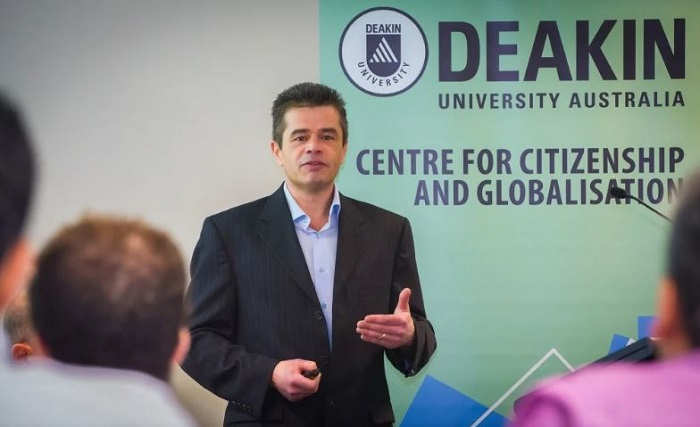
Liam Anderson is a political scientist and professor at Wright State University specializing in international relations and comparative politics. He holds an MPhil in International Relations from the University of Cambridge and a PhD in Political Science from the University of Georgia. Anderson is widely known for his work on constitutional design and federalism in ethnically divided states, particularly Iraq. His research explores how political systems can be structured to manage ethnic conflict, prevent state fragmentation, and give citizens a stronger voice in democratic governance. He is the co-author of several influential books, including The Future of Iraq: Dictatorship, Democracy, or Division and Crisis in Kirkuk: The Ethnopolitics of Conflict and Compromise. His later work focuses on federal solutions for fragile states in the Middle East. Anderson regularly contributes expert analysis on Iraqi politics, federalism, and conflict resolution.
Gulan: In your book Federal Solutions to Ethnic Problems, you discuss different models of federalism. Two decades after the drafting of Iraq’s 2005 Constitution, do you think Iraq’s main problem lay in ambiguous constitutional texts, or rather in the absence of a federal political culture among Iraq’s political elite?
Professor Liam D. Anderson: In terms of the Constitution, the articles relating to federalism are actually rather unambiguous in most regards. Article 110 lays out the exclusive powers of the federal government; Article 114 lays out powers shared between the federal government and regions/governorates; and Article 115 states very clearly: “All powers not stipulated in the exclusive powers of the federal government belong to the authorities of the regions and governorates that are not organized in a region. With regard to other powers shared between the federal government and the regional government, priority shall be given to the law of the regions and governorates not organized in a region in case of dispute.” There may be some ambiguity regarding who is responsible for managing oil and gas, but otherwise, the Constitution is actually very clear on federalism. The problems arise from the fact that the Constitution’s provisions relating to federalism have effectively been ignored by the Iraqi gov and the Supreme Court. In particular, the Court has made some decisions that are totally incoherent, which is problematic because this Court should not even exist.
In terms of “federal political culture”, I think there is a problem, but this exists among both elites and ordinary Iraqis (excepting Kurdish elites and people, obviously). Some of this is that there appears to be a lack of understanding about what federalism actually is, and how federalism is different from, say, partition. There is also the sense that federalism is synonymous with “weak” government, though this is obviously not true – states like Canada, the US and Germany are all federal, but are all string states. In general, opinion polls indicate that the Iraqi people are supportive of “decentralization”, but not federalism, so I think the problem is one of terminology
Gulan: Was Iraq a victim of a form of federalism that existed only on paper? Why has the federal model succeeded in countries such as Canada or Switzerland, but failed in Iraq to reduce tensions among its components?
Professor Liam D. Anderson: Yes, very much so. Iraq has never actually had a system of federalism; since 2005, it has had one autonomous Region and 15 totally powerless governorates. Governorates have tried to transition from governorate to region, according to Article 119, but the federal government has always blocked this. The institution that should step in to enforce Article 119 is the Supreme Court, but the Court, in my view, is completely illegitimate. The Court envisioned in the Constitution has never actually come into existence, so the current Court should not exist. It continues to exist because it makes decisions that favor the powerful. In other contexts, such as Canada and Switzerland, federalism works because the Court serves as a neutral arbiter of the constitution, and can protect the powers of the regions against power grabs by the federal government.
Gulan: In 2009 you published Crisis in Kirkuk. Fifteen years later, and after the post-2017 shift in the balance of power, do you still see Article 140 as a viable solution to the Kirkuk issue, or is there a need to search for a new model?
Professor Liam D. Anderson: I’m not sure Article 140 was ever really a viable solution to the problem of Kirkuk. The US always claimed to support Article 140, but they never actually did support it, and given that only the Kurds really supported it, it was always destined to fail. In my view, the best future for Kirkuk is to use Article 119 to make the transition from governorate to region, and then to have a Kirkuk that enjoys some autonomy from the federal government. I think this is an outcome that would enjoy the support of all components in Kirkuk, and would create a new ally for the KRG in its dealings with Baghdad.
Gulan: In recent years, Iraq’s Federal Supreme Court has issued several decisive rulings against the Kurdistan Region (notably on oil and elections). As an expert in constitutional design, do you see this as an expression of the rule of law, or as a political attempt to transform Iraq’s system from federalism toward centralization?
Professor Liam D. Anderson: I see it as the actions of as Court that should not exist, and that continues to exists because it makes decisions that favour the powerful over the weak (Baghdad over Erbil, the federal government over the governorates/regions etc)
Gulan: In 2005 you outlined three possible futures for Iraq (democracy, dictatorship, or partition). Today, which of these three do you believe Iraq is closest to? Has a fourth model emerged?
Professor Liam D. Anderson: Iraq seems currently to be somewhere between a dictatorship and a democracy. There are democratic procedures in place (elections etc), but the distribution of power depends on elites. What saves Iraq from degenerating into something more dictatorial is that elites are politically fragmented, so that no single political party, or leader is able to establish dominance over the others.
Gulan: Is the constitutional and political position of the Kurdistan Region within Iraq weakening, or is this merely a temporary phase? What are the risks of new centralization in Baghdad for the future of the Kurds?
Professor Liam D. Anderson: I think the position of the KRI has deteriorated significantly since 2005. Ultimately, the Region no longer controls its own income; it is dependent on the federal government to provide funding, so the federal government holds all the power. A federal system can only exist if the regions have some degree of financial autonomy, and the KRI no longer has this.
The dangers of centralization are already apparent. As long as Iraq is dependent almost exclusively on oil for its income, and Baghdad gets to dictate how oil revenues are distributed, then Baghdad has all the power.
Gulan: Why, after 20 years, has Iraq still been unable to build a strong institutional state, with the muhasasa (sectarian quota-sharing) system becoming the core identity of the state?
Professor Liam D. Anderson: The muhasasa is a form of power sharing that enables all groups (Shia, Sunni and Kurds) to participate in government and enjoy a share of the spoils. It is not a pretty system of government, but it is quite stable. The alternative would be some sort of majoritarian system that might result in Shia parties holding all the power, and Sunni and Kurdish parties being excluded. This might be more efficient in terms of political decisionmaking, but I think it would be a dangerous development. In other words, the muhasasa is an ugly system, but it helps spread power around and helps avoid even more centralization.
Gulan: Iraq has become an arena for managing the conflict between Tehran and Washington. How has this struggle affected constitutional stability and trust among Iraq’s components?
Professor Liam D. Anderson: Obviously, the various components of the so-called “resistance” are tied to Iran and therefore, any confrontation between the US and Iran risks involving Iraq; but both the US and Iran have a shared interest in avoiding instability inside Iraq and as long as this remains the case, then I don’t see this rivalry as a serious threat to Iraq’s constitutional stability.
Gulan: In light of the Gaza war and the possibility of conflict in Lebanon, what will Iraq’s position be in the new regional map? Can Iraq keep itself out of a broader regional war?
Professor Liam D. Anderson: PM al-Sudani, and Khadimi before him, have both done a good job of helping keep Iraq out of broader wars. The obvious danger is that the various components of the Hashd (the Resistance) get involved in any conflict involving Iran against either the US or Israel; however, I think this is much less likely now that it ever has been. The Hashd is seen as an Iranian proxy, but my sense is that the various components of the Hashd have their own interests separate from Tehran, and that they are not willing to fight in Iran’s wars. During the 12-day war between Iran and Israel/the US, for example, the Hashd stayed out of the conflict, so I think the dangers of Iraq getting sucked into a regional war are overstated
Gulan: Returning to your 2013 thesis, is federalism still the only solution for Iraq, or should alternative models such as confederalism or soft partition be considered?
Professor Liam D. Anderson: Both of these are non-starters. A confederal system is a more extreme version of a federal system in which most of the power resides with the regions, not the federal government; the Kurds might favour this, but I don’t see any support for this elsewhere in Iraq. I am not even sure the terms “soft partition” means anything, but I am absolutely certain that any system than includes the term “partition” will enjoy zero support outside the KRI. A confederation might make good sense for Iraq, but it will not happen because it is politically impossible. There is no support for it.
Gulan: What should the Kurds do to protect their historic gains (the Kurdistan Region) amid these complex dynamics, and avoid becoming victims of regional bargains?
Professor Liam D. Anderson: The Kurds need allies, and this can only come from governorates that make the transition to regions. Basra is trying again, so that would be a very positive development for the KRI. I would also seriously consider initiating the 119 process in Kirkuk. As it stands, any dispute over federalism in the current system creates a zero-sum confrontation between Erbil and Baghdad, which Erbil is always going to lose. If the KRG has as allies other Regions – Basra, Kirkuk, Anbar etc – then the KRG is not alone in its struggles. The emergence of other regions would change the dynamics of the system in a direction that is good for the Kurds and would help them preserve what they still have left