Syria's Assad Uses Captagon as a Tool to Win Over Arab States
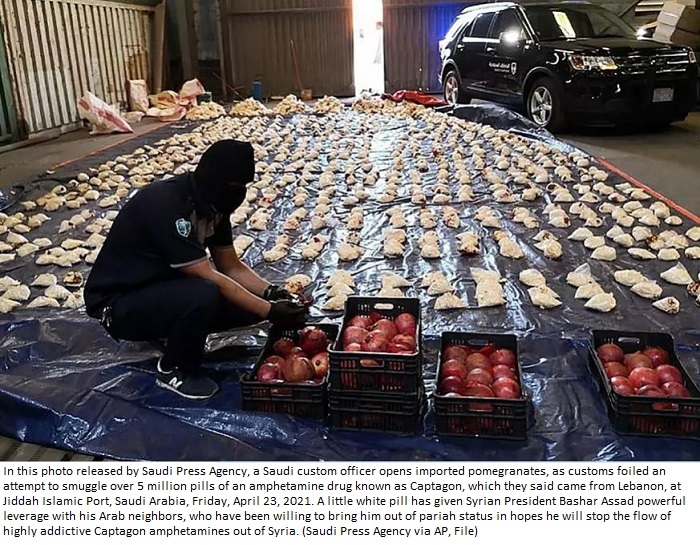
In a surprising turn of events, Syrian President Bashar Assad has found a potent weapon in the form of Captagon, a highly addictive amphetamine pill, to secure support from his Arab neighbors. Arab countries, desperate to stem the flow of Captagon out of Syria, have been willing to bring Assad out of his pariah status in exchange for his cooperation in combating the drug trade.
The lucrative Captagon trade has been a major concern for Arab states as hundreds of millions of pills have been smuggled into Jordan, Iraq, Saudi Arabia, and other Gulf Arab countries. The drug is commonly used recreationally and by individuals with physically demanding jobs to stay alert. The majority of the world's Captagon production takes place in Syria, with Lebanon also contributing to a lesser extent. Western governments estimate that the illegal trade in Captagon generates billions of dollars, providing a significant financial lifeline to Assad's rule, despite the crumbling Syrian economy.
Western governments, including the United States, Britain, and the European Union, accuse Assad, his family, and allies, including Hezbollah, of facilitating and profiting from the Captagon trade. However, Assad has managed to leverage his control over the drug trade to gain political advantage, reconstruction funds, regional integration, and pressure for an end to Western sanctions.
The Assad regime recognized the potential political gains of weaponizing the Captagon trade, leading to large-scale production. To address the concerns of Arab countries, stopping the Captagon trade has become a key demand in negotiations to end Syria's political isolation. As a result, Assad has made limited gestures to combat the drug trade, hoping to secure further regional cooperation and financial support.
Recent airstrikes in southern Syria targeting a prominent drug kingpin's residence and a suspected Captagon factory near the Jordanian border indicate behind-the-scenes trade-offs. Jordan, with Assad's consent, is believed to be behind these strikes. Jordan views the Captagon trade as a threat to its security and communal peace. The country has intensified border surveillance and conducted raids to combat drug smuggling, even engaging in military action when necessary.
At a recent meeting in Jordan, top diplomats from Syria, Saudi Arabia, Iraq, and Egypt discussed various issues, including setting a roadmap for peace talks and the return of Syrian refugees. Progress was made on the Captagon issue, with Syria pledging to crack down on smuggling and the establishment of a regional security coordination committee. Subsequently, Syrian police discovered one million Captagon pills hidden in a pickup truck in Aleppo.
However, untangling the complex drug networks remains challenging due to the intricate smuggling routes. Militias in Iraq's Anbar province, which borders Syria, Jordan, and Saudi Arabia, have played a crucial role in Captagon smuggling. While the Syrian government denies profiting from the trade, opposition groups are believed to be involved. Western governments have imposed sanctions on individuals close to Assad for their direct role in Captagon production and trade.
Assad's willingness to fully dismantle the drug trade depends on the incentives offered by Arab states. While reports suggest Saudi Arabia may have offered financial assistance to Syria, Riyadh denies such claims, emphasizing that countering the damage caused by Captagon among Saudi youth outweighs any potential cost. The normalization of Arab states' relations with Syria worries the United States and other Western governments, as it undermines efforts to push Assad towards making concessions and following the UN peace roadmap outlined in Resolution 2254.
Assad may utilize the Captagon issue to seek the shelving of the UN resolution, but lifting Western-led sanctions would be a more challenging task. Gulf Arab states, unable to directly provide financial support due to the sanctions, could funnel money through UN-led projects in government-held Syria to incentivize Assad to take action against Captagon.
As Arab states prioritize the fight against the Captagon trade, Assad has seized the opportunity to regain regional support and potentially alter the trajectory of Syria's conflict. The implications of this new dynamic could have far-reaching consequences for the ongoing civil war and regional dynamics in the Middle East.
Source: AP