Turkey seeking to reap rewards in Libya to boost faltering economy
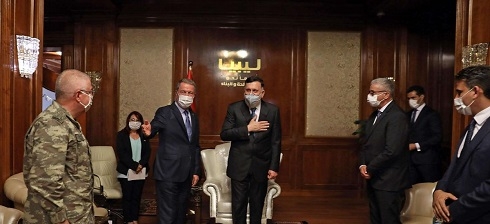
Turkish military support has helped the GNA reverse a 14-month assault on Tripoli by rebel General Khalifa Haftar's eastern-based Libyan National Army (LNA).
Turkish businesses say they are looking forward to playing a key role in the rebuilding of the oil-rich North African country, DW reported. Turkish officials have made trips to Tripoli last month and this week to meet GNA officials to discuss cooperation in areas such as construction and energy.
"[Turkey] gave strength to the GNA when it was at its weakest and I think many members of the GNA are keen to return that favour and are looking for partners that they can have a strategic relationship with," Anas el Gomati, director of the Libyan think tank Sadeq Institute, told DW.
"Libya, the GNA are looking to Turkey to build more than just a political or a commercial relationship. They are looking for a strategic relationship" el Gomati said.
Mithat Yenigün, head of the Turkish Contractors Association, told DW that Turkish companies are at an advantage in Libya since they had been a major player in the country well before the war, as Turkish firms have signed around $40 billion worth of contracts in Libya's construction sector since 1972.
"Libya is unfortunately in ruins. There is going to be a big business opportunity in the country's construction sector. I estimate around $50 billion," said Yenigün.
Turkey is well-placed to win contracts in the construction sector, Karim Mezran, a senior fellow at the Atlantic Council, told DW.
"Everybody in Libya is ready to work with Turkish companies, while making sure there is no monopoly. That’s what the Libyans are trying to make clear. The Turks seem to be aware of this and appear to be accepting it," Mezran said.
The rewards in Libya are expected to give the Turkish economy a much-needed boost as it faces a looming recession due to the fallout from the COVID-19 pandemic. Turkey has been struggling with double-digit inflation, high unemployment, a weak Turkish lira, and fast-depleting foreign reserves.
DW cited reporting by Al-Arabiya Net on Thursday that said the governor of the Libyan central bank, Al-Siddiq Al-Kabir, had deposited $8 billion in Turkey’s central bank for about four years without interest to help stabilise the Turkish lira.
Yenigün said the Turkish economy will get a significant boost once the security situation improves in Libya and Turkish firms can start working there.
"It will hugely benefit (the Turkish economy). When we win contracts, we will have the opportunity to export materials. Advisory firms will go there to study the projects before the contractors. We will have the opportunity to use Turkish materials. This will help boost our foreign reserves," he said.
Turkey is keen to cooperate with Libya in its efforts to revive its lucrative oil sector and on gas exploration. Cooperation between the two countries have expanded since last November when they signed a maritime deal to redefine their territorial waters in the eastern Mediterranean.
The agreement was followed by a military deal where Turkey sent hardware and personnel to the GNA to support its fight against the LNA, which is backed by Russia, the United Arab Emirates, and Egypt, among others.
Talking about Turkey's prospects of winning hydrocarbon exploration contracts and concessions in Libya, el Gomati told DW: "I am sure there will be some degree of political push. That's a question for the Libyan National Oil Corporation to consider. It doesn't typically make decisions based on political favouritism, but on technical know-how and commercial viability."
But Turkish firms "have an edge" when it comes to production and services, he told DW.
Ahval