SpaceX craft carrying US astronauts docks at ISS in historic mission
After the 19-hour flight, the arrival went smoothly above the border between China and Mongolia, in a race against time as orbital night approached.
The capsule completed docking at 1416 GMT, in what NASA personnel called an epic moment in history.
After a pressurization sequence, hatch opening and connecting the power systems of the two spacecraft, the ISS welcomed astronauts Doug Hurly and Bob Behnken on board.
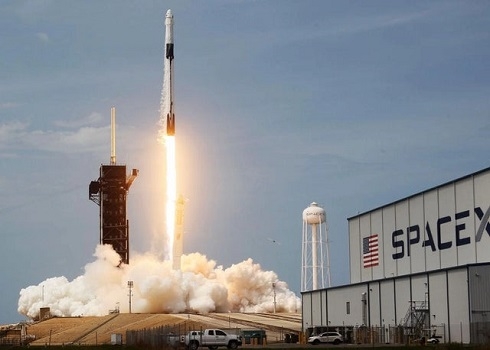
Hurly and Behnken were launched into Earth's Orbit aboard the Dragon capsule Endeavor on a Falcon 9 rocket, both built by SpaceX, a private commercial spaceflight company.
Back on Earth, the process was watched by NASA staff, some wearing masks, others without. "Endeavour, this is Houston after spectacular rendezvous and docking," they greeted the moment of contact. "This is an incredible time to be at NASA."
It was the first launch from US territory in nearly a decade and the first time a private firm, rather than a government space agency, has sent astronauts into orbit.
This is a "wonderful day," NASA head Jim Bridenstine said, tweeting, "America's two favourite dads in space have docked to the ISS."
There was also a message of congratulations from Russia.
"It's essential to have two transport systems," Vladimir Ustimenko, spokesman for the Roskosmos space agency, said earlier on Sunday in Moscow. "Now, not only Russians will fly to the ISS but also Americans. That's wonderful!"
The purpose of the trip is to complete the validation of human spaceflight operations for SpaceX hardware, which will pave the way for private companies to ferry astronauts to the ISS, ushering in a new era of commercial spaceflight.
According to NASA, SpaceX, along with Boeing, which is also developing rockets, will be able to launch crews to low-Earth orbit, allowing the government agency to focus on deep space missions - with an eye towards Mars.
The Dragon capsule was designed to self-dock at the ISS. However, the two veteran astronauts Behnken and Hurley were able to assume control if necessary.
After docking, Behnken and Hurley will be stationed on the ISS for a undetermined amount of time, depending on "readiness of the next commercial crew launch," NASA said.
The Dragon capsule is capable of staying in orbit for at least 210 days, NASA said, and will autonomously undock with the astronauts on board when the mission is complete.
On the ISS, the astronauts will perform tests and join one American and two Russians who are currently aboard the station.