Syrian Kurds say aid for those displaced by Turkish attack 'not enough'
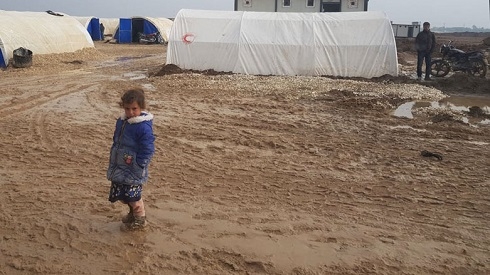
Internally displaced persons (IDPs) living in camps and informal settlements in northern Syria are especially vulnerable during the cold winter months.
Democratic Union Party (PYD) Co-spokesperson Salih Muslim told Kurdistan 24, “There are many countries and sides donating money for helping those IDPs, but all this is going through governmental agencies [that] belong to the Syrian or the Turkish regime.”
He added that if funding goes to local NGOs linked to the Syrian, Turkish or other local governments, then “it would not go to the people in need.”
Various countries have donated, including Japan, which pledged $14 million worth of emergency aid on Dec. 10 which will be administered by the UNCHR, the United Nation’s refugee agency.
“Japan, for example, could send it directly or contact people working in the camps,” Muslim added.
The UN’s Assistant Secretary-General for Humanitarian Affairs and Deputy Emergency Relief Coordinator, Ursula Mueller, said in a Thursday briefing to the Security Council that the humanitarian situation in northeast Syria remains critical, with 1.8 million people in extreme need.
She added that “humanitarian organizations have mounted a significant response to assist hundreds of thousands of people affected by hostilities in the northeast.”
However, Khalid Ibrahim, co-chair of the Office for Humanitarian Affairs in Syria’s Jazira Region, told Kurdistan 24 that, since the beginning of the Turkish invasion, almost all international relief organizations have suspended their programs and left the region.
“They clearly stated that they are not able to work under the current political and military developments. Therefore, they withdrew and did not complete their missions and responsibilities.”
Ibrahim continued, “The UN also says that they cannot intervene to respond, that they are limited by the political and military stage in the region. Some of the reports that the UN and other organizations have provided are not accurate, about the level of assistance they distributed to the displaced population.”
As a result, he claimed, the UN has not spent any funds to support the newly-created Washokani camp near Hasakah that hosts over 4,500 displaced Syrians from Serekaniye (Ras al-Ain).
“They have said that they have supported the IDPs, but on the ground, there was not such a thing,” said Ibrahim. “We are following the situation 24 hours [a day]; the external aid is not enough to respond to the crisis.”
According to data of the local administration in northeast Syria, there are over 300,000 IDPs in northeastern Syria, especially in the Jazira region [Hasakah province].
“In Afrin region [in northwest Syria], there is a number of [between] 120,000-150,000 IDPs. There are almost 150,000 IDPs from Tal Abyad near Kobane and Raqqa – and around 150,000 IDPs in Jazira Region. The IDPs from Jazira region, places like Derik, Qamishlo, Dirbesiye, and Amude, have returned to their homes,” Ibrahim said.
The official added that the situation is particularly dire due to winter weather conditions. “There is an urgent need for clothes for the cold season. There are diseases in the camp where there are many women, children, and elderly.”
“There are more than 900 pregnant women among the IDPs – there are 45,000 children from 1 to 12 years old. There are more than 60 unaccompanied children.”
He added that there are also 110 schools hosting 4,000 IDP families. As a result, 68,000 children cannot finish their education.
“There are some promises and communication with international organizations, but the routine of the camp is the same for the time being – their response does not meet the urgency of the situation, and we cannot wait for their intervention.”
“They are continuing their work at Al-Hol Camp,” which hosts roughly 68,400 people, including foreign families of Islamic State fighters.
“Yet, there are already 800 families at Washokani Camp, and the numbers are increasing every day, but they are reluctant to intervene there.”
In Washokani Camp, there is also a complete lack of running water and electricity.
The official concluded by saying, “We do not know if they will ever respond.”
Editing by John J. Catherine