NATO summit seeks to reanimate patient after 'brain death'
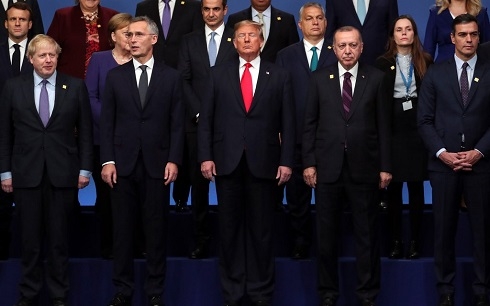
Watford, England (dpa) - This week's NATO summit was supposed to be a celebration of the alliance's 70th anniversary and a demonstration of unity, but the headlines were dominated by disagreement among allies on a range of key issues.
By the time Queen Elizabeth II launched the the birthday celebrations on Tuesday evening, leaders had aired plenty of dirty laundry in the wake of France's criticism that the alliance is undergoing "brain death."
US President Donald Trump, who is no stranger to pre-summit scuffles, began on Tuesday by lashing out at the "very nasty" and "insulting" comments of French President Emmanuel Macron, while turning on his French counterpart with retaliations against a new digital tax.
But it was Macron who later went on the offensive, in a strained 50-minute impromptu press conference with Trump during which the US leader appeared to strike a more conciliatory tone.
NATO is "not serious" if discussions centre only on what allies pay - an issue at the core of Trump's engagement with the alliance - rather than key strategic issues, Macron argued.
He pointed to open questions the alliance must address, such as disagreements about a recent US-facilitated Turkish operation against Western-allied Kurds in neighbouring Syria - the same issue that had prompted his "brain death" remarks.
"How can we build a durable peace in Europe?" Macron asked on his way into Wednesday's summit talks. "Who is our enemy? How to act jointly against terrorism?"
When NATO was formed in 1949, it had a clear foe in the Soviet Union. Since the fall of Communism 30 years ago, the alliance has evolved to face myriad challenges, of which Russian aggression is just one - and one that, in Macron's mind, is secondary to the threat posed by terrorism.
Many agree with the questions raised by Macron, while disagreeing over his approach, which has also raised doubts about NATO's core pledge that an attack on one is an attack on all.
"NATO is the most successful alliance in history because we have changed as the world has changed," said NATO Secretary General Jens Stoltenberg on Wednesday, adding that billions of dollars in new defence investments are "making us stronger."
"Whatever our differences, we will continue to unite around our core task, to defend one another," Stoltenberg insisted, in remarks echoed by British Prime Minister Boris Johnson, who was hosting the summit.
"There is far, far more that unites us than divides us," Johnson said, while German Chancellor Angela Merkel welcomed the "signal of unity" emerging from the summit.
In their declaration, the leaders reaffirmed the bond between Europe and the US - tested over recent years by Trump's persistent criticism that Europeans are not paying enough for their defence - as well as their commitment that "an attack against one ally shall be considered an attack against us all."
Such assurances are particularly important to NATO's eastern allies, who are most wary of aggressive Russian action and worry about the signal that Macron's remarks may have sent to Moscow. Many fear that divisions within NATO will only embolden its detractors.
"If we are consistent in our messages and actions the threat from Russia is low, but if we are weak, divided or wobbly the threat is very real," Estonian Defence Minister Jurik Luik told a NATO think tank event in London.
But Canadian Prime Minister Justin Trudeau argued that it was crucial for allies to debate their disagreements.
"NATO has survived because we've always had frank conversations," he said, stressing the importance of institutions like NATO that can "tackle complex problems in sophisticated and nuanced ways."
As a result of Macron's remarks, leaders agreed on Wednesday to a "reflection process" aimed at further strengthening "NATO's political dimension including consultation."
Macron, who has congratulated himself on the debate he launched, welcomed the summit outcome as a positive step, while warning that work now lay ahead to address the issues he had raised.
"When there is ice, you need icebreakers. That creates a bit of a fracas but clears a way through," Macron said.
The French leader can also take credit for stealing some of Trump's habitual limelight at the two-day summit.
The US president repeated his usual criticism of "delinquent" allies who fail to meet NATO's goal of spending 2 per cent of their economy on defence, while rewarding the club of "two-percenters" with a joint lunch.
But much of his sting was removed by Stoltenberg's pre-summit announcements of sizeable increases in defence investments, massaged somewhat to suit Trump's narrative ahead of next year's US elections.
Trump, who once declared the alliance as "obsolete," went so far as to declare that NATO's adaptation to the challenges it faced had made him a "bigger fan."
"If they weren't flexible, I think I would probably be not so happy. But they are very flexible," the US leader said.