Hong Kong university bosses demand action as campus clashes continue
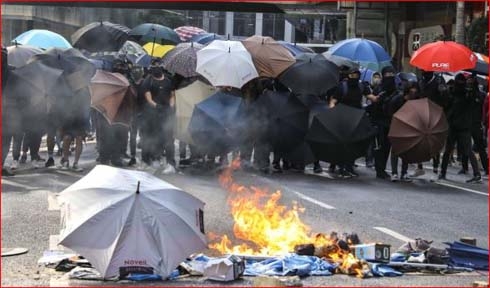
"The government must take the lead with swift and concrete action to resolve this political deadlock and to restore safety and public order now," the statement said.
"It is regrettable that societal disagreement has led to university campuses becoming major political battlefields, and that the government response has so far not been effective," it added.
Over the past few days, universities have become the latest flashpoint for the anti-government protests that have rocked Hong Kong in recent months.
The president of the Chinese University of Hong Kong said on Friday that his campus had been occupied by "masked outsiders" and that the university may have to ask for support from the government if it cannot resume normal operations.
Three days ago, a fierce clash between pro-democracy protesters and police saw over 1,000 canisters of tear gas fired on the grounds and parts of the campus set ablaze.
In an open letter, president Rocky Tuan said that the situation was "unacceptable" and "out of control." He had previously urged staff and students to leave the campus for their own safety, and cancelled all remaining classes for the semester.
Petrol bombs and bricks were being stockpiled on campus, Tuan said.
"The university is a place for knowledge, and not a warzone for resolving political conflict, and even for making weapons and using force," Tuan said.
"If the university cannot exercise its basic missions, we will have to seek assistance from relevant government departments to resolve the current crisis." He did not specify what the government assistance may entail.
The entrance of the university is currently controlled by protesters.
The protesters, most of whom are young university or secondary school students, have barricaded multiple universities across Hong Kong, including the Polytechnic University and Hong Kong Baptist University.
"At first it was just at CUHK, now tertiary institutions all across Hong Kong are united together to defend our homes," said Harry Cheung, a 21-year-old student at the City University of Hong Kong.
He told dpa in Polytechnic University that he only came to bring supplies for protesters there, but had decided to stay.
"The Hong Kong government and police continue to ignore our demands and use violence, so some Hong Kong people are more understanding of what we are doing now," said Cheung.
According to a report in Germany's Bild newspaper, two Germans have been arrested in the protests. They are said to be exchange students from an art college.
The Foreign Minstry confirmed to dpa that it was offering consular assistance to two German citizens in Hong Kong.
Protesters and students have occupied the Chinese University since the clashes on Tuesday, and took control of a bridge above Tolo Highway, a major transportation route for residents living in the New Territories area of Hong Kong.
The protesters opened one lane of the motorway this morning, with some describing it as a gesture of "goodwill," and stated that they would open the rest of the highway if the government promised not to cancel the upcoming Hong Kong district council elections.
With no response from the government, the motorway was fully blocked again.
Hong Kong has now entered its 24th straight week of protests. Their initial calls for the withdrawal of a now-shelved extradition bill morphed into demands for greater democratic reforms and an independent investigation into police violence.
Also on Friday, British police were investigating a suspected attack by demonstrators on Hong Kong's justice minister in London.
Teresa Cheng Yeuk-wah was surrounded and attacked by dozens of Hong Kong independence supporters, the Chinese embassy in London said.
She was knocked to the ground and suffered a hand injury, the embassy said.
London's Metropolitan Police confirmed that a woman was taken to hospital on Thursday evening with an arm injury. An investigation was ongoing, police said. There have been no arrests.