Trump Announces Sweeping New Tariffs, Sparking Global Market Jitters
US President Donald Trump unveiled a new wave of punitive tariffs on a broad spectrum of imported goods set to take effect October 1, causing immediate declines in pharmaceutical and furniture stocks across Asian markets.
The announced tariffs, detailed by the president on Thursday, include drastic increases on key consumer and industrial products:
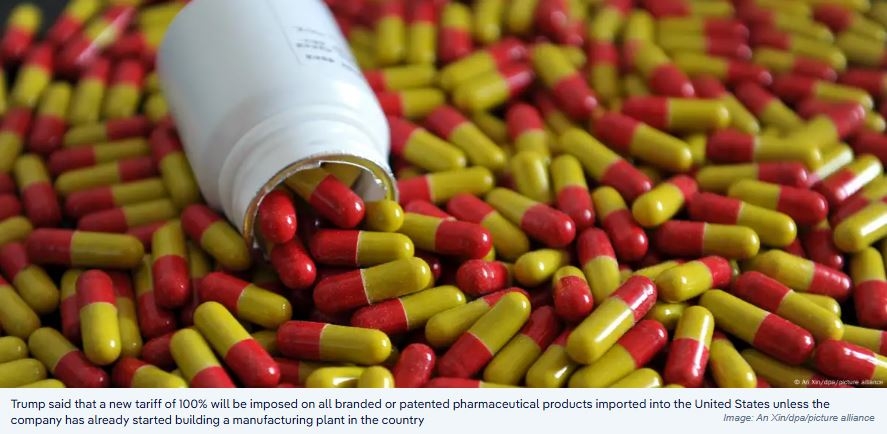
100% on branded pharmaceutical drugs.
50% on kitchen cabinets and bathroom vanities.
30% on upholstered furniture.
25% on heavy-duty trucks.
The announcements left key questions unanswered, notably whether these tariffs would be applied on top of existing duties and whether close US partners with trade deals, such as the European Union and Japan, would be exempted. This uncertainty contributed to market volatility.
Justifying the measures, President Trump cited economic and national security concerns. On his Truth Social platform, he attributed the furniture tariff to the "flooding" of the US market by other countries, claiming it would help return the furniture business to states like North Carolina and South Carolina. He similarly stated the truck tariff was designed to protect US manufacturers from "unfair outside competition."
The announcement drew immediate pushback from US allies and industry groups. The US Chamber of Commerce criticized the proposed truck tariffs, noting that the top import sources—Mexico, Canada, Japan, Germany, and Finland—are allies that "pose no threat to US national security."
Furthermore, the new tariffs appear to conflict with recently negotiated trade agreements. Irish Trade Minister Simon Harris emphasized on Friday that an EU-US deal struck in August caps tariffs on pharmaceuticals at 15%.
"I want to stress that the EU and US joint statement... made absolutely clear that any new tariffs announced by the US on pharmaceuticals would be capped at 15% for pharma products being exported by the EU," Harris said in a statement. This suggests that the 100% tariff may not be enforceable on products from the EU, highlighting the complex web of existing international commitments.
President Trump did specify that the 100% pharmaceutical tariff would not apply to companies that have already begun building manufacturing plants in the United States.
The news triggered a sell-off in related sectors globally. In Asia, Japan's Topix Pharmaceutical Index closed down 1%, while Hong Kong's innovative drug index fell 2.8%. South Korea's SK Biopharmaceuticals saw its shares drop 2.7%, and Australian biotech firm CSL ended the day down 1.6%. An index tracking Chinese furniture manufacturers also declined by 1.1%.
The move reinforces President Trump's use of tariffs as a central instrument of his foreign policy, a strategy he employed in his previous term to renegotiate trade deals and exert pressure on other nations. However, analysts note that his administration's existing agreements with partners like the EU, UK, and Japan include binding caps on tariffs for specific goods, including cars and pharmaceuticals. Therefore, the newly announced national security tariffs are unlikely to raise rates above the levels already agreed upon in those pacts.